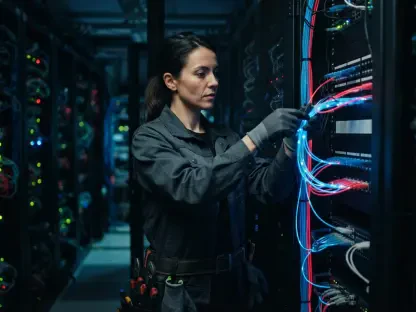

The digital landscape is currently witnessing an unprecedented transformation as processing power requirements for artificial intelligence outpace every historical benchmark of industrial expansion. This shift represents more than just a technical upgrade; it marks a fundamental change in how global infrastructure supports the modern economy. The 2026 summit serves as a definitive turning point where the conversation moves beyond simple data storage to the creation of high-density computing hubs capable of sustaining the next generation of machine learning.
The “Innovation at Scale” ErWhy the 2026 Summit Marks a Turning Point for Global Infrastructure
The transition from traditional server environments to high-density AI computing hubs has fundamentally altered the architectural requirements of the modern data center. In previous years, facilities were designed to house rows of racks with predictable, low-density power needs. Today, the focus has pivoted toward specialized environments that can handle the massive computational loads required for generative intelligence and complex data modeling. This shift ensures that digital infrastructure is no longer a peripheral support system but a core driver of global economic progress.
As digital infrastructure begins to dictate global economic health and national sovereignty, the stakes for operators have never been higher. Reliable data processing is now a requirement for participating in the global market, making the physical location and capability of these centers a matter of strategic importance. Leaders in the field recognize that those who can scale efficiently will define the economic boundaries of the next decade, while those who lag behind risk obsolescence in an increasingly automated world.
The current summit offers a compelling preview of a future defined by energy sovereignty and the rapid expansion of hyperscale facilities. There is an evolving social contract between these massive industrial sites and the local communities that host them. Moving toward a model where data centers provide as much as they consume is essential for long-term viability. This involves rethinking the relationship between technology, power grids, and social responsibility to ensure that growth remains sustainable for all stakeholders.
Navigating the Technical and Economic Pressures of the Intelligence Age
From Back-Office Support to National Sovereignty: The Strategic Rebranding of the Modern Data Center
The sector has undergone a radical rebranding, evolving from an overlooked utility hidden in industrial parks to a front-facing component of geopolitical influence. Data centers are now recognized as the “AI factories” of the modern era, producing the intelligence that fuels everything from national security to financial markets. This elevation in status reflects the reality that a nation’s computing capacity is now directly proportional to its ability to compete on the world stage.
Expert insights suggest that the AI factory model is the primary engine behind a market valuation projected to exceed $1.9 trillion by 2030. This massive capital influx is driven by the realization that intelligence is a commodity that requires specialized, high-performance environments. However, this rapid ascent is not without its hurdles. The industry must balance this explosive financial growth with the physical constraints of equipment and real estate, ensuring that the infrastructure remains stable under the pressure of global demand.
This growth creates a significant tension between the desire for expansion and the fundamental laws of physics. As clusters of servers become more powerful, they demand more from the environment around them. Operators are finding that the rapid pace of advancement often outstrips the ability of the physical world to provide land, water, and electricity. Navigating these constraints requires a sophisticated approach to logistics and site selection that prioritizes technical feasibility over mere convenience.
Beyond Traditional Cooling: Managing the Heat of Megawatt-Scale Power Densities
The industry is moving away from standard server racks toward high-performance GPU environments that require nearly 1 megawatt of power per rack. This level of density was nearly unheard of just a few years ago, but it has become the new standard for facilities supporting large-scale AI training. Standard air-cooling methods are proving insufficient for these extreme thermal loads, forcing a transition toward more advanced liquid-based solutions that can dissipate heat more effectively at the chip level.
Legacy designs are increasingly viewed as stale because they cannot accommodate the granular power optimization required for modern workloads. Advanced thermal management strategies now include complex cooling loops and heat recovery systems that allow facilities to operate with minimal environmental impact despite their high energy use. Operators who fail to adopt these radical designs find themselves at a competitive disadvantage, as high-density environments are the only way to support the most profitable AI services.
There are inherent risks associated with such extreme density, including the immense pressure on operators to retrofit existing facilities. Converting an older data center to support megawatt-scale racks is a complex engineering feat that requires substantial capital investment. The competitive landscape is now defined by the ability to manage these thermal challenges safely, ensuring that the hardware remains operational even as power consumption reaches levels previously seen only in heavy industrial manufacturing.
Pursuing Energy Sovereignty Through Nuclear SMRs and Independent Microgrids
The industry is witnessing a significant move toward energy sovereignty, a concept where data centers function as self-sufficient energy hubs. Rather than relying solely on local utilities, operators are exploring ways to generate their own power on-site. This shift is motivated by the need for absolute reliability and the desire to insulate operations from the volatility of the public grid. By becoming energy independent, these facilities can maintain uptime even during periods of regional energy stress.
Disruptive innovations such as Small Modular Reactors and linear generators are at the forefront of this movement. These technologies offer a path toward carbon-free baseload power that can be deployed directly at the data center campus. While nuclear fusion remains a long-term goal, the immediate potential of modular nuclear technology provides a scalable solution for the massive energy requirements of AI. These independent microgrids allow for a level of resilience that was previously impossible.
Industry leaders are challenging the assumption that data centers are a drain on public resources by demonstrating how they can contribute back to the grid. In some configurations, these facilities provide excess power or heat to surrounding neighborhoods, turning a perceived liability into a community asset. This symbiotic relationship helps to stabilize the local energy infrastructure while ensuring that the data center has the consistent power it needs to function at peak capacity.
The Social Contract: Reconciling Industrial Expansion with Community Values
A growing disconnect exists between the critical role of the data center and the public perception of these facilities as mysterious “black boxes.” While they are essential for modern life, many residents see them as intrusive neighbors that consume vast amounts of land and power. Reconciling this gap is necessary for the industry to continue its expansion without facing insurmountable legal and social hurdles.
Traditional behind-the-curtain operations are being replaced by new strategies for transparency and early community engagement. Modern operators are finding that being proactive about their plans leads to better outcomes during the zoning and approval process. By inviting local leaders to understand the technology and its benefits, companies can build a foundation of trust that mitigates conflict. This approach shifts the narrative from one of intrusion to one of partnership.
Demystifying data center operations by highlighting their role in essential services like healthcare and navigation can significantly improve public relations. When communities understand that these facilities are the reason their hospitals function efficiently and their GPS systems remain accurate, the value proposition becomes clear. Proactive outreach helps to frame the data center as a vital utility that supports the collective well-being of society rather than just a profit-driven enterprise.
Tactical Blueprints for Future-Proofing Digital Ecosystems and Community Relations
Integrating sustainable power sources and high-density infrastructure has become the primary objective for operators looking to secure their market position. The combination of local power generation and advanced cooling allows for a more resilient ecosystem that can withstand both technical and environmental challenges. Actionable recommendations for the current year include the adoption of microgrids to offset grid dependence and the implementation of liquid cooling as a standard requirement for all new AI-focused developments.
Proactive outreach to local municipalities must occur long before groundbreaking to ensure a smooth development cycle. Operators should focus on articulating the economic benefits, such as job creation and tax revenue, while also addressing concerns about resource consumption. Aligning corporate growth targets with the projected 17% increase in U.S. electricity consumption requires a transparent approach that prioritizes efficiency and shared goals between the industry and the public sector.
Defining a Lasting Legacy: The Final Mandate for Building Responsible Intelligence Infrastructure
The pace of change in digital infrastructure became a permanent fixture of the global economy, as demonstrated by the shifts witnessed throughout the year. Leaders recognized that the systems built today would serve as the foundation for decades of technological advancement. The summit emphasized that building systems which were as socially responsible as they were technically powerful was no longer an option but a necessity for survival in a scrutinizing market.
Responsibility toward the environment and the community took center stage as the industry matured. Operators moved toward a model of long-term legacy, prioritizing sustainable growth over immediate capacity gains. This shift ensured that the most consequential age of technology was managed with the foresight required to benefit both the industry and the world at large. The commitment to responsible innovation became the defining characteristic of the successful digital infrastructure leader.
The focus eventually settled on the importance of creating a durable and ethical infrastructure that could support the weight of global intelligence. By addressing energy needs and community relations with equal vigor, the industry secured its place as a vital pillar of modern civilization. The final mandate for leaders was to ensure that their contributions to the digital world were matched by their commitment to the physical one, leaving a positive legacy for future generations to build upon.