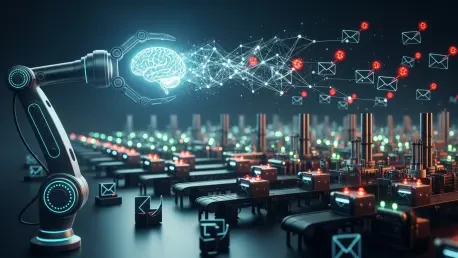

The traditional image of a lone hacker struggling with syntax errors has been replaced by a globalized, automated industry where deception is manufactured with the precision of a modern assembly line. The digital landscape is currently witnessing a profound shift in how cyber threats are conceived and executed, moving away from manual, uncoordinated attempts toward a streamlined, high-speed ecosystem. For years, phishing was often viewed as a numbers game played by solo actors sending clunky, error-ridden emails. However, the integration of Artificial Intelligence (AI) fundamentally changed this dynamic, turning a once-manual craft into a high-speed, industrialized powerhouse. This transformation is driven primarily by the rise of “Phishing-as-a-Service” (PhaaS), where AI serves as the engine for a sophisticated global business model that challenges the most basic security assumptions of modern enterprises.
From Script Kiddies to Global Service Providers: The SaaS-ification of Cybercrime
To understand the current state of the market, it is essential to look at how phishing has professionalized over the last decade. Historically, launching a phishing campaign required a specific set of technical skills, including compromising servers, building convincing website clones, and managing massive mailing lists. This high barrier to entry kept the volume of attacks relatively low and the quality inconsistent. However, the emergence of a robust underground economy led to the “SaaS-ification” of cybercrime, mirroring the legitimate tech world in both structure and efficiency.
Criminal developers began selling “phishing kits”—turnkey packages that allowed even low-skill actors to launch sophisticated attacks for a small subscription fee. These kits provide malicious customers with dashboards, real-time analytics, and even technical support, effectively democratizing access to high-level exploitation. This industrialization was not a random occurrence but the latest evolution of a highly profitable, mature industry. Understanding this historical shift is vital because it highlights that the current AI-driven surge is built upon a foundation of existing professional infrastructure designed for maximum ROI.
The AI Revolution: A Paradigm Shift in Social Engineering
Eliminating the Human Error Factor: Precision in Content Creation
One of the most significant ways AI drives industrialization is by removing the “tells” that humans once relied on for protection. In the past, security training taught employees to look for broken English, poor grammar, and suspicious formatting. Large Language Models (LLMs) have effectively rendered these indicators obsolete by generating perfectly phrased, stylistically accurate communications. These tools allow attackers to mirror the tone of a CEO or a well-known brand like Microsoft or Amazon with chilling accuracy, making the deceptive intent nearly impossible to spot through text alone.
Furthermore, this capability enables “mass personalization” at an unprecedented scale. AI can tailor thousands of individual emails based on a victim’s specific industry, job title, or public social media profile. This level of customization used to require hours of manual research for a single target, but it is now achieved in seconds. By making each message feel uniquely legitimate and contextually relevant, the probability of a successful click increases exponentially, turning personalized spear-phishing into a high-volume commodity.
Scaling Technical Sophistication: The Power of Automated Tooling
Beyond content creation, AI acts as a massive force multiplier for the technical components of an attack chain. Sophisticated frameworks are now appearing that use AI to automate the coding of malicious payloads and the design of deceptive web structures. For example, AI-driven tools can rapidly iterate on malicious code to find versions that bypass specific antivirus filters or endpoint detection systems. This automated optimization means that even if a security vendor identifies a specific malicious link, the AI can generate hundreds of unique variations in seconds, ensuring the campaign remains active.
This speed makes it nearly impossible for traditional, manual security reviews to keep pace with the sheer volume of new threats. The market for these automated tools has grown because they allow attackers to bypass the “signature-based” detection models that many organizations still rely on. By constantly mutating the underlying code, AI-powered kits ensure that each attack looks “new” to a defensive system, effectively neutralizing many of the security investments made over the last decade.
Bypassing Modern Guardrails: Advanced Evasion and Token Theft
The industrialization of phishing is also characterized by a deep understanding of defensive technologies and how to circumvent them. Modern attackers use AI to implement “conditional delivery,” a technique where a phishing site only reveals its malicious content if it determines the visitor is a real human. If the visitor is identified as a security bot or a sandbox—based on browser fingerprinting analyzed by AI—the site displays a harmless page. This ensures that security scanners remain unaware of the threat while the actual target is successfully exploited.
Moreover, the industry has shifted its focus toward bypassing Multi-Factor Authentication (MFA), which was once considered a silver bullet for security. Nearly half of modern attacks now include methods to steal session cookies or tokens rather than just passwords. By automating the interception of these tokens through proxy-based attacks, AI-powered kits allow an unauthorized user to step directly into an active session. This technical evolution makes traditional password security almost irrelevant and highlights the need for a fundamental rethink of how identity is verified in a professionalized threat environment.
The Road Ahead: Autonomous Agents and Multi-Channel Deception
Looking toward the immediate future, the industrialization of phishing will likely become even more autonomous. The market is moving toward a reality where AI agents conduct end-to-end campaigns with minimal human intervention. These agents will be capable of identifying targets through data breaches, engaging in real-time chat conversations to extract credentials, and even adjusting their tactics mid-conversation based on the victim’s responses. As regulatory bodies struggle to keep up, the industry may see the rise of more stringent “Know Your Customer” (KYC) requirements for cloud hosting providers to prevent the misuse of infrastructure.
The next major shift involves the integration of deepfake audio and video into standard phishing flows. A victim might receive a polished email followed by an AI-generated voice call from a manager, creating a multi-channel deception that is incredibly difficult to resist. This layered approach exploits human psychology across different senses, making it harder for even the most skeptical employees to maintain a high level of alertness. The professionalization of these tools means that such high-tier attacks will soon be available to any criminal with a subscription to the right service.
Building Resilience: Strategic Defenses for an Industrialized Threat
To combat an industrialized threat, organizations must adopt an industrialized defense. The primary takeaway from this evolution is that legacy, signature-based defenses are no longer sufficient. Businesses should prioritize a “Zero Trust” architecture and transition to phishing-resistant MFA, such as FIDO2-compliant passkeys or hardware tokens. Unlike traditional codes or push notifications, these methods cannot be easily intercepted by proxy-based AI attacks because they require a physical or cryptographic link between the device and the service.
User training must also be modernized to reflect the disappearance of traditional red flags. Rather than teaching employees to look for spelling mistakes, training should focus on the context of requests, such as unexpected urgency regarding invoices or unusual HR demands. Implementing AI-driven security platforms that analyze behavior rather than just code helps organizations detect the subtle anomalies that characterize even the most sophisticated attacks. By focusing on how a user or system is behaving, rather than what the email looks like, organizations can build a more resilient perimeter.
Navigating the New Reality: Lessons from the Professionalization of Crime
In conclusion, the industrialization of phishing through AI represented a fundamental change in the digital threat landscape that stripped away the effectiveness of older security models. What was once a scattered collection of amateur attempts became a streamlined, automated, and highly effective global industry. This shift highlighted the ongoing reality that security functioned as a continuous process of adaptation rather than a static goal. The emergence of professionalized cybercrime forced a transition toward identity-centric and behavior-based security models. Ultimately, staying safe required a proactive mindset where technological sophistication was met with equal defensive innovation, ensuring that protection evolved as quickly as the threats it aimed to stop.