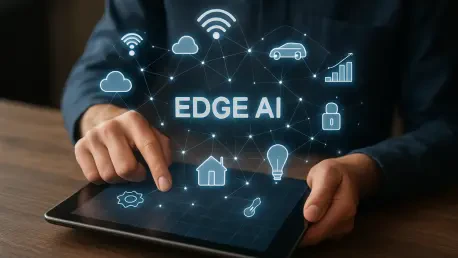

The Internet of Things is undergoing a fundamental revolution, shifting away from its historical reliance on centralized cloud infrastructure and embracing a new era of on-device intelligence powered by the integration of Generative AI. This transformation is not merely an incremental upgrade but a strategic pivot toward Edge AI, which embeds powerful artificial intelligence capabilities directly into the billions of connected devices that capture and interact with data at its source. At the forefront of this movement, MediaTek is pioneering a new generation of smart devices with its Genio platform, engineering systems that can think, reason, and act in real time without the delays and vulnerabilities of constant cloud communication. This decisive move from devices as simple data collectors to devices as intelligent, autonomous systems is redefining what is possible across industries, unlocking unprecedented levels of efficiency, responsiveness, and security for the next wave of IoT innovation.
The Imperative for Edge AI to Solve Cloud Limitations
The industry-wide migration of artificial intelligence processing from distant cloud servers to the network edge is a direct and necessary response to the inherent weaknesses of traditional, cloud-centric IoT architectures. For years, the model of sending vast amounts of raw data to centralized servers for analysis was plagued by significant operational friction, including high latency from data round-trips, immense bandwidth consumption and associated costs, and persistent privacy and security concerns over transmitting sensitive information off-site. MediaTek’s strategy, as articulated by company executives, directly confronts these challenges by empowering devices to localize AI processing. This paradigm shift, already in progress, fundamentally redefines operational efficiency. Instead of streaming continuous sensor or video feeds, devices can now analyze this information on-site, transmitting only the most relevant insights, alerts, or aggregated data. This approach solves a multifaceted problem, concurrently addressing the need for immediate responsiveness, the economic burden of high data traffic, and the critical demand for user privacy in an increasingly connected world.
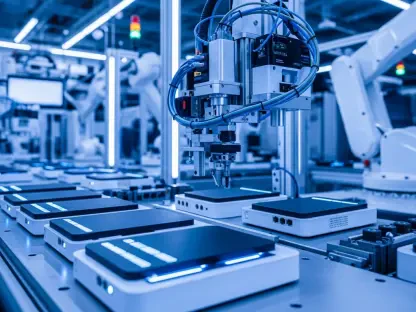
The practical and immediate benefits of this edge-first approach are already being demonstrated through tangible, real-world deployments that underscore its value in demanding environments. For instance, a key MediaTek partner is currently utilizing the Genio 700 System-on-Chip (SoC) to power a sophisticated, AI-driven factory safety inspection system that operates in real time, identifying potential hazards without the crippling delays of cloud-based analysis. In another compelling use case, the more powerful Genio 1200 SoC is being deployed in rugged industrial settings where consistent connectivity cannot be guaranteed. In these environments, the ability to perform complex on-device inference proved absolutely crucial for maintaining low latency and operational reliability, ensuring that critical processes continue uninterrupted even with constrained or intermittent network access. These examples move the conversation beyond theoretical advantages, showcasing how edge computing provides a robust, reliable, and efficient solution precisely where traditional cloud dependency becomes a significant liability and a point of failure.
A Comprehensive Strategy for Accelerated Innovation
The foundational principle of MediaTek’s strategy is the localization of AI processing, bringing sophisticated computation directly to the source of data generation. By equipping IoT devices with powerful, integrated Neural Processing Units (NPUs) within the Genio platform, complex artificial intelligence models can now run directly on the hardware itself. The company’s recent Genio 520-720 offerings, for example, provide up to 10 TOPS (trillions of operations per second) of AI performance to support these demanding on-device applications. This architecture is transformative for a wide array of use cases. Smart cameras can perform advanced video analytics locally, identifying events of interest without ever sending raw footage to the cloud. In industrial contexts, sensors can run predictive maintenance algorithms to anticipate equipment failures, ensuring operational continuity even without a stable network connection. Similarly, interactive retail kiosks can personalize user experiences and process transactions while ensuring sensitive customer data never leaves the device, bolstering security and trust. The overarching outcome is a significant enhancement in performance and responsiveness, coupled with a sharp reduction in operational costs and bandwidth requirements.
Recognizing that groundbreaking hardware is only one part of the equation, MediaTek engineered its Genio platform to dismantle the prolonged and complex development cycles that have traditionally hindered IoT adoption. This is achieved by providing a streamlined and accessible development environment, complete with flexible software frameworks, a comprehensive suite of developer tools, and complete software stacks that significantly shorten the path from concept to production, reducing timelines from months to mere weeks. This acceleration is further enhanced by broad support for diverse operating systems, including Android and Linux, and leading AI frameworks like NVIDIA TAO. This platform-agnostic approach allows development teams to leverage existing skills and tools, fostering a more agile process. Furthermore, MediaTek has cultivated a robust and collaborative partner ecosystem, working with major cloud providers, specialized AI software vendors, and a vibrant global developer community. This ecosystem provides solution providers with access to validated software on proven hardware, pre-integrated AI models, and a network of partners for design and deployment support, ensuring a faster time-to-market.
Redefining Industries and Envisioning an Autonomous Future
The adoption of Edge AI is particularly rapid and transformative in industries that depend heavily on real-time responsiveness, stringent data security, and localized decision-making. The retail sector stands out as one of the fastest-moving arenas, where Edge AI is not a peripheral enhancement but a core strategic capability that is actively reshaping customer interactions and operational processes. Innovations such as smart shelves for automated inventory management, predictive replenishment systems that anticipate demand, adaptive digital signage that personalizes content, and AI-powered conversational kiosks all rely on the high-performance, low-latency computing that edge devices provide. This represents a fundamental shift in retail from a historically reactive model to a modern, anticipatory one. Beyond the storefront, other industries like industrial automation, healthcare, transportation, and smart cities are also aggressively adopting Edge AI for applications ranging from predictive maintenance and privacy-compliant medical diagnostics to intelligent logistics and data-driven urban infrastructure management.
The current wave of generative AI at the edge was seen as a crucial stepping stone toward the next frontier: agentic AI. This future vision involved devices that could not only process information but also reason, plan, and execute actions autonomously with minimal human oversight. In a retail context, this manifested as small, domain-specific language models running locally on edge systems. These models, trained on a retailer’s proprietary product catalog and brand voice, offered highly personalized and context-aware customer assistance while keeping all interaction data private and secure on the device. MediaTek’s long-term strategy was designed to synergize its leadership in silicon innovation with the depth and breadth of its partner ecosystem. By doing so, the company provided its customers—OEMs, developers, and enterprises—with a clear and efficient path to bring sophisticated, AI-enabled devices to market, which ultimately accelerated the transition toward a world of more capable, autonomous, and intelligent connected systems.