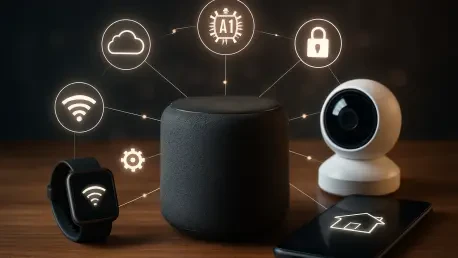

The term ‘smart device’ has become so commonplace that its original meaning is often lost in a sea of connected gadgets that are more reactive than truly intelligent, but a significant technological evolution is underway to change that perception. This transformation is not about adding more features or faster connections to the cloud; it is about fundamentally rethinking where the “thinking” happens. The next generation of intelligence is being embedded directly into the devices themselves, enabling them to process information, make decisions, and respond to their environment in real-time, without constant reliance on a distant server. This strategic pivot towards on-device processing, or edge computing, is poised to redefine what it means for a device to be smart across a vast array of sectors. From bustling retail environments and complex manufacturing floors to intelligent transportation systems and responsive smart homes, the focus is shifting to creating autonomous, efficient, and secure systems that enhance daily life by bringing powerful computational capabilities closer to the source of data.
The Shift Towards On-Device Processing
The migration of processing power from centralized cloud servers to the edge of the network is driven by the demand for instantaneous performance and greater data security. When a device must send information to the cloud and wait for a response, even a momentary delay, or latency, can be unacceptable in critical applications like autonomous vehicle systems or industrial automation. By performing computations locally, devices can analyze data and react in milliseconds, enabling a level of responsiveness that is simply not possible with cloud-dependent models. Furthermore, this approach significantly enhances user privacy and security. Keeping sensitive data, such as voice commands within a home or biometric information from a driver monitoring system, on the device itself drastically reduces the risk of interception or unauthorized access during transmission. An integrated ecosystem of advanced modules, purpose-built antennas, and supportive services is facilitating this transition, providing developers with the tools to build sophisticated systems that are not only faster and more secure but also more reliable, capable of functioning even when network connectivity is lost.
Innovations Driving the Intelligent Edge
The practical applications of this intelligent edge philosophy are already materializing in a suite of advanced solutions designed for specific, real-world challenges. For instance, a sophisticated, software-based audio enhancement system can now effectively isolate and eliminate background noise in chaotic settings like factories or busy transit hubs, ensuring crystal-clear communication for intercoms and calls without the need for expensive, specialized hardware. This technology is compatible with a range of modules, including the EC800M, SC200L, and SC66. In the home, ultra-compact smart audio modules are enabling everyday appliances to understand their surroundings and respond to voice commands entirely offline, boosting convenience and reliability. Meanwhile, the retail sector is being transformed by turnkey solutions for automated vending, where a powerful SG560D module provides highly accurate, real-time product identification to streamline the checkout process. The same module powers a compact, 5G-enabled edge computing box that delivers an impressive 14 TOPS of computational power, running advanced algorithms for gesture recognition, driver monitoring, and object detection for easy deployment in diverse applications.
A Blueprint for a More Autonomous Future
The technologies showcased at a recent major industry event provided a clear and compelling vision of this evolving landscape. The focus was not on incremental improvements to existing cloud-based systems but on a foundational shift toward localized intelligence. The sophisticated solutions on display, from noise-canceling software to high-performance edge computing boxes, demonstrated how embedding powerful processing directly into devices could solve tangible problems, enhancing both efficiency and security. This move away from total cloud dependency represented a critical step toward creating systems that were not just connected but truly autonomous and context-aware. The innovations presented were more than just concepts; they were practical tools that laid the groundwork for a future where devices could perceive, reason, and act independently, ultimately delivering a more seamless and intelligent user experience.