
The days of purpose-built networking hardware are numbered. For decades, building or scaling a network meant racking and stacking physical boxes for every function: routers, firewalls, and load balancers. This model is rigid, expensive, and slow.
Network Functions Virtualization (NFV) directly challenges this paradigm. It decouples network functions from proprietary hardware, transforming them into software applications that run on standard servers. By using a hypervisor, virtual machines can run critical processes such as routing and security, providing unprecedented agility.
This isn’t just a technical shift. It’s a strategic move away from capital-intensive hardware cycles toward a flexible, software-defined future. It allows organizations to build and adapt networks at the speed of software, not the speed of procurement.
How NFV Redefines Network Architecture
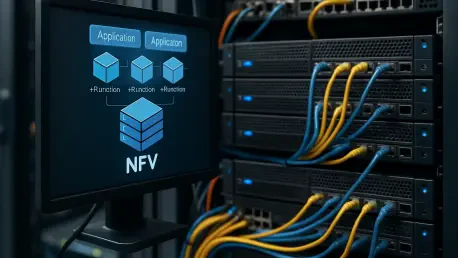
NFV works by abstracting network tasks from the underlying physical equipment. Instead of a dedicated appliance, a Virtualized Network Function (VNF) runs as a software instance on a commodity server. Functions such as load balancing, firewall security, and routing are managed by a hypervisor as applications.
A software-defined networking controller or hypervisor gives network engineers a centralized control plane. This allows them to program, automate, and provision network segments in minutes, not months. The entire lifecycle of a network service can be managed through a single interface, dramatically simplifying operations.
An NFV architecture consists of three core layers:
NFV Infrastructure (NFVI). This foundational layer includes the physical compute, storage, and network resources, along with the virtualization layer (hypervisor or container platform) that abstracts them.
Virtualized Network Functions (VNFs). These are the software applications that perform the tasks previously handled by hardware, such as firewalls, domain name system (DNS), and caching.
Management, Automation, and Network Orchestration (MANO). This framework is the brain of the operation. It oversees the NFVI and manages the VNF lifecycle, covering everything from instantiation and configuration to scaling and termination.
From Cost Reduction to Business Agility
The initial driver for NFV adoption was often cost savings. Moving from expensive, proprietary hardware to generic servers can reduce infrastructure costs by up to 40% compared to traditional hardware. But the true value of NFV extends far beyond the budget. Its primary benefit is agility.
Consider a multinational retailer planning to roll out a new guest Wi-Fi and point-of-sale security service to 500 stores. A traditional, hardware-based approach would involve shipping, installing, and configuring physical appliances at each site, a process that could take more than a year. With NFV, the retailer can centrally provision and deploy the necessary VNFs across its entire network in weeks, accelerating time-to-market and gaining a competitive edge.
Other strategic benefits include:
Dynamic Scalability. Network resources can be scaled up or down on demand to match traffic patterns, eliminating overprovisioning and improving resource efficiency.
Reduced Operational Overhead. Centralized management and automation reduce the need for on-site technicians and manual configuration, lowering operational costs.
Service Innovation. New services and security policies can be tested and deployed rapidly as software, fostering a culture of experimentation and continuous improvement.
Navigating the Hurdles of NFV Implementation
Despite its benefits, NFV introduces complexities that can hinder adoption if not addressed proactively. The primary concerns revolve around security and operational readiness.
Virtual environments change the security landscape entirely. Converting network functions to software offers clear advantages but significantly expands the attack surface, requiring defenses against a wider range of threats.
Key risks include:
Expanded Attack Surface. Software-based components running on shared infrastructure are more exposed than dedicated hardware locked in a data center.
Compromised Hypervisor. If the hypervisor is compromised, an attacker could gain control over every VNF running on it, creating a single point of catastrophic failure.
East-West Traffic Blind Spots. Traditional security tools are designed to inspect north-south traffic entering and leaving the data center. They often lack visibility into the traffic moving between virtual machines, making it difficult to detect lateral movement by attackers.
Complex Management Layers. NFV environments span multiple layers, from physical hardware to orchestration software. Securing each layer and ensuring consistent policy enforcement are significant challenges.
NFV and SDN: Complementary Technologies
NFV is often discussed alongside software-defined networking (SDN), but they address different problems. They are mutually beneficial but not dependent on each other.
NFV virtualizes the network functions themselves, turning them into software. SDN, on the other hand, separates the network’s control plane (which determines where traffic flows) from the data plane (which forwards traffic). This separation allows for centralized, programmable control over the entire network.
When used together, they create a highly automated and agile infrastructure. SDN can provide the intelligent, programmable fabric that directs traffic to and between the VNFs that NFV creates. This combination is foundational for modern cloud-native and edge computing environments.
The Future of NFV: Powering 5G and the Edge
Originally championed by telecommunications providers to modernize their networks, NFV’s principles are now critical for enterprise IT. The rise of 5G and edge computing depends on the ability to deploy network functions dynamically and close to the end user.
NFV enables the creation of lightweight, distributed networks required for edge use cases such as IoT data processing and real-time analytics. Telecom operators are already leveraging NFV to build flexible 5G core networks, with nearly 70% of 5G infrastructure expected to use NFV-based solutions by 2024. For enterprises, this means the same technology can be used to manage network services at remote branch offices or factory floors with greater efficiency.
Conclusion
NFV adoption is not a technology upgrade but an operational transformation. Moving from hardware-centric infrastructure to software-defined services requires changes to the security posture, workforce capabilities, and service design. Organizations that treat NFV as a simple swap will struggle with fragmented deployments and unmanaged risk.
The strategic tension is clear: NFV promises agility and cost efficiency, but only if security is embedded from the start, automation expertise is cultivated, and orchestration extends across the entire service lifecycle. Without these foundations, the flexibility NFV offers becomes a liability, expanding the attack surface, increasing complexity, and creating operational bottlenecks that undermine the value proposition.
For enterprises moving toward hybrid cloud and edge architectures, the question is not whether to adopt NFV, but whether they are prepared to manage it as a continuous operational discipline rather than a one-time deployment. Success depends on treating virtualization as a strategic capability, not a technological endpoint.