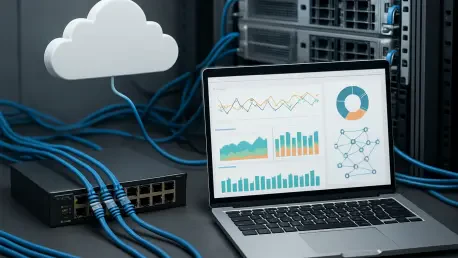

Traditional monitoring was built for a world of static hosts, predictable traffic, and tidy fault trees. That world is gone. Cloud-native networks spin up and down in seconds. East-west traffic explodes inside clusters and across regions. Service-to-service dependencies change with every deploy. Old tools that watch fixed endpoints cannot explain a system that keeps moving. Cloud-native network observability provides what monitoring cannot. It turns raw signals into a live picture of how packets, services, and users actually interact. The result is fewer blind spots, faster incident response, and a realistic path to reliability at scale.
Why Old Monitoring Fails In Ephemeral, East-West Networks
Classic monitoring assumes known failure modes. A CPU spike. A full disk. A dead process. It watches hosts and ports, then raises an alert. That approach worked for monoliths on stable infrastructure. It breaks down when containers churn, services autoscale, and the network becomes the system’s memory bus.
Three shifts explain the gap. First, ephemerality makes infrastructure a moving target. Containers and serverless functions appear and disappear in seconds, which means host-based checks and static dashboards miss short-lived spikes and transient errors. Second, topology churn accelerates. Dependency graphs now change daily as independent teams ship updates. Fixed runbooks do not keep pace with shifting call paths, sidecars, and NAT gateways. Third, east-west traffic dominates. Most transactions traverse multiple internal hops. Latency and packet loss inside clusters often matter more than internet ingress, yet traditional synthetic tests at the edge rarely catch the real bottlenecks.
Kubernetes adoption illustrates the point. The majority of enterprises now run Kubernetes in production, which increases service dependencies and east-west traffic within virtual networks.
What Cloud-Native Network Observability Means
Observability is not a prettier dashboard. It is the ability to ask new questions without shipping new code or reconfiguring probes. In networking terms, observability connects signals from layers 3 to 7 into an explainable narrative. It correlates packet flow with process identity and service context. It shows how a retry storm in one namespace can saturate an egress gateway. It reveals how a slow dependency in one region degrades a user journey in another. It turns symptoms into stories that engineers can act on.
The most credible approaches bring together three capabilities and treat them as one system. High-fidelity telemetry collects metrics, logs, traces, flow records, and packet-level samples with low overhead. Context and correlation enrich raw traffic with metadata from service meshes and orchestration systems, including workload, team, and environment details. Analytics and action-layer intelligence on top to group symptoms into incidents, link them to likely causes, and trigger safe, automated responses when thresholds are crossed.
Signals That Matter From L3 To L7
Modern observability stitches together packet and application views into a single timeline, where each signal plays a specific role. Network metrics, such as round-trip time, retransmits, packet drops, and egress volume by VPC or VNet, identify congestion and unexpected data exfiltration. Flow logs and packet samples map real paths through peering links, transit gateways, and firewalls, while also validating whether policy behaves as designed. Traces connect API calls end to end, revealing where retries start, where time is spent, and how errors propagate across services.
Identity ties it all together. Service-mesh telemetry and kernel-level sensors, such as extended Berkeley Packet Filter (eBPF) link flows, are linked to the exact workload and version, so teams stop guessing which pod or node emitted the traffic. Control plane events from Kubernetes, cloud routing, and API gateways capture why a path changed at a particular moment. A sudden spike in 502s can be traced to a redeployed sidecar or a rotated certificate, not just an overloaded node. When these signals live in one place with a consistent timeline, teams see not only that a problem exists but why it exists and which group owns the fix.
Topology And Dependency Mapping That Stays Current
Static diagrams age out in weeks. Cloud-native observability provides live topologies that adapt to the environment. New services appear as they register. Edges update when DNS or routes change. Nodes carry context such as ownership and service-level objective (SLO) health. This living map spans multiple layers. At the application layer, it reveals real-time service-to-service relationships with latency and error rates at each edge. At the network layer, it shows effective paths through VPC peering, transit gateways, software-defined WAN, and on-premises links, complete with throughput, loss, and policy hits. At the governance layer, it flags flows that cross regulated boundaries or violate egress policies, such as a restricted namespace reaching the public internet. With a living map, teams understand the blast radius, plan rollouts, and validate zero-trust policies before incidents expose gaps.
Automation And Intelligent Triage
Volume is the enemy. Telemetry at cloud scale overwhelms manual triage. Intelligent features separate the signal from the noise and compress time to resolution. Anomaly detection models learn normal patterns for latency, traffic mix, or error ratios per service and environment. They flag outliers that simple thresholds miss. Topology-aware correlation consolidates a pile of alerts into a single incident. A failing database does not generate fifty downstream pages. The system groups symptoms by dependency chains, highlights the root cause, and lists impacted services.
Auto-remediation closes the loop where it is safe to do so. Approved runbooks can scale a gateway, rotate a misconfigured certificate, or drain a bad node when a known signature appears. SLO enforcement turns red graphs into business impact. When an incident threatens a committed service level, it carries clear priority. Enterprises that implement correlation- and SLO-driven routing report significant reductions in paging volume and faster resolution of severe incidents. Outage studies also show that a growing share of events now cost more than 100,000 dollars, which raises the stakes for getting this right.
Data Volume, Cost, And Privacy Trade-Offs
Observability is not free. Costs rise quickly without a plan, so collection and retention must be intentional. Smart collection focuses depth where it matters. Tail-based sampling keeps complete traces for high-latency or error-heavy requests while dropping healthy ones. Packet capture is scoped to problem links or time windows. Retention tiers place hot data in fast stores for active investigations, while warm and cold tiers keep trends and compliance records at lower cost. Lifecycle policies handle the shift automatically.
Privacy must be engineered into the pipeline. Logs and traces often contain sensitive information and personal data. Redaction at source, tokenization, and strict access controls keep observability from becoming a liability. Tool choices matter as well. Multiple point solutions can duplicate ingest and storage, fragment context, and inflate spend. Industry reports show many enterprises still maintain nine or more observability and monitoring tools, which increases cost and slows triage.
An Architecture Pattern That Works In Practice
A practical blueprint aligns platform, network, and application teams around shared data and shared controls. It starts by standardizing telemetry. OpenTelemetry becomes the common language for metrics, logs, and traces across services, while cloud flow logs and VPC or VNet traffic mirroring add network visibility. eBPF-based collectors on nodes enrich flows with process and pod identity. With consistent signals in place, a governed data pipeline enforces schemas, applies sampling and redaction at the edge, and routes data to hot and warm stores with explicit retention.
Visibility must be usable. Rendering a living map that merges application traces with network paths provides a single source of truth for everyone. Ownership, SLOs, and recent deploys appear on the same canvas as traffic and errors. Correlation and automation then tie symptoms to change. Incidents are grouped by dependency and connected to runbooks. Deployments and configuration updates appear in the same timeline as error spikes, so engineers do not waste time hunting for context. The blueprint ends with practice. Game days simulate failures and regional traffic shifts to validate that alerts fire once, auto-remediation is safe, and dashboards guide engineers to the root cause in minutes.
Tooling And Standards Without The Hype
Vendors promise one-click clarity. Reality rewards fit-for-purpose building blocks and open standards. OpenTelemetry is now the de facto standard for portable telemetry, which reduces agent sprawl and vendor lock-in. It has broad vendor support and active community momentum, making it a safe default for new services.
Cloud providers complement this with native options such as VPC flow logs, traffic mirroring, managed tracing, and analytics services that integrate cleanly with identity and policy controls. Packet-level visibility powered by eBPF provides near-real-time insights with low overhead, which is invaluable for diagnosing cryptic network issues and validating policies. Service mesh telemetry adds a consistent layer-7 layer of metrics and policy enforcement, creating rich context for zero-trust controls and SLO tracking within clusters. Success depends less on picking a single tool and more on unifying context and ownership across the tools already in place.
KPIs That Tie To Business Outcomes
Executives do not buy telemetry. They buy reliability, speed, and control. KPIs should reflect that reality and read like a contract between platform teams and the business. Reliability improves when the mean time to detect and the mean time to repair fall. The failure rate and incident recurrence decline for critical services.
Performance becomes tangible when P95 and P99 latency stabilize for key user journeys and error budget burn rates align with targets. Cost clarity shows up as a lower ingest cost per host or per million spans, a higher percentage of data in warm and cold tiers, and a measurable reduction in overlapping tools. Risk and compliance mature when more policy-violating flows are detected and blocked before impact, audit evidence is assembled faster, and privacy incidents tied to logs and traces trend down.
Multi-Cloud And Edge Raise The Stakes
Traffic rarely lives in one place anymore. Multi-cloud, hybrid, and edge deployments complicate paths and policies, which makes consistent observability essential. Identity should travel with services. Centralized identity and short-lived credentials help tie telemetry to people and workloads across environments.
Policy should not fork per platform. Egress, segmentation, and encryption rules need to be expressed once and enforced across cloud networks, service meshes, and on-premises gear. Visibility must cross domains. The same view should correlate software-defined WAN behavior, cloud backbone health, and public internet performance. Problems often sit at the seams. Analyst data shows that multi-cloud adoption continues to grow, which increases operational complexity and the need for consistent observability across providers.
Conclusion
Cloud-native network observability addresses the limitations of traditional monitoring in environments defined by ephemeral infrastructure, dynamic service dependencies, and heavy east-west traffic. By combining telemetry from network and application layers with identity and deployment context, observability platforms help teams understand how traffic actually moves across services, clusters, and regions. This visibility improves incident detection, shortens troubleshooting cycles, and reduces operational blind spots.
Adopting observability requires more than deploying new tools. Organizations must standardize telemetry, manage data volume and retention carefully, and enforce privacy controls throughout the pipeline. Equally important is aligning networking, platform, and application teams around shared data and clear ownership. Without that coordination, additional tooling can increase complexity rather than improve insight.
For enterprises operating Kubernetes, hybrid cloud, or multi-cloud environments, observability provides a practical way to maintain service reliability as infrastructure becomes more distributed. The primary benefits are operational: faster root-cause analysis, fewer redundant alerts, clearer service dependencies, and better alignment between network performance and business-level service objectives. In cloud environments where change is constant, observability is no longer optional. It is foundational to operating at scale.