
What happens when the digital revolution outpaces the physical world? In the relentless pursuit of artificial intelligence dominance, the United States and Europe are racing against a ticking clock—not just of innovation, but of energy grids groaning under pressure and land vanishing under regulatory red tape. The promise of AI as a transformative force is undeniable, yet the very foundation it rests on is cracking. This clash between ambition and reality demands attention as the stakes for global leadership hang in the balance.
The Critical Crossroads of AI’s Ascent
The significance of AI extends far beyond tech labs and boardrooms; it’s a pivotal driver of economic might and national security. Nations that harness this technology stand to redefine industries, from healthcare to defense, while those who falter risk obsolescence. The urgency to scale AI infrastructure in the US and Europe isn’t merely about keeping up—it’s about securing a foothold in a world where competitors are rapidly advancing. With capital investments for AI projected to soar into trillions by the end of this decade, the question looms: can the West build fast enough to match its vision?
Energy: The Grid’s Breaking Point
AI data centers are energy hogs, with projections estimating they could devour up to 20% of current US electricity by 2030. This insatiable demand is pushing already stressed grids to their limits, raising alarms about potential blackouts and service disruptions. In Europe, aging infrastructure compounds the issue, as utilities scramble to meet skyrocketing needs without consistent renewable backups. The strain isn’t just technical; it’s a policy challenge, with regulators caught between ensuring stability and greenlighting rapid expansion.
Moreover, the environmental cost adds another layer of complexity. Fossil fuel reliance in some regions clashes with sustainability goals, creating a public relations nightmare for tech giants. Balancing the push for AI with climate commitments is no small feat, and without innovative energy solutions, progress could stall under the weight of public and political scrutiny.
Land: A Battle for Space
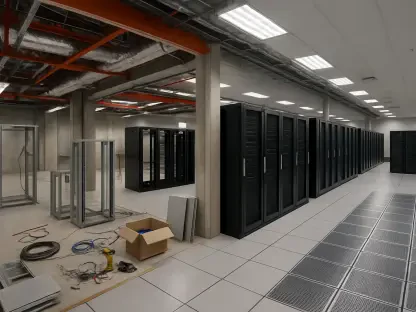
Beyond energy, finding room for sprawling data centers poses a formidable obstacle. In densely populated areas of the US and Europe, land scarcity drives fierce competition, while permitting delays can drag projects for years. A single data center might require hundreds of acres, yet local opposition and zoning laws often stand in the way, turning each proposal into a protracted battle.
Contrast this with regions less constrained by space or bureaucracy, where infrastructure rises at a breakneck pace. The West’s struggle to secure sites isn’t just a logistical hiccup—it’s a strategic disadvantage. As companies grapple with these spatial limits, the risk of falling behind in the global race grows ever more real.
Regional Rivalries: Stacking Up Against China
When comparing challenges, the disparity between the US, Europe, and China becomes stark. China benefits from streamlined power generation, blending coal, hydropower, and renewables with remarkable efficiency. Its dominance in solar and battery tech, paired with swift infrastructure deployment, gives it a clear edge. Innovations like energy-efficient AI models further tilt the scales, mitigating the bottlenecks that plague Western nations.
In the US and Europe, regulatory hurdles and fragmented energy policies slow momentum. While China builds nuclear reactors on time and on budget, Western projects often face delays and cost overruns. This gap isn’t merely technical—it’s a signal of who might lead the AI frontier in the years ahead, as physical advantages translate into digital supremacy.
Expert Perspectives: Balancing Risk and Reward
Insights from senior investment strategists paint a nuanced picture of AI’s trajectory. One expert cautioned that the massive upfront costs—potentially reaching $5-8 trillion by 2030—carry significant risks if growth doesn’t outpace historical benchmarks. Yet, optimism persists among others who see undervalued infrastructure investments as a golden opportunity. They argue that private funding in energy and land solutions could yield outsized returns despite the hurdles.
Industry trends echo this duality. Stories of tech firms partnering with utilities for renewable projects highlight a path forward, even as some cautionary tales of stalled data center builds temper enthusiasm. These voices collectively underscore a delicate moment: AI’s potential is vast, but its realization hinges on navigating a minefield of physical constraints with precision and foresight.
Charting a Path Forward: Solutions on the Horizon
Despite the daunting barriers, strategies to overcome energy and land challenges are emerging. On the energy front, investment in renewables like wind and solar offers a sustainable way to fuel AI’s appetite. Tech companies collaborating with power providers to upgrade grids can bridge immediate gaps, while innovations in energy storage promise to stabilize supply during peak demands.
For land issues, policy reform stands as a critical lever. Streamlining permitting processes through public-private partnerships could slash delays, while creative urban planning—such as repurposing industrial zones—might unlock new spaces. Learning from global leaders, particularly China’s rapid deployment models, offers a blueprint for efficiency that the West could adapt to its own regulatory landscape. These approaches, if prioritized, could turn obstacles into stepping stones for sustained AI growth.
Looking back, the journey to reconcile AI’s ambitions with physical limits revealed a profound tension between innovation and infrastructure. The hurdles of energy and land had tested the resolve of the US and Europe, exposing vulnerabilities in the race for technological dominance. Yet, the path forward lay in bold action—forging alliances between tech and energy sectors, reforming outdated policies, and embracing global lessons. As solutions took shape, the focus shifted to sustained collaboration, ensuring that the digital future would not be dimmed by the constraints of the physical world.