
The rapid proliferation of artificial intelligence training clusters has pushed traditional networking hardware to a breaking point where the physical space required to house switches often rivals the footprint of the GPUs themselves. As data centers scale toward 128,000-node clusters, the industry has encountered a “thermal wall” that standard air-cooled pluggable optics can no longer climb. Arista Networks’ eXtra-dense Pluggable Optics (XPO) technology emerges as a direct response to this infrastructure crisis, promising a radical consolidation of bandwidth and cooling efficiency. By reimagining the transceiver not just as a component but as a miniature liquid-cooled system, this technology aims to solve the density bottleneck that currently limits the next generation of hyperscale AI fabrics.
Evolution of High-Density Interconnects
The transition to XPO represents a fundamental shift away from the incremental improvements seen in the Octal Small Form-factor Pluggable (OSFP) era. For years, the industry relied on doubling the lane rate or increasing the number of channels within a familiar physical shell. However, as 800G and 1.6T modules became standard, the power density within these small modules reached levels that air cooling simply could not dissipate without massive, energy-hungry fans. This evolution reflects a broader trend where the network is no longer an auxiliary service but the primary heartbeat of the AI compute engine, requiring a more integrated approach to hardware design.
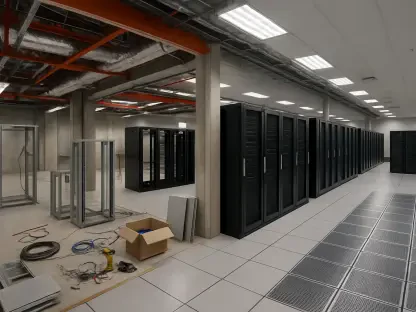
In the current technological landscape, the sheer volume of cabling and switch racks has become a logistical nightmare for “neocloud” providers. The emergence of XPO signifies the end of the “one module per port” philosophy, moving instead toward a multi-terabit “super-module” that acts as a localized hub for data transmission. This shift is relevant because it acknowledges that scaling AI is as much a mechanical and thermal challenge as it is a mathematical one. By addressing these physical constraints, XPO provides the groundwork for clusters that can operate with significantly lower latency and higher reliability than previous generations.
Core Technical Innovations of XPO Modules
High-Bandwidth Density and Electrical Architecture
The most striking feature of the XPO module is its ability to deliver 12.8 Tbps of bandwidth through a single physical interface. This is achieved by utilizing 64 electrical lanes, effectively doing the work of eight traditional OSFP modules. The significance of this architectural leap lies in the reduction of complexity; by consolidating the electronics, Arista has eliminated 75% of the microcontrollers and voltage converters typically required for this amount of throughput. This reduction is not just about saving space; it addresses the statistical reality that in a fabric with 50,000 links, fewer components mean fewer points of failure.
From a performance standpoint, the XPO module utilizes two 32-channel paddle cards that share a simplified control plane. This design ensures a “clean” electrical channel to the switch chip, which is vital for supporting low-power linear interfaces. By minimizing signal degradation across the electrical-to-optical boundary, the system can maintain high-speed integrity without the massive power overhead typically associated with complex digital signal processing. This architectural efficiency is what allows the technology to scale without linearly increasing the power consumption of the entire network fabric.
Integrated Liquid Cooling and Thermal Management
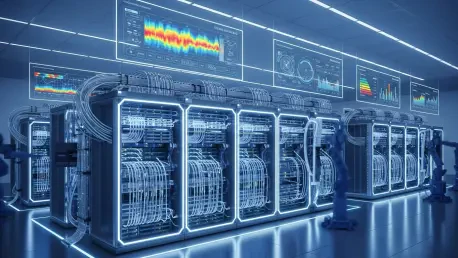
Thermal management is where the XPO technology truly deviates from its competitors. While traditional designs use “flat-top” heat sinks or external liquid cooling attachments, the XPO integrates a liquid-cooled cold plate directly into the module’s housing. This allows the module to handle power loads exceeding 400W, a threshold where air cooling effectively fails. The integration of the cooling mechanism directly into the pluggable unit ensures that heat is removed at the source, preventing the thermal “soak” that often leads to optical laser degradation and premature component failure in high-density racks.
This approach to cooling is a necessity for high-performance optics like 8x1600G-ZR/ZR+. By moving the cooling medium—liquid—closer to the heat-generating photonics and RF components, Arista has created a system that is far more efficient than any air-cooled alternative. In real-world usage, this means that data center operators can pack switches closer together without risking a thermal shutdown. This capability is unique because it treats the optical module as a high-performance thermal element, similar to a modern CPU or GPU, rather than a passive peripheral.
Current Trends in Optical Networking and AI Fabric
The industry is currently witnessing a move toward “lean” networking, where the goal is to maximize the ratio of compute power to networking overhead. Innovations are increasingly focused on reducing the “tax” that networking places on the data center’s power envelope. The trend is moving away from proprietary, closed-loop systems toward Multi-Source Agreements (MSAs), as evidenced by the 45 suppliers backing the XPO ecosystem. This shift suggests that the market no longer views the optical link as a commodity but as a specialized piece of the AI infrastructure that requires industry-wide standardization to reach scale.
Real-World Applications and Industrial Impact
In the massive AI training environments operated by hyperscalers, the deployment of XPO technology can reduce the number of required switch racks by up to 75%. For a 400 MW facility, this translates to saving over a thousand racks and reclaiming 44% of the floor space. This impact is profound for companies building 100,000-GPU clusters, where the cost of construction and power distribution is measured in the billions. By streamlining the physical layer, these organizations can deploy more compute power within the same building footprint, directly accelerating their time-to-market for new AI models.
Beyond pure space savings, the reliability of XPO is critical for maintaining long-running AI training jobs. In a standard setup, a single failed optical link can halt a multi-day training session, wasting millions of dollars in compute time. The simplified internal architecture of XPO reduces the “soft” failure rates that plague high-density fabrics. This implementation is unique because it prioritizes operational continuity for the compute layer, recognizing that the most expensive part of a data center is the idle time of its GPUs, not the cost of the optics themselves.
Challenges and Adoption Barriers
Despite its advantages, the adoption of XPO technology faces significant hurdles, primarily concerning the infrastructure overhaul required for liquid cooling. Most existing data centers are designed for air cooling, and retrofitting these facilities with the necessary plumbing for liquid-cooled optics is a capital-intensive endeavor. Additionally, the move to a new form factor creates a potential “vendor lock-in” concern, even with an MSA in place. The industry must also contend with the logistical complexity of managing liquid connections at the port level, which requires new maintenance protocols and specialized training for technicians.
Future Outlook and Scalability
Looking ahead, the trajectory of XPO technology points toward even higher levels of integration, possibly merging optical engines directly onto the switch silicon package. As AI models continue to grow, the demand for 25.6 Tbps and 51.2 Tbps modules will likely drive further iterations of this liquid-cooled architecture. The long-term impact will be a data center environment that looks less like a library of servers and more like a single, massive, fluid-cooled supercomputer. This evolution will likely lead to a new standard in how we perceive modularity and field-replaceable units in high-performance computing.
Final Assessment of Arista XPO Technology
The evaluation of Arista’s XPO technology revealed a sophisticated solution to the physical limits of traditional networking. By successfully merging 12.8 Tbps density with integrated liquid cooling, the module addressed the dual crises of space and heat in the AI data center. The strategic reduction in component count proved to be a logical path toward the reliability levels demanded by massive GPU clusters. While the transition necessitated a shift in how infrastructure was cooled and maintained, the trade-off in floor space and power efficiency offered a compelling economic argument for hyperscalers.
The technology’s impact was most visible in the significant reduction of switch racks, which allowed for a more streamlined and cost-effective deployment of compute resources. Moving forward, stakeholders should prioritize the standardization of liquid-cooling interfaces to lower the barrier for entry into this high-density ecosystem. The success of this platform likely set a new benchmark for the industry, suggesting that future optical developments will increasingly rely on thermal innovation rather than just electrical speed. Ultimately, XPO provided the necessary bridge for the networking industry to keep pace with the exponential growth of artificial intelligence.