
The relentless tide of global data generation has finally outpaced the physical durability of the magnetic media we rely on to store it. As high-definition archives, massive artificial intelligence training sets, and historical records expand, the industry faces a “digital dark age” where the hardware fails faster than the information can be migrated. Project Silica, a long-term storage initiative, proposes a radical departure from fragile spinning disks and decaying tapes. By embedding data into the molecular structure of glass, this technology offers a medium that is practically immortal, potentially preserving the sum of human knowledge for ten millennia without the need for constant maintenance or energy-consuming climate control.
Introduction to Borosilicate Glass Storage Technology
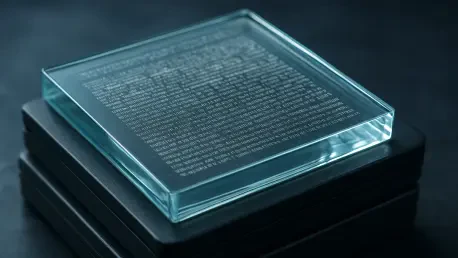
At its heart, this technology is an exercise in extreme durability and high-density spatial encoding. Unlike traditional hard drives that store bits on a thin magnetic surface or optical discs that use pits on a plastic layer, this system uses the internal volume of a glass slab. The process involves using ultra-fast lasers to create physical distortions within the glass, which are then read back using high-speed microscopic imaging. This shift from surface-level storage to volumetric storage allows for an unprecedented amount of data to be packed into a form factor no larger than a coaster.
The emergence of this technology signals a shift toward sustainability in the data center industry. Current archival methods require “scrubbing” every few years—a process where data is moved to new hardware to prevent bit rot. This cycle consumes enormous amounts of electricity and generates tons of electronic waste. Glass storage, by contrast, is a “write once, read forever” solution. It requires no power to maintain the data and is impervious to electromagnetic pulses, moisture, and extreme temperatures, making it the most resilient storage medium ever engineered.
Core Technical Components and Innovations
Transition: From Fused Silica to Borosilicate Glass
The most significant recent evolution in this field is the strategic move from fused silica to borosilicate glass. Fused silica, while optically pure, is notoriously difficult and expensive to manufacture, requiring extreme temperatures and specialized equipment. In contrast, borosilicate glass is the same robust material found in high-end kitchenware and laboratory equipment. This transition is not merely a cost-cutting measure; it is a play for scalability. By utilizing a material already mass-produced at a global scale, the technology moves from a laboratory curiosity to a commercially viable enterprise solution.
Furthermore, borosilicate glass offers a unique balance of thermal stability and chemical resistance that suits the needs of modern hyperscale data centers. While it is cheaper to source, it does not sacrifice the primary benefit of the medium: longevity. The material can withstand being baked in an oven or boiled in water without losing a single byte of data. This resilience allows organizations to store their most precious assets in passive environments, drastically reducing the total cost of ownership compared to traditional air-conditioned tape libraries.
Femtosecond Laser Writing and Voxel Architecture
The “engine” behind this storage method is the femtosecond laser, which emits light pulses lasting one-quadrillionth of a second. These pulses are so brief and intense that they change the physical structure of the glass at a microscopic level, creating three-dimensional pixels known as voxels. These voxels are not just simple dots; they hold information through their size, orientation, and the way they refract light. This multi-layered approach allows engineers to stack hundreds of layers of data within a sheet of glass only two millimeters thick, achieving densities that rival modern hard drives.
To read the data back, the system employs machine learning-assisted microscopy. Polarized light is shone through the glass, and the resulting patterns are captured by a high-speed camera. AI algorithms then decode these optical signals back into digital bits. This decoupling of the writing and reading processes is crucial. While writing is a precision-heavy, slower task, reading can be performed rapidly using standard optical components, making the retrieval process efficient enough for “cold” storage applications where data is needed occasionally but must be perfectly preserved.
Current Trends and Technological Progress
The storage industry is currently grappling with a massive influx of data driven by the rapid expansion of machine learning models. As of now, the market for archival storage is projected to reach nearly a trillion dollars by the mid-2030s. This growth has forced a rethink of how we categorize “cold” data. Previously, archives were seen as stagnant graveyards for old files, but today, they are viewed as valuable training sets for future AI. Consequently, the trend has shifted toward media that can hold vast amounts of information for decades without the risk of degradation or the overhead of migration.
Innovation has also focused on increasing the “ingestion” speed of glass storage. Earlier iterations were criticized for being too slow to write, making them impractical for large-scale backups. However, the introduction of parallel writing techniques—where multiple laser beams work on a single pane of glass simultaneously—has significantly closed the gap. Moreover, the integration of robotic “libraries” that can fetch and load glass panes into readers automatically has turned a manual laboratory process into a fully automated data center tier.
Real-World Applications and Sector Impact
The entertainment industry was among the first to realize the potential of this technology. Major film studios possess thousands of hours of high-resolution footage that is currently stored on magnetic tape, which must be replaced every five to seven years. By moving these master copies to borosilicate glass, studios can ensure that their cultural heritage remains intact for centuries without ongoing labor costs. This “immutable” archive serves as the ultimate insurance policy against the physical failure of digital assets.
Beyond Hollywood, the medical and legal sectors are finding unique value in glass storage for compliance purposes. Genomic sequences and long-term legal records require decades of retention with zero tolerance for corruption. In these fields, the inability to alter or accidentally erase data once it is etched into the glass is a feature, not a bug. This provides a level of security and “data provenance” that magnetic or flash media simply cannot match, as those formats are inherently erasable and susceptible to silent data corruption.
Technical Limitations and Market Obstacles
Despite its promise, borosilicate storage is not a universal replacement for the SSDs in our laptops or the high-performance arrays in our servers. The primary hurdle remains retrieval latency. Accessing data from a glass pane involves a robotic arm locating the slab and an optical system focusing on the correct layer, a process that takes seconds or even minutes. This makes it unsuitable for transactional databases or any application requiring real-time access. It is a specialized tool for the “bottom” tier of the data pyramid.
Another obstacle is the high initial capital expenditure for the writing infrastructure. While the glass itself is inexpensive, the femtosecond lasers and the specialized hardware required to etch the data remain costly compared to traditional tape drives. For the technology to achieve widespread adoption, manufacturers must continue to drive down the cost of the writing hardware. Until then, glass storage will likely remain a service offered by major cloud providers rather than a product that individual companies deploy in their own small server rooms.
Future Outlook and Industry Trajectory
Looking ahead, the integration of glass storage into the broader “circular economy” of technology will be a major focal point. Because glass is non-toxic and easily recyclable, it offers a much cleaner environmental profile than the rare-earth metals and plastics found in traditional drives. We can expect to see data centers designed specifically around these passive glass libraries, featuring “dark” rooms that require no lighting or cooling, significantly lowering the carbon footprint of global data preservation.
As the technology matures, the density of these glass panes will likely increase even further. Researchers are already exploring ways to use different wavelengths of light to pack more voxels into the same volume, potentially reaching petabyte-level capacities on a single small sheet. If the writing speeds continue to improve through multi-beam optics, we could see a future where glass becomes the standard for all long-term backups, eventually making magnetic tape a relic of the past.
Summary and Assessment
The evaluation of borosilicate glass storage revealed a technology that has successfully navigated the transition from a complex scientific theory to a viable industrial solution. By leveraging the physical properties of a common material and the precision of modern photonics, researchers created a medium that solves the problem of data longevity. The shift to borosilicate was the defining moment that made the economics of this system work, providing a path toward sustainable, centuries-long archiving that traditional hardware could never achieve.
The industry moved toward a hybrid model where glass serves as the bedrock of the data ecosystem. While it did not replace flash for speed or magnetic drives for mid-tier storage, it established itself as the undisputed king of archival media. Future developments should prioritize the miniaturization of writing hardware and the further refinement of parallel processing to make the technology accessible to a broader range of sectors. Ultimately, this innovation provided the necessary bridge to ensure that the digital footprint of the present remains readable for the civilizations of the distant future.