
Matilda Bailey has spent her career at the intersection of high-speed networking and next-generation data center architecture, witnessing firsthand the transition from experimental AI projects to the massive, production-grade infrastructures that power today’s digital economy. As organizations move beyond the initial excitement of model training into the complex reality of large-scale deployment, her insights into the hardware and software shifts required for this transition have become invaluable. This discussion explores the pivot toward high-volume inference, the operational intricacies of the latest liquid-cooled Blackwell systems, and the emerging role of agentic AI in streamlining enterprise workflows. We delve into how memory capacity and interconnect speeds are reshaping the economics of AI and how the integration of real-world data is shortening the gap between simulation and physical robotics.
With AI demand shifting from initial model training to high-volume production inference, how are infrastructure requirements changing? Could you explain how memory capacity and interconnect bandwidth impact the economic viability of running 100-billion-parameter models at scale?
The shift from training to inference is where the true economic impact of AI is finally realized, and it requires a fundamental rethinking of how we build clusters. Currently, we are seeing a massive demand wave where 30% of organizations have reached AI deployment at scale, and a staggering 64% expect to follow suit within the next six months. When you are running a model with 100 billion parameters, the bottleneck moves away from raw compute and toward how quickly you can move data between the GPU and the memory. By utilizing 2.1 TB of HBM3e memory per node, we can finally run these massive models on significantly fewer nodes, which drastically reduces the communication overhead that usually kills performance. It is a sensory experience for an engineer to see a cluster that used to span several racks consolidated into a few dense nodes, operating with a fluidity that was previously impossible. This efficiency isn’t just a technical win; it represents a move toward inference workloads that could eventually be orders of magnitude larger than the training phase.
The move toward HGX B300 systems introduces liquid cooling and ultra-low-latency InfiniBand networking to manage dense compute clusters. What operational challenges do these high-density configurations present, and how do these hardware advancements specifically reduce the number of nodes required for massive AI reasoning tasks?
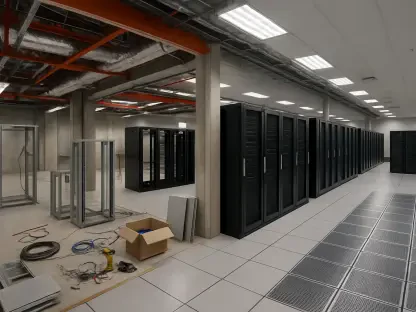
Moving to the HGX B300 platform is like stepping into a new era of data center density, where the hum of traditional fans is replaced by the silent, efficient flow of liquid cooling systems. These systems are necessary because the thermal demands of eight Blackwell GPUs packed into a single node are intense, and maintaining peak performance requires keeping those chips within a very tight temperature window. The operational challenge lies in the infrastructure complexity, but the payoff is that we can now leverage Nvidia Quantum-X800 InfiniBand networking to link these clusters with ultra-low latency. Because the NVLink technology allows for seamless memory sharing and high-bandwidth communication within the node, we can handle distributed AI training and model serving with far more grace. This density means a company can achieve the same reasoning power with a fraction of the physical footprint, turning what used to be a sprawling data center floor into a highly concentrated powerhouse of parallel compute.
Enterprise AI is moving toward agentic systems that use environment-free reinforcement learning to improve directly from production data. What are the practical steps for integrating real-world usage patterns into a model, and how does this approach shorten the development cycle compared to traditional simulation-only environments?
The transition to agentic systems is about breaking the model out of the “clean room” of simulation and letting it learn from the messy, unpredictable reality of real-user interactions. Practically, this involves setting up software workflows that capture performance traces and real-world usage patterns, allowing the AI to refine its decision-making based on actual successes and failures in production. By bypassing the need for a perfectly modeled simulation environment, developers can close the loop between deployment and improvement almost instantaneously. It is incredibly satisfying to watch a model evolve and increase its accuracy as it encounters data that no programmer could have anticipated in a synthetic test. This approach significantly shortens the development cycle because you are no longer spending months building and tweaking simulations that only approximate the real world; instead, you are letting the production environment itself serve as the ultimate teacher.
Robotics teams are increasingly combining multimodal monitoring with simulation results to refine physical AI systems. How does comparing video data with training outputs in a single workspace accelerate iteration, and what are the benefits of using mobile monitoring tools for early issue detection in these workloads?
In the world of physical AI and robotics, there is often a frustrating gap between what the math says should happen and what the robot actually does on the floor. By integrating video data, simulation results, and training outputs into a single workspace, we give engineers a “god’s eye view” that allows them to spot discrepancies the moment they occur. This multimodal approach means that if a robotic arm fumbles a maneuver, the team can immediately overlay the visual failure with the internal neural network state to see exactly where the logic diverged from reality. We have also seen a huge shift in agility with the introduction of mobile monitoring applications, which allow engineers to track training runs and detect anomalies from their phones while away from their desks. There is a certain peace of mind that comes with receiving a real-time alert on your mobile device, knowing you can catch a failing run early and save thousands of dollars in wasted compute time.
What is your forecast for AI infrastructure?
I believe we are entering a phase where the primary bottleneck will no longer be the supply of GPUs, but rather the sheer complexity of operating these autonomous, continuously learning systems in a production environment. We will see a massive “rotation to inference” as the industry realizes that the real value of AI is not in the one-time training of a model, but in the billions of small decisions it makes every day for users. Infrastructure will become increasingly specialized, moving away from general-purpose clusters toward high-memory, liquid-cooled environments specifically tuned for agentic AI and embodied robotics. As these systems mature, the line between software development and real-time model improvement will blur, creating a world where AI systems aren’t just deployed—they are lived with and evolved in real-time. The future belongs to those who can master the art of high-volume inference while maintaining the flexibility to let their models learn from the world around them.