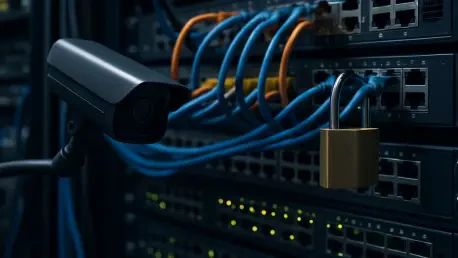

The digital walls that once defined the safety of an organization are no longer just being scaled; they are being systematically dismantled through the very hardware designed to protect them. As we navigate the complex landscape of 2026, the traditional distinction between software vulnerabilities and hardware-level exploits has effectively vanished, leaving IT administrators in a perpetual race against time. The scale of modern network management has reached a tipping point where a single security advisory can now dictate the operational capacity of a global enterprise for weeks.
The Escalating Landscape of Infrastructure Vulnerabilities
Statistical Surge in Critical Exploits and Patching Volume
Modern data security has entered a period of unprecedented volatility, evidenced by the sheer volume of critical updates required to maintain basic perimeter integrity. A defining moment in this shift occurred with the March 2026 Cisco release, which forced administrators to contend with 48 distinct CVEs packaged across 25 separate advisories. This is no longer an occasional maintenance task but a massive logistical undertaking. The density of these releases suggests that the internal complexity of networking code has finally outpaced the ability of traditional manual auditing to keep up, leading to these “bulk” disclosure events.
The most concerning metric in recent industry reports is the rise of the “Perfect 10” CVSS score. In current cycles, we are seeing a higher frequency of flaws that allow for unauthenticated root access to core networking hardware. These are not minor bugs requiring local access or complex social engineering; they are wide-open backdoors that grant total control to anyone who can reach the management interface. For IT departments, the statistical reality is a relentless cycle of managing semiannual “zero-day events” that demand immediate, high-stakes intervention to prevent total systemic collapse.
Real-World Applications and High-Stakes Breach Scenarios
In production environments, these vulnerabilities manifest as direct threats to the Secure Firewall Management Center (FMC) and Adaptive Security Appliances (ASA). When a flaw like CVE-2026-20079 is disclosed, the technical mechanics of the Authentication Bypass mean that the digital locks on the front door are essentially bypassed by a specially crafted HTTP request. An attacker does not need to guess a password or steal a token; they simply speak the right “language” to the interface and are granted the keys to the kingdom.
Moreover, the danger of Insecure Deserialization, such as seen in CVE-2026-20131, turns legitimate data processing into a weapon. By sending malicious serialized Java objects, threat actors can execute arbitrary code with root privileges. We have seen this play out in historical precedents, such as the 2025 exploits of VPN web services, where state-sponsored actors leveraged similar infrastructure flaws to persist inside corporate networks for months. These actors do not target the users; they target the machines that manage the users, ensuring their presence remains undetected even if individual accounts are secured.
Industry Perspectives on Perimeter Defense Weaknesses
Security researchers are increasingly vocal about the fundamental shift from software-layer attacks to deep infrastructure-level compromise. The consensus is that the perimeter is no longer a solid line but a series of interconnected, and often fragile, management interfaces. Experts argue that the “zero-day” phenomenon has become a tool for overwhelming administrative capacity. When dozens of critical flaws are disclosed at once, the sheer weight of the patching requirement creates a window of opportunity for attackers to strike while teams are still triaging the most severe threats.
There is a growing professional alarm regarding the exposure of centralized management interfaces to the public internet. While the convenience of remote administration is undeniable, the current threat environment makes such exposure a liability that few organizations can afford. Security professionals now advocate for a “management darknet” approach, where the tools used to configure firewalls and VPNs are entirely invisible to the outside world. This shift reflects a loss of faith in the inherent security of the hardware itself, moving the burden of protection onto architectural isolation rather than vendor code.
The Future of Network Resilience and Intelligent Security
Looking toward the remainder of 2026 and beyond, the industry is pivoting toward AI-ready infrastructure as the primary solution for patching fatigue. The goal is to develop networks where automated policy enforcement can detect and mitigate exploit attempts before a human administrator even reads the security advisory. As we enter the “no-workaround” era—where software updates are the only viable defense against root-level takeover—the speed of automated response becomes the only metric that truly matters in a defensive strategy.
This evolution is triggering a move toward more modular and self-healing network architectures. Instead of massive, monolithic firmware updates that risk breaking connectivity, future systems are expected to use containerized services that can be patched individually without taking down the entire firewall. This modularity is a direct response to the global arms race between infrastructure providers and sophisticated threat actors, where the ability to adapt in minutes rather than days determines the survival of the enterprise perimeter.
Strategic Recommendations and Concluding Thoughts
The massive security event of early 2026 served as a definitive benchmark for the risks inherent in modern enterprise architecture. It demonstrated that relying on a single vendor’s ability to remain flaw-free is a precarious strategy. Moving forward, the prioritization of management interface security must be the cornerstone of any resilience plan. Utilizing diagnostic tools like the Cisco Software Checker is no longer an optional best practice but a fundamental requirement for maintaining a known secure state across the hardware fleet.
Organizations transitioned their focus toward a proactive, zero-trust hardware configuration where every internal component is treated with the same suspicion as an external one. By adopting a posture of organizational agility, firms successfully mitigated the risks of centralized management flaws. The shift from reactive patching to an architectural model that assumes eventual compromise allowed the most resilient enterprises to maintain their integrity even when the underlying infrastructure was technically vulnerable. This evolution marked a significant turning point in the philosophy of network defense.