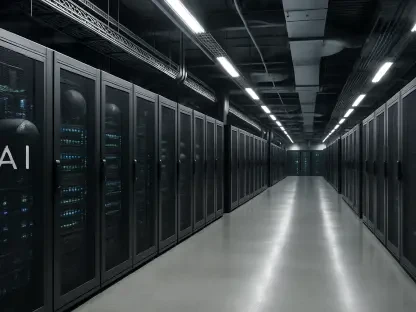

The modern enterprise no longer views artificial intelligence as a speculative luxury but as a core engine of survival that demands a radical reimagining of the digital perimeter. As organizations transition from experimental pilots to full-scale production environments, the infrastructure supporting these Large Language Models (LLMs) must perform a difficult balancing act: delivering astronomical computational power while maintaining a hardened defense against increasingly sophisticated cyber threats. The “Secure AI Factory,” a strategic collaboration between Cisco and Nvidia, has materialized as the industry response to this dilemma, embedding security directly into the hardware and software fabric to ensure that innovation does not come at the cost of data integrity.
Bridging the Gap: Scalable Performance and Enterprise Security
The rapid integration of AI into the global market has highlighted a significant friction point between the speed of innovation and the necessity of risk management. Traditional data center models, which often prioritized general-purpose workloads, proved insufficient for the massive datasets and low-latency requirements of generative AI. This gap forced a shift toward a more holistic architecture where performance and security are treated as a single, inseparable unit. By addressing these concerns through a unified framework, the alliance allows enterprises to scale their AI ambitions without exposing sensitive intellectual property to the vulnerabilities inherent in fragmented legacy systems.
The Foundation: A Strategic Partnership in the AI Era
To appreciate the current state of this alliance, one must consider the historical fragmentation that once characterized data center management. In previous technological cycles, networking, compute, and security functions operated in distinct silos, managed by separate teams using incompatible tools. This disconnection created bottlenecks and visibility gaps that became untenable as AI workloads began to demand unprecedented throughput between GPU clusters. The realization that traditional Ethernet architectures could not keep pace with the needs of accelerated computing necessitated a new blueprint for the modern era.
This collaboration emerged from the necessity of creating an “AI-ready” environment that leverages Cisco’s historical dominance in networking and Nvidia’s leadership in accelerated computing. Instead of forcing organizations to reinvent their entire operational models, the partnership focused on providing a streamlined path to deployment. This historical shift from disparate components to a unified “factory” approach has redefined how businesses perceive the relationship between the physical network and the intelligent applications it supports, setting a new standard for infrastructure resilience.
Synergizing Networking Power and Architectural Flexibility
High-Capacity Silicon: The Power of Choice
A fundamental pillar of the Secure AI Factory is the deployment of high-performance networking hardware designed to manage the data-intensive nature of distributed training. The Cisco N9100 switch, integrated with Nvidia’s Spectrum-6 silicon, delivers a massive 102.4Tbps of throughput, which is vital for moving vast amounts of information between GPUs with minimal delay. This hardware is not merely a speed upgrade; it represents a flexible platform where customers can choose between architectures compliant with Nvidia Cloud Partners or Cisco’s own Silicon One Nexus environments. This “open” approach ensures that enterprises are not locked into a single vendor path, allowing them to optimize their investments based on specific scale and budget requirements.
Streamlining Operations: Nexus Hyperfabric
Complexity is often the greatest enemy of security, and the alliance tackles this through the Nexus Hyperfabric management system. By consolidating the management of GPUs, switches, and storage into a single, familiar framework, the alliance allows traditional IT teams to oversee AI hardware using the same workflows applied to standard data center fabrics. This operational consolidation is a strategic move to lower the barrier to entry for businesses that may lack specialized AI infrastructure experts. When management is simplified and centralized, the likelihood of configuration errors—a primary source of security breaches—is significantly reduced, leading to a more stable and predictable environment.
Securing the AI Lifecycle: Server-Level Defense
Security within this infrastructure is treated as a core architectural feature rather than an external layer. A key innovation involves the integration of Cisco’s Hybrid Mesh Firewall technology directly into Nvidia BlueField data processing units (DPUs). By moving security enforcement to the DPU within the GPU server, the alliance enables a true zero-trust architecture where every data packet is scrutinized before it moves. This allows for granular microsegmentation, ensuring that if one segment of the network is compromised, the threat is isolated at the server level. Additionally, the inclusion of guardrails within the AI models themselves helps prevent hallucinations and policy violations, protecting the organization’s reputation.
Emerging Trends: Distributed AI and Edge Computing
As the industry moves toward more localized data processing, the alliance is expanding its reach toward the edge of the network. The support for Nvidia’s Blackwell architecture within the Cisco Unified Computing System (UCS) indicates a trend where high-performance AI is no longer confined to massive, centralized data centers. We are witnessing the rise of sovereign clouds and localized AI factories that allow sensitive data to remain within specific geographic or regulatory boundaries. Experts suggest that the future of the market will be defined by “inference at the edge,” where real-time decisions are made in hospitals, factories, and retail spaces. This distributed model requires the same level of automated security and scalable hardware found in the core, a need that the Cisco-Nvidia alliance is currently positioned to fulfill.
Strategic Takeaways: Implementing Secure AI
For organizations aiming to capitalize on these advancements, the primary focus should be on establishing a unified operating model that spans from the core to the edge. To successfully implement a Secure AI Factory, businesses should prioritize three essential strategies:
- Integrate Management Early: Use tools like Nexus Hyperfabric to eliminate “shadow AI” projects and maintain total visibility across all clusters.
- Adopt Zero-Trust at the Hardware Level: Utilize DPU-based security to protect sensitive training datasets from the moment the infrastructure is activated.
- Plan for Scalable Inference: Select hardware, such as Blackwell-supported servers, that can handle today’s workloads while remaining compatible with more demanding future models. By following these best practices, professionals can ensure that their infrastructure is not only capable of running advanced AI but is also resilient enough to withstand the evolving threat landscape.
Establishing a Resilient Foundation for Intelligence
The Cisco and Nvidia alliance represented a fundamental shift in the way enterprise AI was constructed and defended. By merging high-performance silicon with deep-seated security and simplified management, the Secure AI Factory addressed the most significant hurdles to adoption: complexity and risk. This collaboration provided the scalable, secure foundation necessary for enterprises to transition from the experimental phase into a period of full-scale digital intelligence. The resulting infrastructure enabled businesses to deploy powerful models while maintaining rigorous control over their data environments. Ultimately, the partnership proved that the path to innovation was most effective when built upon a bedrock of integrated trust and architectural excellence.