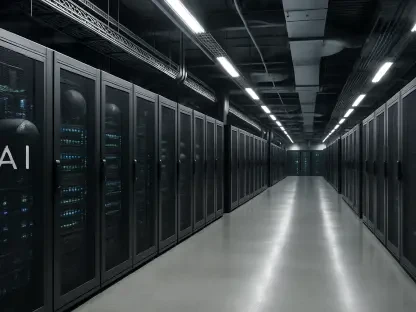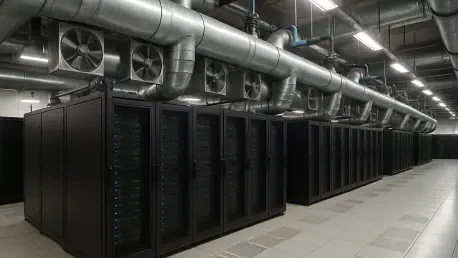

Walking through a modern data hall today feels less like visiting a library of servers and more like standing in the center of a high-stakes industrial thermodynamic experiment. The explosive growth of Artificial Intelligence has sparked a common narrative: the transition to high-density computing makes liquid cooling an immediate, non-negotiable requirement. However, this simplified view ignores the complex operational reality that most modern data centers face. Managing heat in the age of AI isn’t about choosing one “winning” technology; it’s about choreographing a delicate dance between legacy infrastructure and cutting-edge hardware. In today’s facilities, the true challenge lies in the “hybrid hall”—a space where traditional air-cooled racks must coexist seamlessly with high-performance, liquid-cooled clusters without compromising uptime.
The Silicon Heat Wave: Beyond the Liquid Cooling Hype
The narrative of an all-liquid future often overlooks the massive installed base of air-cooled infrastructure that continues to serve critical business functions. For the majority of operators, the immediate goal is not a wholesale migration but rather the integration of high-density AI clusters into existing environments. This requirement forces a shift in perspective from viewing cooling as a facility-wide utility to seeing it as a targeted, rack-level service. The transition is fueled by necessity, yet it is tempered by the economic reality of amortizing existing assets that were never designed for the thermal intensity of modern GPUs.
Maintaining a cohesive operational strategy requires recognizing that different workloads have vastly different thermal footprints. While generative AI models demand extreme density, standard enterprise applications and database management often remain perfectly viable within traditional air-cooled parameters. Consequently, the most successful data center managers are those who treat their floor space as a mosaic of cooling zones. By doing so, they avoid the “over-cooling” of low-density racks while ensuring that high-performance zones receive the precision cooling they require to prevent thermal throttling.
Why Thermal Management is Hitting a Breaking Point
The urgency surrounding cooling strategies stems from a fundamental shift in the physics of computing. As modern GPUs reach unprecedented Thermal Design Power (TDP) levels, operators are encountering three distinct “physical walls.” The airflow wall occurs when it becomes physically impossible to move enough air through a chassis to keep components safe. The fan power wall follows, where the energy required to spin server fans begins to cannibalize the facility’s power budget. Finally, the space wall forces operators to condense the power of ten racks into two to minimize latency and fiber-optic costs.
These pressures, combined with a 70% industry reliance on traditional perimeter cooling, have created a transitional period where mixed-density management is the only viable path forward. This convergence of physical constraints means that the facility itself must evolve to become as dynamic as the software it hosts. When the energy required to move air starts to rival the energy used for the actual computation, the economic and environmental costs become unsustainable. This tipping point is precisely why the hybrid hall has moved from a theoretical concept to a daily operational challenge for data center engineers.
Analyzing the Hierarchy of Cooling Architectures
Air cooling remains the cornerstone of data center operations for rack densities between 10kW and 15kW. Its dominance is fueled by a mature supply chain, a workforce trained in its maintenance, and its predictable behavior during power failures. For legacy retrofits where structural constraints like concrete slabs prevent the installation of piping, air cooling remains the most logical and reliable choice for standard compute workloads. It provides a safety net of familiarity that liquid systems have yet to match in widespread deployment, ensuring that standard operations continue without the risk of fluid leaks.
For facilities experiencing “thermal creep”—where loads are rising but have not yet reached the threshold for immersion—chilled-water infrastructure serves as a vital bridge. Rear-Door Heat Exchangers (RDHx) neutralize heat at the back of the rack before it enters the room. This allows for higher thermal headroom while keeping internal server components dry and accessible, offering a path to increased density without a radical architectural overhaul. It acts as a transitional technology that mitigates the risk of direct fluid contact while substantially increasing heat rejection capacity.
Direct-to-chip (DTC) and immersion cooling should be viewed as precision tools reserved for hardware that exceeds the limits of air. These systems are necessary when the silicon itself demands liquid to function. While highly efficient, they introduce a different “blast radius” for failures; while a fan failure affects a single server, a manifold or Coolant Distribution Unit (CDU) malfunction can take down an entire high-density cluster. This necessitates a more rigorous approach to redundancy that mirrors the complexity of the workloads being processed, ensuring that high-value AI clusters remain operational.
Navigating the Operational Tax of the Hybrid Hall
The shift toward liquid cooling is often hindered by what experts call a “fear of water,” which is actually a calculated concern regarding five-nines availability. Unlike the standardized C13 power cord, liquid cooling components like quick-disconnects lack universal standards, complicating multi-vendor environments. Implementing liquid cooling requires a fundamental shift in risk management, necessitating robust leak detection, secondary containment, and rigorous fluid chemistry maintenance. Operators must balance these new risks against the benefits of densification, recognizing that the “operational tax” of a hybrid hall includes managing two distinct maintenance rhythms simultaneously.
The integration of fluids into the compute environment also changes the fundamental nature of facility maintenance. Instead of just monitoring air pressure and temperature, technicians must now become proficient in managing fluid pressures, filtration, and the long-term integrity of wetted joints. This added layer of complexity requires a sophisticated approach to building management systems that can correlate data from diverse cooling mediums. Without a unified view of the hall, a failure in one system could lead to a cascading thermal event that affects both air and liquid-cooled hardware, undermining the stability of the entire facility.
Strategies for a Successful Infrastructure Transition
To mitigate the risks associated with a lack of industry-wide standards, operators focused on internal standardization. Using consistent manifolds, CDUs, and quick-disconnect fittings across the facility simplified spare parts inventory and reduced the likelihood of technician error during high-pressure maintenance windows. Aligning cooling methods with specific workload density avoided a one-size-fits-all approach by categorizing hardware into density zones. Reserving air cooling for standard racks, using RDHx for mid-tier density growth, and deploying liquid-to-chip solutions only for the most demanding AI clusters ensured that infrastructure investment matched the actual thermal requirements of the hardware.
Prioritizing the human element through workforce upskilling proved to be the most critical factor in a successful transition. Staff members were trained in wetted joints, glycol concentrations, and fluid pressure drops, moving beyond the traditional reliance on psychrometric charts. Furthermore, the implementation of integrated monitoring for divergent systems allowed for better predictive maintenance. By deploying a unified management layer that tracked both traditional units and modern liquid distribution systems, facilities achieved a level of visibility that protected against cascading thermal failures. This holistic strategy transformed the cooling infrastructure from a rigid constraint into a scalable, high-performance asset.