
The long-standing wall between the rigid stability of the mainframe and the flexible efficiency of mobile-born silicon has finally crumbled as IBM integrates Arm architecture into its enterprise ecosystem. This shift represents a fundamental pivot in how high-stakes computing is handled, moving away from monolithic silos toward a fluid, hybrid environment. For decades, the mainframe was an island of proprietary excellence, but the modern demand for performance-per-watt and rapid software deployment has forced a reconciliation with the Arm ecosystem. This integration is not merely a hardware update; it is a survival strategy that marries the “systems of record” reliability of IBM Z with the ubiquitous, cloud-native versatility of Arm-based computing.
Evolution of the IBM and Arm Strategic Partnership
This technological convergence emerged from a necessity to modernize the backbone of global finance and governance without discarding decades of hardened security protocols. Traditionally, enterprises had to choose between the specialized power of the IBM Z series and the cost-effective, scalable nature of Arm-based cloud instances. The partnership bridges this gap by allowing Arm-based workloads to run directly within the IBM hardware footprint. This creates a unified environment where the core ledger—the absolute truth of a bank’s data—stays protected on the mainframe, while the agile, customer-facing applications written for Arm chips run right alongside it.
The relevance of this move in the current landscape cannot be overstated, as it addresses the growing friction between legacy infrastructure and modern developer talent. By supporting the Arm software ecosystem, IBM is effectively inviting a new generation of cloud-native developers into the mainframe fold. This integration simplifies the pipeline, allowing teams to use the same tools and languages they use in the public cloud while benefiting from the physical security and data residency of on-premises hardware. It is a strategic move to prevent “mainframe flight” by transforming the platform into a high-performance internal cloud.
Core Technical Components and Performance Pillars
Virtualization and Cross-Architecture Compatibility
At the heart of this integration lies a sophisticated virtualization layer designed to mask the underlying differences between the CISC-based IBM Z architecture and the RISC-based Arm instruction set. IBM has refined its PR/SM partitioning and LinuxONE capabilities to ensure that Arm-native containers can execute with minimal latency. This isn’t just emulation, which typically hampers performance; it is a deep-level integration that allows the mainframe to manage Arm resources as first-class citizens. The pursuit of high-performance compatibility means that data-intensive applications can leverage the mainframe’s massive I/O bandwidth while utilizing Arm’s efficient processing logic.
Specialized Hardware: Telum II and Spyre Accelerator
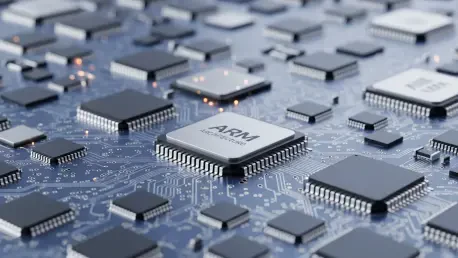
The hardware supporting this transition is nothing short of formidable, led by the Telum II processor and its companion, the Spyre Accelerator. The Telum II, clocked at a staggering 5.5GHz, provides the raw computational muscle and massive on-chip caches necessary to handle the overhead of a heterogeneous environment. However, the real breakthrough is the Spyre Accelerator, which is purpose-built for “ensemble AI.” By running multiple AI models simultaneously across its 32 compute cores, the system can provide real-time fraud detection and risk assessment at a scale that traditional x86 or even standard Arm chips struggle to match. This hardware duo ensures that the transition to Arm-based workloads doesn’t result in a performance bottleneck.
Current Trends in Heterogeneous Computing
The shift toward heterogeneous computing is driven by an industry-wide obsession with efficiency. Major hyperscalers have already moved toward custom Arm silicon to slash power consumption and heat output in massive data centers. IBM is now bringing that same “performance-per-watt” philosophy to the private data center. As enterprises face stricter carbon footprint regulations and rising energy costs, the ability to run more compute cycles on less power becomes a competitive advantage. This trend reflects a broader move away from general-purpose chips toward specialized, architecture-specific silicon that can be tuned for particular enterprise tasks.
Real-World Applications in Regulated Industries
In the banking and insurance sectors, the integration solves the “mainframe adjacency” problem. Previously, if a bank wanted to run a modern Arm-optimized app, it had to move data out of the mainframe, across a network, and into a separate server rack, creating latency and security risks. Now, those apps can live in the same physical box as the database. This proximity is vital for low-latency transaction processing and ensuring that sensitive data never leaves the encrypted memory of the mainframe. Government agencies also benefit, as they can maintain strict data sovereignty while still utilizing the latest Arm-based digital services.
Critical Challenges and Market Obstacles
Despite the technical prowess, significant hurdles remain, particularly the dual-architecture virtualization overhead. While IBM has optimized the stack, there is always a “tax” paid when running software not native to the silicon. Furthermore, the development timelines for these integrations are long, often spanning several years before a feature reaches general availability. Bridging the talent gap also remains a social challenge; even with Arm compatibility, the culture of mainframe management is vastly different from the fast-break world of cloud-native development. Overcoming these silos requires more than just new hardware; it requires a shift in enterprise operations.
Future Outlook and Technological Trajectory
Looking forward, the trajectory of this integration points toward an “internal cloud” model that is virtually indistinguishable from public cloud experiences but remains entirely under the user’s control. We are likely to see breakthroughs where Arm-based nodes within the IBM ecosystem handle the bulk of microservices, while the Telum-driven cores focus exclusively on high-value AI reasoning and core database transactions. The long-term viability of the mainframe is no longer in question as it evolves into a multi-architecture hub. Furthermore, while Arm handles the application logic, the continued expansion into GPU-centric AI training ensures that IBM’s ecosystem remains the definitive home for mission-critical enterprise AI.
Summary of the Strategic Integration
The integration of Arm architecture into the IBM ecosystem was a necessary evolution that redefined the boundaries of enterprise computing. By merging the reliability of the mainframe with the efficiency of Arm, IBM successfully created a path for organizations to modernize their infrastructure without the inherent risks of a full cloud migration. The technology proved that the future of the data center is not a monoculture but a heterogeneous mix of specialized tools. This shift not only de-risked the modernization process for global financial systems but also ensured that the most critical data on the planet could finally benefit from the pace of modern software innovation. In the end, the success of this integration laid the groundwork for a more resilient, power-efficient, and developer-friendly era of mission-critical computing.