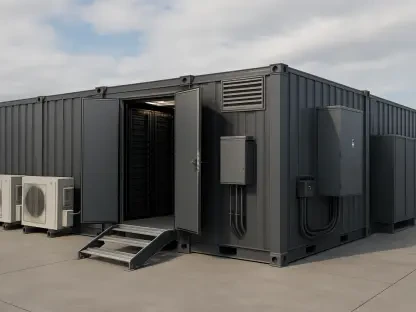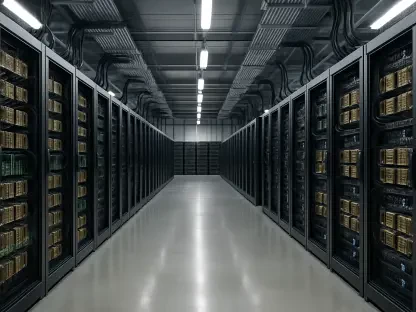

The silent hum of air conditioners that once defined data center floors is rapidly being replaced by the sophisticated gurgle of liquid cooling systems, a change driven not by choice but by the raw computational demands of artificial intelligence. This technological pivot marks one of the most significant transformations in digital infrastructure, moving thermal management from an operational consideration to a strategic linchpin for performance. The question is no longer if liquid cooling will become mainstream, but how quickly the industry can adapt to its inevitability.
The Evolving Landscape of Data Center Thermal Management
For decades, the data center industry relied almost exclusively on air-based cooling solutions. This established paradigm, championed by digital infrastructure giants like Vertiv, proved sufficient for managing the thermal loads of traditional servers. However, the landscape is undergoing a seismic shift, accelerated by the insatiable processing needs of artificial intelligence and High-Performance Computing (HPC).
This transition was powerfully underscored by Vertiv’s recent $1 billion acquisition of PurgeRite, a specialist in fluid management services. This move is not merely a corporate expansion but a clear market indicator that the industry’s thermal management strategy is being fundamentally rewritten. As AI workloads push hardware to unprecedented thermal outputs, the limitations of air cooling are becoming starkly apparent, forcing a pivot toward more potent solutions.
The Unstoppable Momentum Market Drivers and Projections
From Niche Efficiency to Mainstream Necessity
The primary driver for liquid cooling adoption has evolved dramatically. Historically viewed as a niche solution for achieving marginal gains in energy efficiency, it is now a critical necessity for enabling performance. The latest generation of GPUs and accelerated servers, the workhorses of AI, generate heat at a density that conventional air cooling systems simply cannot dissipate effectively. Pushing air faster or colder yields diminishing returns and hits a wall of physical limitation.
Consequently, liquid cooling has emerged as a strategic lever in the AI era. It allows data center operators to deploy high-density racks of powerful processors without the risk of thermal throttling or system failure. Managing these intense computing environments is no longer an afterthought but a core component of AI infrastructure design, making liquid cooling an indispensable technology for any organization serious about competing in the AI-driven economy.
Sizing the Surge A Multi-Billion Dollar Market in the Making
Market data confirms this technological shift with compelling financial figures. The liquid cooling sector is experiencing explosive growth, transforming from a peripheral market into a multi-billion dollar industry. This surge is directly tied to the exponential increase in AI hardware deployments across the globe.
Analysts project that the market will continue its rapid ascent, potentially exceeding $15 billion by 2028. This forecast is supported by a consistently high annual growth rate that shows no signs of slowing. Such sustained momentum underscores that the move toward liquid cooling is not a fleeting trend but a permanent and escalating industry-wide transition.
Implementation Hurdles The Challenges of a Liquid-Cooled Future
Despite its clear advantages, the transition from air to liquid cooling is fraught with complexity. Introducing fluids into an environment traditionally designed to be dry presents significant logistical and technological hurdles. Retrofitting existing data centers requires specialized planning and engineering to accommodate intricate piping, pumps, and heat exchangers without disrupting ongoing operations.
This is where the industry faces a critical skills gap. Expertise in fluid dynamics, plumbing, and chemical management is not a traditional data center competency. Strategic acquisitions, like Vertiv’s integration of PurgeRite, are a direct response to this challenge. By bringing specialized service capabilities in-house, companies aim to offer end-to-end solutions, simplifying the transition for customers and overcoming the barrier of specialized knowledge.
The Regulatory Environment Pushing for Greener Cooler Operations
Simultaneously, the regulatory landscape is applying its own pressure on data center design. A global push toward sustainability has resulted in stricter standards for energy consumption and environmental impact. Regulators and customers alike are demanding greater operational efficiency, making metrics like Power Usage Effectiveness (PUE) more important than ever.
Liquid cooling provides a clear path to meeting these heightened expectations. Because liquids transfer heat far more efficiently than air, these systems consume significantly less energy to achieve the same or better cooling results. This inherent efficiency not only lowers operational costs but also helps data centers comply with increasingly stringent environmental regulations, positioning the technology as a solution for both performance and sustainability.
The Next Frontier What’s Ahead for High-Density Cooling
Looking ahead, the evolution of thermal management will continue to mirror the rapid innovation in AI. The industry is already moving beyond general liquid cooling toward more advanced, targeted solutions. Direct-to-chip and full immersion cooling, which bring coolant into direct contact with heat-generating components, are poised to become the standard for next-generation AI infrastructure, offering unparalleled thermal performance.
This technological advancement is also reshaping the competitive landscape. The market is witnessing a wave of strategic consolidation and vertical integration as cooling providers race to build comprehensive service portfolios. Companies that can offer a complete suite of hardware, software, and specialized services will be best positioned to capture the immense opportunities in this new era of high-density cooling.
The Verdict A Liquid-Cooled Reality in the Age of AI
The analysis within this report confirmed that artificial intelligence was the primary catalyst forcing the industry’s monumental switch to liquid cooling. The sheer thermal density of modern AI hardware rendered traditional air-based methods insufficient, transforming what was once a niche technology into a mainstream necessity. The evidence showed that performance, not just efficiency, became the undeniable driver.
Furthermore, strategic moves within the market, epitomized by Vertiv’s acquisition of PurgeRite, signaled a permanent and irreversible pivot. This was not a tentative step but a definitive declaration that the future of high-performance data centers is liquid-cooled. The consolidation of specialized skills and technologies under major infrastructure providers underscored the industry’s commitment to this new paradigm.
Ultimately, the findings concluded that embracing liquid cooling was no longer an optional upgrade but a critical strategic requirement. For organizations looking to remain competitive, reliable, and scalable in the AI-driven economy, adopting advanced thermal management solutions became a foundational element for future growth and success.