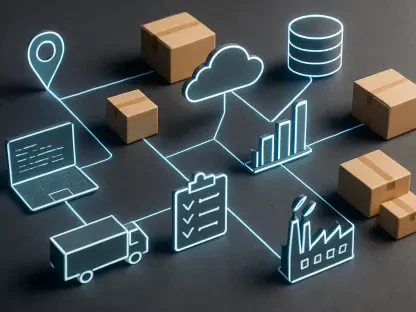

The relentless expansion of artificial intelligence from experimental labs into the core of daily business operations is generating a torrent of data traffic that legacy network infrastructures were never engineered to withstand. As enterprises embed AI into customer-facing applications, internal systems, and productivity tools, they are discovering that the very networks undergirding their digital ambitions are becoming a critical point of vulnerability. This surge in AI-driven activity is not a temporary spike but a fundamental shift in how data is generated, processed, and transmitted across the globe. Consequently, the responsibility to fortify this digital backbone falls on both the enterprises driving the demand and the global service providers managing the infrastructure. Without a coordinated and proactive strategy, the risk of widespread service degradation and outages grows with every new AI model deployed.
The New Reality AI’s Unprecedented Demand on Network Infrastructure
The adoption of artificial intelligence in the workplace has accelerated at a breathtaking pace. Since 2024, the percentage of employees reporting regular AI use has nearly doubled, signaling a profound integration of these tools into standard business processes. This is not simply about more users; it is about a fundamental change in the nature of network demand. According to Nik Kale, a principal engineer at Cisco, the rise of concurrent inference requests from AI-powered applications is causing dramatic increases in both traffic volume and volatility. Architectures like retrieval-augmented generation, which pull data from external sources to inform large language models, create significant network load as information moves between regions, cloud storage, and vector indexes.
This new traffic pattern is fundamentally different from the human-paced interactions that networks were originally designed to support. AI operates at machine speed, generating traffic that is not only immense in volume but also highly unpredictable. Ed Barrow, CEO of Cloud Capital, notes that AI shifts internet traffic from human-paced to machine-paced, with machines generating up to 100 times more requests without any concept of “off-hours.” A single AI feature can trigger millions of additional high-bandwidth requests per hour, placing continuous, high-intensity strain on globally distributed systems. This creates fast and unpredictable bursts of network activity that can easily overwhelm infrastructure that was never built for such relentless demand.
This reality necessitates a shared commitment to building a more resilient digital ecosystem. Enterprises can no longer view the network as a simple utility; they must actively participate in managing and optimizing their AI-driven traffic. Simultaneously, global service providers, from cloud giants to core internet backbone operators, must re-evaluate their capacity planning and network architecture. The challenge is not merely about adding more bandwidth but about developing more intelligent, dynamic, and responsive systems capable of handling the unique demands of machine-to-machine communication at a global scale.
The High Stakes of Network Instability
For modern enterprises, network performance is directly tied to the bottom line. When AI pipelines slow down or shared infrastructure becomes overloaded, the impact is immediate and severe. Business processes grind to a halt, customer experiences degrade, and revenue streams are disrupted. Many organizations now rely on real-time AI for mission-critical functions such as fraud detection, operational forecasting, and security threat response. In these contexts, even minor latency or intermittent outages can have significant financial and reputational consequences. A single bottleneck can cascade through an organization, diminishing the value of the entire digital ecosystem.
The risks extend far beyond individual companies, touching the stability of the entire digital economy. Because virtually every enterprise relies on a complex web of shared networks—including cloud providers, content delivery networks, and domain name systems—a failure in one layer can trigger a domino effect. As Ed Barrow explains, this creates systemic load risk where a buckle in a shared infrastructure layer cascades everywhere. This transforms cloud infrastructure from a technical cost center into a strategic liability that can impact gross margins, business continuity, and even company valuation if not managed proactively.
This situation has exposed a significant “readiness gap” between the ambition to leverage AI and the current state of network preparedness. A Broadcom study of networking professionals revealed that while 99% of organizations have adopted cloud and AI strategies, less than half believe their networks can support the necessary bandwidth and low-latency requirements. This gap highlights a critical vulnerability: many organizations are investing heavily in AI development without making the corresponding investments in the network infrastructure required to run those systems reliably at scale. Closing this gap is not just a technical challenge but a strategic imperative for any organization looking to compete in an AI-driven world.
A Blueprint for Resilience Preparing for the AI Traffic Surge
Enterprise-Level Strategies for Network Fortification
Enterprises must begin by treating AI workloads as a distinct and demanding application category. The first step is to gain a deep understanding of how these workloads generate traffic and identify potential bottlenecks within the infrastructure. This analysis forms the foundation of any effective resilience strategy. Best practices include implementing intelligent rate limiting and sophisticated traffic shaping to manage unpredictable surges without impacting other critical systems. Furthermore, separating AI workloads from other business applications can prevent a traffic spike in one area from causing a system-wide failure, thereby protecting core operational integrity.
Building redundancy and rapid failover capabilities into the IT architecture is another crucial defense against network instability. Shaila Rana, co-founder of the ACT Research Institute, advises against relying on a single cloud provider or data center. Instead, organizations should distribute services across multiple regions and providers to create a resilient, diversified technology stack. When one provider experiences a slowdown due to AI traffic, systems can automatically route requests to healthy alternatives. This multi-cloud, multi-region approach is vital because AI-driven disruptions often cascade. It is not enough to simply have a failover plan; these systems must be tested regularly to ensure they function seamlessly when a crisis occurs.
Finally, leveraging AI to manage AI traffic is becoming an essential strategy. Investing in real-time monitoring and predictive analytics tools allows organizations to gain visibility into their traffic patterns and anticipate problems before they escalate. These systems learn normal network behavior and can issue immediate alerts when anomalies are detected, giving IT teams precious time to respond before a minor issue becomes a catastrophic failure. This monitoring should also extend to third-party service providers. Knowing immediately when a cloud partner is under strain enables an organization to activate its backup plans and maintain service continuity for its customers and employees.
Global Infrastructure Provider Imperatives
The core internet backbone, the superhighway of global data, requires massive upgrades to accommodate the new reality of AI-driven traffic. According to Shaila Rana, this involves more than just adding bandwidth; it requires a fundamental re-architecting of how data is managed. Infrastructure must be sized for constant, massive, and unpredictable machine-generated traffic, not the predictable peaks and valleys of human usage. This calls for smarter routing systems that can dynamically respond to surges in real-time, moving beyond static rules to intelligently redirect traffic and prevent congestion before it cripples the network. Enhanced DDoS mitigation, increasingly powered by AI itself, is also critical to protect against malicious and accidental traffic floods.
Cloud operators and other service providers must also completely rethink their models for capacity planning and resource distribution. The old approach of forecasting gradual growth is no longer viable in an era where a single new AI feature can trigger an exponential increase in demand. As Ed Barrow notes, providers need to deploy GPU capacity closer to the edge, implement AI-aware routing, and build far more route diversity to handle continuous, high-intensity loads. Maintaining significantly more reserve capacity than traditional models suggest is essential. Dynamic scaling systems that can provision resources in seconds, not hours, are necessary to respond to the sudden and massive traffic surges characteristic of AI workloads. Those operators who can deliver reliable, low-latency performance during these events will become the preferred partners for enterprises.
Conclusion From Vulnerability to Strategic Advantage
The analysis showed that while the explosive growth of artificial intelligence placed unprecedented strain on global networks, a system-wide breaking point was averted through a combination of proactive enterprise strategies and critical infrastructure upgrades. The recognition that AI traffic operates on a completely different scale and rhythm than human-generated data forced a necessary evolution in network architecture and management. Organizations and providers who adapted early were the ones who thrived.
The most successful tech leaders were those who reframed network resilience not as an IT cost center, but as a foundational strategic imperative. They understood that in the AI era, business continuity, customer satisfaction, and revenue growth depended directly on the network’s ability to perform under extreme and unpredictable stress. They invested in multi-cloud redundancy, predictive analytics, and intelligent traffic management, treating their network as a competitive asset rather than a utility.
Ultimately, the challenge presented by AI traffic became a catalyst for innovation. The organizations that successfully fortified their networks did more than just prevent outages; they built a durable competitive advantage. By ensuring the consistent and reliable performance of their AI-driven services, they were able to deliver superior value to their customers and solidify their leadership in a landscape where digital resilience became synonymous with market success.