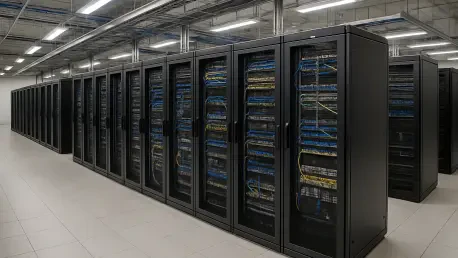

The relentless global engine of digital transformation, once fueled by unchecked expansion, now confronts a labyrinth of rules that both accelerate and obstruct its path forward. For an industry accustomed to moving at the speed of innovation, this new reality presents a fundamental challenge where the finish line is constantly being redrawn by regulators, local communities, and shifting economic tides. The era of simply building bigger and faster is over, replaced by a complex, high-stakes game of strategic compliance.
The Digital Gold Rush Meets a Wall of Regulation
The data center industry has moved beyond the era of landmark, monolithic legislation like the GDPR. Today, operators face a continuous stream of incremental yet impactful compliance changes that span cybersecurity, environmental reporting, AI governance, and supply chain integrity. This constant evolution demands a posture of perpetual adaptation rather than occasional, large-scale adjustments. The rules of the game are no longer set by single, sweeping directives but by an accumulating weight of granular requirements from a multitude of authorities.
This regulatory friction creates the central conflict defining the industry: an explosive, AI-driven demand for more capacity is colliding head-on with a dense and growing thicket of operational and environmental mandates. While the appetite for data processing has never been greater, the freedom to build and operate is increasingly constrained. This tension is forcing a strategic reevaluation across the sector, shifting focus from pure expansion to the more nuanced challenge of sustainable and compliant growth.
Consequently, a significant disconnect is emerging between high-level policy goals and ground-level reality. Federal initiatives designed to accelerate the development of critical infrastructure are often rendered ineffective by a patchwork of local ordinances, community opposition, and fierce competition for essential resources like power and water. The result is a paradoxical environment where a green light from national authorities means little without navigating a series of red lights at the municipal level.
Navigating the Contradictions of Modern Data Center Compliance
The Double-Edged Sword of AI: Driving Growth While Demanding Unprecedented Transparency
The regulatory landscape is tightening on multiple fronts simultaneously. Stricter cybersecurity frameworks, such as the EU’s Digital Operational Resilience Act (DORA) and the expanded NIS 2 Directive, are now converging with emergent AI governance laws like the EU AI Act. This convergence means data center operators must satisfy distinct but overlapping requirements for security, resilience, and transparency. Compliance is no longer a siloed function but an integrated challenge that touches every aspect of operations, from incident reporting protocols to the ethical oversight of hosted algorithms.
This new legal reality is forcing a profound operational shift. The era of satisfying regulators with high-level security policies and corporate statements is ending. In its place is a new mandate for granular, auditable proof of compliance. Operators must now be able to demonstrate workload isolation, document the efficacy of specific security controls, and provide clear maps of data flows through their infrastructure. This move from policy to proof requires significant investment in automation, monitoring, and reporting tools capable of translating complex operations into a clear, defensible compliance record.
This added complexity has sparked a debate within the industry over the true bottleneck to AI-driven growth. While the new web of regulations undeniably adds friction and cost, many analyses suggest that physical constraints remain the more immediate barrier. Limited access to power, extended lead times for critical equipment from OEMs, and a persistent shortage of skilled labor are often the primary factors delaying the deployment of new AI infrastructure, with regulatory hurdles acting as a significant but secondary constraint.
The Green Imperative: How Sustainability Mandates Are Reshaping Siting and Operations
Globally, governments are sharpening their focus on the environmental footprint of data centers, a trend accelerated by the immense energy and water consumption of modern AI facilities. The European Union is leading this charge with its revised Energy Efficiency Directive (EED), which mandates public reporting of key metrics like Power Usage Effectiveness (PUE) and Water Usage Effectiveness (WUE). This proactive approach moves beyond voluntary disclosures, compelling operators to adopt and prove concrete efficiency measures. In contrast, the United States maintains a more passive federal stance, leaving the regulatory initiative to other jurisdictions.
This federal inaction in the U.S. has empowered state and local authorities to become the de facto environmental regulators for the data center industry. States are actively creating their own frameworks, as seen with Oregon’s POWER Act, which establishes special electricity rates to incentivize grid-friendly energy consumption. In Minnesota, a landmark ruling by the Public Utilities Commission denied a request to exempt hundreds of diesel backup generators from review, signaling that even ancillary systems are now subject to stringent local environmental scrutiny.
This patchwork of localized rules introduces a significant new risk: the potential for stranded assets. A data center designed and built to meet today’s environmental standards may fall short of stricter local mandates enacted just a few years later. This uncertainty complicates long-term financial planning and elevates the importance of future-proofing designs. The risk is that facilities could become operationally unviable or prohibitively expensive to retrofit, impacting their long-term value and the return on massive capital investments.
Federal Green Lights vs. Local Red Tape: The Battleground for New Construction
A core paradox now defines data center construction. At the federal level, momentum is building to accelerate development. A 2025 executive order, reinforced by updated EPA guidance, was specifically designed to streamline the permitting process for critical infrastructure projects. In theory, this top-down support should shorten timelines and provide greater certainty for developers aiming to meet the urgent demand for new capacity.
However, this federal push is frequently neutralized by intractable local barriers. The success or failure of a new data center project is increasingly determined by municipal zoning codes, protracted negotiations over community benefit agreements, and organized local activism. Fierce competition for limited power and water resources has become a primary chokepoint, with grid interconnection queues and water rights negotiations stalling projects for years. These ground-level realities form a wall of red tape that federal streamlining efforts struggle to penetrate.
This dynamic challenges the long-held assumption that strong federal backing can overcome local resistance. It is becoming clear that a sophisticated, hyper-local engagement strategy is no longer optional but essential for successful development. Operators must move beyond transactional relationships with municipalities and invest in genuine, early-stage community dialogue to address concerns about noise, job creation, and environmental impact before they escalate into project-killing opposition.
The Unstable Economics of Expansion: Streamlined Procurement in a High-Stakes Market
Simultaneously, the economic landscape is being reshaped by competing forces of simplification and complexity. In the public sector, initiatives like FedRAMP 20x are streamlining the process for U.S. federal agencies to adopt third-party cloud and data services. While this simplifies procurement for government clients, it intensifies market competition among providers, who must now more rigorously demonstrate superior security, value, and performance to win and retain contracts in a more fluid marketplace.
These competitive pressures are amplified by significant financial headwinds. Escalating U.S. tariffs on critical components like semiconductors are driving up both construction and operational costs, introducing volatility into project budgets. Furthermore, the tax environment is becoming less predictable as initial incentive programs, such as those within the Inflation Reduction Act (IRA), begin to expire. This creates an urgent need for robust tax governance and audit readiness to navigate the shifting fiscal landscape.
In response, states are adopting divergent strategies to either attract or manage data center growth. While some jurisdictions are reconsidering or placing moratoriums on tax incentives, others are doubling down. Alaska, for example, is actively marketing its favorable tax posture and reliable energy grid to lure new AI-era developments. This fragmentation requires operators to build sophisticated financial and incentive modeling directly into the earliest stages of their site selection process to mitigate risk and secure long-term economic viability.
A Blueprint for Resilient Growth in a Regulated World
The key takeaways from this shifting landscape are clear: the new pillars of success in the data center industry are provable compliance, hyper-local engagement, and a proactive financial strategy. Operators can no longer thrive by focusing on construction speed and operational efficiency alone. They must now build core competencies in navigating regulatory frameworks, fostering community acceptance, and managing complex financial variables. This represents a fundamental evolution in the business model, where non-technical skills have become as critical as engineering excellence.
To translate this understanding into action, organizations must adopt a new suite of strategies. This includes investing in compliance automation tools that can generate the auditable proof required by modern regulations. It also means fully integrating community and government relations into the site selection process from day one, not as an afterthought. Furthermore, building flexible tax governance models that can adapt to changing incentives and tariffs is essential for protecting long-term profitability in an increasingly volatile economic environment.
Ultimately, industry leaders face the challenge of balancing two competing imperatives: the urgent, market-driven need for rapid expansion and the long-term necessity of building sustainable, secure, and compliant operations. Success is no longer about choosing one over the other. It is about developing an integrated strategy that allows for aggressive growth while simultaneously embedding the resilience needed to thrive in a world of ever-present rules and regulations.
The New Competitive Edge Is Compliance, Not Just Construction
In this new era, the ability to expertly navigate a fragmented and demanding regulatory landscape has become a primary differentiator for data center operators. While speed to market and technological superiority remain important, they are no longer sufficient for securing a competitive advantage. The capacity to anticipate, interpret, and integrate compliance requirements into core business processes is now what separates market leaders from the rest of the pack.
This paradoxical environment—where growth is simultaneously enabled by technological demand and constrained by new rules—is the new normal. The friction generated by this dynamic is not a temporary trend but a permanent feature of the mature data center industry. Attempting to bypass or ignore this reality is a strategy destined for failure. The focus must shift from resisting regulation to mastering it.
Future industry leaders will be those who make a critical mental shift: they will treat regulatory mastery not as an unavoidable cost center but as a core strategic advantage. By building deep expertise in compliance, community engagement, and financial governance, these organizations will unlock opportunities, mitigate risks, and build a foundation for resilient growth that their less-prepared competitors simply cannot match.