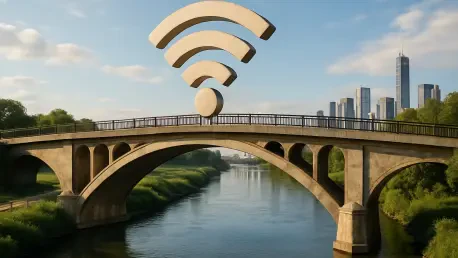

The nightly closures of the Samoa Bridge along State Route 255 represent much more than a temporary inconvenience for commuters traveling between Eureka and the Samoa Peninsula. These strategic operations are the visible components of a massive subterranean effort to install high-capacity fiber optic conduits that will finally link this isolated stretch of the Humboldt County coastline to the modern digital economy. For decades, the peninsula has remained a technological island, tethered to the mainland by aging copper wires and inconsistent satellite signals that frequently falter under the heavy coastal fog and salt-laden winds. This current construction phase, led by Vero Fiber with substantial financial backing from the California Department of Technology, is designed to systematically dismantle the digital divide. By prioritizing the installation of middle mile infrastructure, the state is facilitating an open-access network that private providers can eventually leverage to reach homes.
Technological Foundation: Building Resilience Underground
Open Access Infrastructure: The Middle Mile Framework
The architectural core of this initiative relies on the deployment of an open-access middle mile network, a strategy that separates infrastructure ownership from service delivery. By creating a high-speed backbone that multiple private internet service providers can utilize, the project fosters a competitive marketplace in a region that was previously considered too expensive for single-company investment. This $6.3 million investment ensures that the primary transmission lines are state-supported, effectively lowering the barrier to entry for local ISPs to provide the last mile connections to approximately 500 residences and business sites. This model is particularly effective in rural California, where the cost of laying fiber across rugged terrain often prevents traditional telecom giants from expanding their footprints. As technicians pull fiber through the newly laid conduits across the bridge this month, the region moves closer to a sustainable and permanent broadband ecosystem.
Hardened Connectivity: Moving Beyond Vulnerable Systems
Transitioning from aerial lines to underground fiber optics provides a level of environmental resilience that was previously unattainable for the communities of Samoa and Fairhaven. Current residents often struggle with connectivity issues caused by the harsh coastal atmosphere, where salt spray and high winds lead to the rapid degradation of traditional copper infrastructure and frequent power-related outages. Unlike satellite or cellular uplinks, which can be disrupted by the dense marine layer and geographical obstructions, underground fiber provides a consistent, low-latency signal that remains unaffected by weather conditions. This modernization is essential for the long-term viability of the peninsula, as it transforms broadband from a luxury into a reliable utility. Local leadership has emphasized that this shift is not merely about faster internet speeds for entertainment but about creating a stable foundation for a community that has historically been left behind by technological progress.
Economic and Regional Integration: Strengthening the Coastline
Essential Services: Supporting Critical Infrastructure
Broadband expansion serves as a critical backbone for municipal operations, particularly regarding the management of water and wastewater systems within the Peninsula Community Services District. Reliable data transmission is required for the real-time monitoring of sensitive environmental equipment, yet current communications often suffer from significant delays that could jeopardize public safety during emergencies. By integrating these essential services into the new fiber network, local officials ensure that monitoring systems remain operational even during severe weather events or regional power fluctuations. Furthermore, the presence of high-speed connectivity is expected to revitalize the local economy by supporting remote work opportunities and enabling small businesses to compete in the digital marketplace. The ability to access telehealth services and online educational resources at Cal Poly Humboldt further illustrates how this infrastructure functions as a catalyst for social and economic equity in the region.
Regional Synergy: Connecting the Coastal Network
The successful completion of the bridge conduit installation functioned as a pivotal milestone in a larger regional strategy to create a redundant fiber ring around Arcata Bay. By connecting the Samoa Peninsula to existing fiber lines along Old Arcata Road and the U.S. 101 corridor, planners established a resilient network that prevents single points of failure from isolating individual communities. This project demonstrated that targeted state funding could successfully bridge gaps where private enterprise had previously failed, as seen in the dissolution of earlier startup attempts in the area. Looking forward, local municipalities were encouraged to streamline the permitting process for last-mile providers to ensure that home installations began as scheduled by the fall. Strategic investments in local technical training programs were identified as the logical next step to maintain this new infrastructure. These combined efforts ensured that the digital divide was replaced by a robust network capable of supporting the evolving needs of rural California.