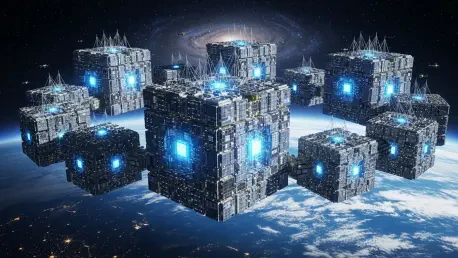

The sheer magnitude of modern artificial intelligence workloads is currently pushing the physical limits of our planet’s power grids and environmental resources to a breaking point. As developers scramble to secure enough electricity to power massive GPU clusters, the terrestrial landscape has become a battlefield of high energy prices, water scarcity for cooling, and mounting regulatory scrutiny. This bottleneck has forced the technology industry to look beyond the atmosphere, catalyzing a high-stakes migration toward low Earth orbit. By transitioning high-density AI compute from the ground to the stars, pioneers in this field are attempting to bypass the years of construction delays and community opposition that define modern infrastructure projects. This movement is not merely a scientific curiosity but a pragmatic response to the urgent need for scalable, autonomous compute capacity that can operate independently of a failing terrestrial grid. As we navigate this transition, the vacuum of space is quickly becoming the ultimate site for the next generation of digital architecture.
Technological Pillars of Orbital Computing
The architectural foundation of space-based data centers relies on the seamless integration of high-performance hardware, such as Nvidia GPUs, into specialized satellite frames designed for the rigors of orbit. Unlike terrestrial facilities that fight against atmospheric interference and the day-night cycle, orbital platforms can position their solar arrays to capture unfiltered sunlight with near-total consistency. This allows for power generation that is roughly five times more efficient per square meter of paneling than what is achievable on the ground. Such a robust energy supply is critical for the continuous operation of AI chips, which consume vast amounts of electricity to process complex neural networks. By moving the power generation source directly adjacent to the compute hardware without the intervention of a fragile electrical grid, these systems achieve a level of energy autonomy that is simply impossible for traditional data centers located in urban or industrial zones.
Thermal management represents another radical shift in engineering, as the vacuum of space offers a unique environment for dissipating the immense heat generated by AI processors. On Earth, data centers are forced to consume billions of gallons of water or utilize massive air-conditioning units to prevent hardware from melting, creating a significant environmental footprint. Orbital data centers, however, leverage radiative cooling to vent excess thermal energy directly into the cold void of space. This process eliminates the need for complex fluid-based cooling systems and the associated mechanical failures that often plague ground-based facilities. While this requires advanced radiator designs to manage heat flow, it simplifies the long-term infrastructure needs of the satellite. This cooling strategy is particularly effective for AI inference workloads, which can be decentralized across a constellation of nodes, allowing each individual unit to manage its thermal load more effectively than a concentrated terrestrial server farm.
The Competitive Landscape and Market Leaders
The race to establish a dominant presence in the orbital compute market is currently led by major aerospace titans and ambitious startups, with SpaceX emerging as the primary pacesetter. Recent filings with the Federal Communications Commission indicate that the company intends to deploy a staggering constellation of up to one million solar-powered satellites specifically optimized for AI workloads. This initiative leverages the existing Starlink infrastructure and the heavy-lift capabilities of the Starship launch system to achieve an economy of scale that no other competitor can currently match. By integrating AI processing directly into its satellite network, SpaceX is positioning itself to provide low-latency compute services to any point on the globe, effectively creating a planetary-scale supercomputer. This move has significant geopolitical implications, as it establishes a digital infrastructure that exists entirely outside the traditional jurisdictions and physical constraints of any single nation-state.
While SpaceX pursues mass-market dominance, a diverse ecosystem of specialized players is exploring niche applications that expand the boundaries of what is possible in orbit. Some organizations are currently utilizing the International Space Station as a laboratory for testing cloud architecture and cybersecurity protocols in a microgravity environment. Simultaneously, projects are underway to explore the lunar surface as a potential site for permanent data archives, utilizing the moon’s stable geological features for long-term storage. Other innovators are investigating the use of quantum computers in space, where the naturally occurring extreme cold of shadowed regions provides an ideal environment for maintaining quantum coherence. This diversification suggests that the orbital data market will not be a monolith but rather a tiered system of services ranging from high-speed AI inference in low Earth orbit to secure, long-term data repositories located on the lunar surface.
Economic Viability and Mission Value
The financial justification for moving data centers into space is shifting away from a simple cost-per-watt comparison and toward the strategic importance of speed and access. While the initial capital expenditure of launching hardware into orbit remains significantly higher than building a warehouse on Earth, the time-to-market advantage is becoming a decisive factor. In the current economic climate, terrestrial data center projects are frequently delayed for five to seven years due to power grid interconnection queues and environmental impact studies. In contrast, an orbital facility can be deployed as quickly as a launch window becomes available, allowing companies to begin generating revenue and processing data in a fraction of the time. This “speed-to-orbit” represents a fundamentally different scaling curve, where the primary constraints are no longer terrestrial bureaucracy but rather the frequency of rocket launches and the efficiency of satellite manufacturing.
Furthermore, the value of orbital compute is maximized in scenarios where terrestrial latency or data sovereignty issues create insurmountable barriers. For high-priority missions involving real-time Earth observation, autonomous navigation, or global communications, processing data at the source—thousands of miles above the planet—is far more efficient than transmitting raw signals to the ground and back. This “edge computing in the stars” reduces the burden on global telecommunications networks and provides instantaneous insights for time-sensitive applications. As the digital economy becomes increasingly reliant on real-time AI processing, the demand for localized compute power within the orbital plane is expected to grow. Consequently, the high costs of spaceflight are being offset by the premium that clients are willing to pay for low-latency, high-availability processing that is shielded from the physical and political vulnerabilities of ground-based infrastructure.
Engineering Challenges and Environmental Risks
Navigating the hostile environment of space requires a complete rethinking of hardware longevity and reliability, as the absence of human technicians makes traditional maintenance impossible. High-energy cosmic radiation and solar flares pose a constant threat to the delicate silicon architecture of modern GPUs, potentially causing permanent hardware damage or frequent “bit flips” that corrupt AI calculations. To combat these effects, engineers must employ expensive radiation hardening techniques and redundant system architectures that can autonomously reroute processing tasks when a component fails. This necessity for extreme durability significantly increases the complexity and cost of the hardware compared to off-the-shelf components used in terrestrial server racks. Ensuring that a GPU can survive a five-year mission without a single physical touchpoint is perhaps the most significant technical hurdle currently facing the industry.
Beyond radiation, the logistics of high-speed networking in a vacuum present a formidable challenge for maintaining a seamless connection with Earth-bound users. Orbital data centers must utilize sophisticated optical laser links to transmit massive volumes of data between satellites and ground stations, a technology that is still in the process of being standardized and scaled. Any interruption in these links, whether caused by atmospheric conditions or orbital positioning, can lead to significant data bottlenecks that negate the speed advantages of space-based compute. Furthermore, the rising density of objects in low Earth orbit increases the risk of kinetic collisions, which could result in the catastrophic loss of expensive hardware. To survive long-term, orbital data center operators must not only master the physics of their own platforms but also navigate the increasingly crowded and dangerous landscape of the space environment itself.
Future Considerations and Strategic Implementation
The successful integration of orbital data centers into the global AI ecosystem will require a shift toward modular and autonomous satellite architectures. To maximize the return on investment, developers should prioritize the creation of interchangeable compute modules that can be upgraded or replaced via robotic docking missions, rather than relying on static, single-use satellites. This approach would allow for the continuous modernization of AI hardware, ensuring that the orbital infrastructure does not become obsolete as new generations of GPUs are released. Additionally, companies should focus on developing standardized APIs and middleware that allow terrestrial developers to seamlessly offload specific AI inference tasks to the cloud-in-the-sky without needing specialized knowledge of orbital mechanics. This democratization of access will be essential for creating a vibrant marketplace for space-based compute resources that can compete with existing hyperscale providers.
Looking toward the next phase of development, the industry must establish clear international standards for data management and debris mitigation to ensure the long-term sustainability of the orbital environment. As more data centers are deployed, the potential for electronic interference and orbital congestion will necessitate a collaborative approach to space traffic management. Governments and private entities should work together to create “safe zones” for high-density compute constellations, paired with mandatory end-of-life deorbiting protocols to prevent the accumulation of space junk. By proactively addressing these environmental and regulatory concerns, the technology sector can secure the future of orbital computing as a stable and reliable pillar of the global digital economy. The transition to the stars is no longer an optional experiment but a necessary evolution for an AI-driven world that has outgrown the physical limitations of its home planet.