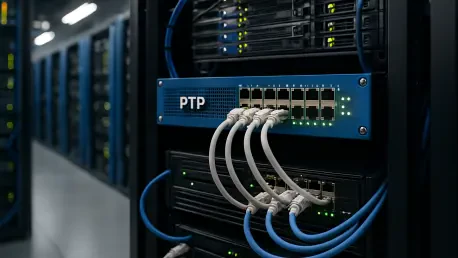

The seemingly simple act of keeping time has evolved into one of the most complex and critical challenges within modern data center architecture, where a single microsecond of error can ripple through interconnected systems with devastating financial and operational consequences. In this high-stakes environment, a decades-old standard is giving way to a new protocol built for the speed and precision demanded by a digital-first world. This transition from the Network Time Protocol (NTP) to the Precision Time Protocol (PTP) is not merely a technical upgrade; it is a fundamental re-engineering of how data centers establish the “now” that underpins every transaction, calculation, and data point.
When Every Microsecond Counts: The New Reality of Data Center Timekeeping
In an economic landscape dominated by high-frequency trading algorithms and split-second autonomous decisions, the business cost of a single millisecond of error has become monumental. A fractional delay can mean the difference between a profitable trade and a significant loss or between a coordinated robotic action and a manufacturing line failure. This escalating need for precision has thrust the often-overlooked discipline of time synchronization into the spotlight, transforming it from a background utility into a core pillar of modern digital infrastructure.
The demand for exact timekeeping stems directly from the nature of contemporary workloads. Applications in finance, telecommunications, industrial automation, and scientific research now operate on timescales far finer than what was required a decade ago. These systems rely on the precise ordering of events across distributed networks to function correctly. Without a universally agreed-upon time, down to the microsecond, the integrity of these operations is fundamentally compromised, making accurate time synchronization an indispensable competitive and operational advantage.
The Synchronization Imperative: Why Data Centers Depend on a Single Source of Truth
Network time synchronization is the foundational process that ensures every server, switch, and storage device within a network operates on an identical, highly accurate clock. In the intricate ecosystem of a data center, where thousands of components constantly communicate, this shared temporal reference is an absolute operational necessity. It provides a single source of truth that allows for the coherent sequencing of events, validation of transactions, and consistent logging for diagnostics and compliance.
Without this synchronized truth, even minor time discrepancies between servers can trigger a cascade of failures. For example, if a database server’s clock is slightly behind that of an application server, it might incorrectly flag a valid transaction as having occurred in the future, leading to its rejection. In distributed systems, these small inconsistencies can snowball, causing data corruption, race conditions where processes execute out of order, and catastrophic system-wide failures. The integrity of today’s highly interdependent data center architectures is therefore directly tied to the precision of its timekeeping.
A Tale of Two Protocols: The Old Guard vs. The New Standard
For decades, the Network Time Protocol (NTP) served as the undisputed standard for keeping computer clocks in sync. Operating on a client-server model, NTP allowed devices to periodically request the time from a central server and adjust their local clocks accordingly. This method provided accuracy within a few milliseconds, which was more than adequate for the general-purpose computing and internet applications of its era. However, as technology evolved, the inherent limitations of this software-based approach became increasingly apparent, especially its inability to break the millisecond barrier consistently. The protocol’s reliance on intermittent check-ins creates windows where a device’s clock can drift out of sync, while variable network latency and the computational overhead of processing time requests in software introduce unpredictable errors that are unacceptable for high-performance workloads.
In sharp contrast, the Precision Time Protocol (PTP) redefines timekeeping by moving the core function from software to dedicated hardware. This represents a fundamental architectural shift. PTP utilizes hardware timestamping, a process where highly accurate timestamps are applied to data packets by the network interface card (NIC) or switch port at the moment they are sent or received. By embedding this function directly into the silicon, PTP bypasses the variable delays associated with software processing and operating system scheduling. This hardware-centric approach drastically reduces timing errors, enabling synchronization accuracy down to the microsecond and even nanosecond level, providing the true real-time data exchange that modern applications demand.
The Market Shift in Action: By the Numbers
The industry’s migration toward PTP is not just a theoretical improvement but a tangible market trend driven by critical business needs. Nowhere is this more evident than in the financial sector, where expert analysis indicates that an estimated 85% of real-time trading workloads now rely on PTP to ensure fair and orderly market operations. The protocol’s microsecond-level accuracy is essential for sequencing trades and meeting stringent regulatory requirements for timestamping financial transactions.
This momentum extends far beyond a single industry. Broader market analysis signals a widespread and sustained adoption of this advanced technology. The global market for PTP solutions is projected to experience a compound annual growth rate (CAGR) of approximately 8.5% through 2031. This steady growth reflects a clear consensus across multiple sectors that the precision offered by PTP is becoming a baseline requirement for building next-generation, high-performance IT infrastructure.
The PTP Implementation Roadmap: A Strategic Investment in Precision
Transitioning from NTP to PTP is not a simple software update but a significant infrastructural investment that requires careful planning. Deploying a PTP-ready data center rests on three essential pillars. The first is acquiring PTP-aware hardware. This involves investing in specialized NICs and network switches equipped with the necessary hardware timestamping capabilities, which represents a notable capital expenditure compared to standard networking gear.
The second pillar is the establishment of a high-precision time source on-premises. To achieve microsecond accuracy, relying on public internet time servers is insufficient due to unpredictable latency. Instead, data centers must deploy their own master time reference, typically a GPS-synchronized grandmaster clock or an atomic clock, to serve as an exceptionally stable and accurate source for the entire network. Finally, the internal network itself must be optimized. PTP’s performance is sensitive to network conditions, so engineers must design a network architecture that minimizes congestion, packet loss, and jitter to ensure the reliable and timely delivery of critical timing packets.
The journey from NTP to PTP represents a deliberate and strategic pivot for data center operators worldwide. The realization that millisecond-level accuracy was no longer sufficient for an expanding class of high-performance workloads drove this evolution. While NTP had provided a reliable foundation for decades, its software-based architecture could not overcome the inherent latencies of modern networks to meet the demands of applications where every microsecond mattered. Consequently, the adoption of PTP, with its hardware-centric design, became a competitive and operational imperative. The associated investments in specialized hardware, on-premises time sources, and network optimization were recognized not as mere expenses but as foundational steps to future-proof infrastructure, enabling the next generation of real-time technologies and solidifying the data center’s role as the engine of the digital economy.