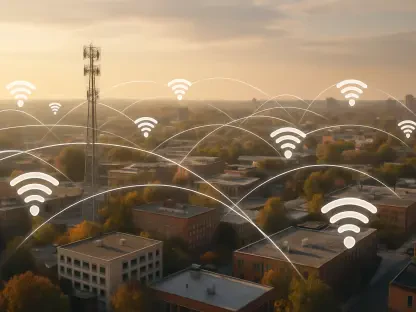

The proliferation of Internet of Things devices has presented a significant challenge for smart cities and utilities, as organizations have been forced to deploy and manage separate, parallel networks to accommodate devices with vastly different power and data requirements. This fragmented approach, where high-performance systems operate independently from low-power sensors, creates immense operational complexity, drives up costs, and hinders long-term scalability. The introduction of the Wi-SUN Alliance’s Field Area Network (FAN) 1.1 Low Energy (LE) Certification program marks a pivotal shift, offering a unified standard that allows these diverse device types to coexist on a single, cohesive mesh network. This development promises to resolve a critical infrastructure bottleneck, paving the way for more integrated, efficient, and future-proof connected ecosystems. By enabling ultra-low-power, battery-operated devices to communicate seamlessly alongside high-throughput applications, this new certification eliminates the need for redundant network infrastructure and simplifies the management of large-scale IoT deployments.
A Unified Network Architecture
Overcoming Network Fragmentation
The central challenge addressed by the FAN 1.1 LE certification is the operational complexity that arises from managing disparate networks for high-performance (HP) and low-energy (LE) devices. Previously, a utility or municipality would need to maintain one network for high-data-rate applications, such as smart electric meters, and a completely separate network for battery-powered sensors used in infrastructure monitoring. This dual-network approach creates significant overhead in terms of deployment, maintenance, and security management. By allowing both HP and LE devices to operate on the same mesh network, the new Wi-SUN standard effectively consolidates this infrastructure. This integration is not merely a matter of convenience; it fundamentally changes the economic and operational calculus for large-scale IoT projects. It removes the need for multiple gateways, backhaul connections, and management platforms, thereby streamlining operations and reducing the total cost of ownership over the network’s lifecycle, which is crucial for public and private sector entities alike.
This unification extends beyond just physical infrastructure to simplify network management, tooling, and overall lifecycle considerations. In a fragmented environment, network administrators must contend with different protocols, security policies, and diagnostic tools for each network, creating silos of information and expertise. The FAN 1.1 LE standard eliminates these protocol handoffs and creates a single, cohesive system where all devices speak a common language. This streamlined approach ensures that data from a low-power environmental sensor can be easily correlated with data from a high-throughput traffic management system without complex and often unreliable middleware. Furthermore, a unified network reduces the potential points of failure and makes it easier to implement network-wide security updates and policies. This consolidation is a critical step toward building robust, future-proof smart infrastructure that can scale to support millions of devices without collapsing under the weight of its own complexity, ensuring long-term viability and performance.
Enabling a New Class of Devices
A key innovation of the FAN 1.1 LE certification is its native support for a new generation of ultra-low-power, battery-operated, and energy-harvesting devices. These endpoints are designed for longevity, with operational lifespans that can extend from 10 to 20 years on a single battery. This capability is transformative for applications where frequent maintenance is impractical, costly, or dangerous, such as sensors embedded in bridges, water pipelines, or remote agricultural fields. Before this standard, deploying such devices often required proprietary, low-power wide-area networks that were isolated from the primary utility or city network. The Wi-SUN standard now brings these long-life devices into the mainstream, allowing them to benefit from the same robust, secure, and interoperable mesh networking technology used by higher-power devices. This extension of the Wi-SUN ecosystem opens the door to a host of new use cases in asset monitoring, environmental sensing, and public safety that were previously not feasible due to power and connectivity constraints.
The seamless integration of LE and HP devices on a single network creates a more dynamic and data-rich environment for smart infrastructure. For example, a utility can now deploy low-power acoustic sensors to detect leaks in its water distribution system, with the data transmitted over the same network fabric that handles its advanced metering infrastructure. This allows for a holistic view of the grid, where real-time consumption data from meters can be correlated with infrastructure health data from sensors. Similarly, a smart city can combine information from battery-powered parking sensors with data from traffic cameras and smart streetlights to create a comprehensive, real-time picture of urban mobility. By extending Wi-SUN’s proven foundation of secure communications and large-scale networking to this new class of low-energy devices, the FAN 1.1 LE standard fosters an environment where diverse data streams can be easily aggregated and analyzed, leading to more intelligent and responsive city and utility services.
Broadening Applications and Ensuring Interoperability
Powering Smart City and Utility Innovations
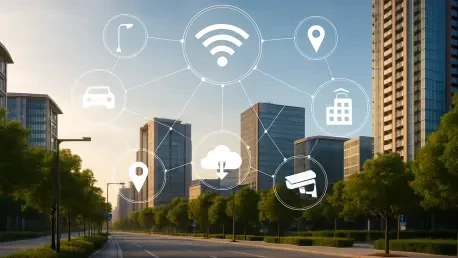
The unified network architecture enabled by the Wi-SUN FAN 1.1 LE certification directly supports a broad range of applications that are foundational to modern smart cities. This single, cohesive system can integrate everything from advanced street lighting and intelligent traffic management to smart parking and automated waste management. For instance, low-power sensors can monitor the fill levels of public waste bins, sending alerts only when collection is needed, while high-performance cameras analyze traffic flow to adjust signal timings in real time. Because both systems operate on the same network, they can share data to create synergistic efficiencies. A traffic jam detected by the traffic management system could trigger an alert to reroute waste collection vehicles, optimizing routes and reducing fuel consumption. This level of cross-system coordination was previously difficult to achieve due to the use of separate, siloed networks for each application. By providing a common communication backbone, the standard fosters a truly interconnected urban environment.
In the utility and industrial sectors, this unified approach is equally transformative, supporting extensive infrastructure monitoring and sensing applications. Utilities can now deploy vast networks of low-power sensors to monitor the health of pipelines, power lines, and substations, detecting potential issues like leaks, corrosion, or equipment stress before they lead to costly failures. These sensors can operate for years without maintenance, providing a continuous stream of valuable data over the same Wi-SUN FAN that manages their smart meter deployments. This integration allows utilities to move from a reactive to a proactive maintenance model, improving reliability and safety while reducing operational costs. In industrial settings, the standard can be used to monitor environmental conditions, track assets across large facilities, and optimize manufacturing processes. The ability to combine low-latency control systems with long-term, low-power sensing on one network provides the flexibility needed to support a wide array of industrial IoT applications.
A Foundation Built on Certified Interoperability
A critical component of the Wi-SUN Alliance’s strategy is its rigorous certification program, which ensures multi-vendor interoperability for all certified products. The FAN 1.1 LE Certification Programme, now officially available, provides device manufacturers and network operators with the confidence that products from different vendors will work together seamlessly in real-world deployments. This is a crucial advantage in the often-fragmented IoT market, where proprietary solutions can lead to vendor lock-in and compatibility issues. By adhering to an open, standards-based approach, Wi-SUN fosters a competitive and innovative ecosystem where customers can choose from a wide range of certified devices without worrying about whether they will integrate with their existing network infrastructure. This interoperability accelerates market adoption, reduces deployment risks, and gives organizations the flexibility to evolve their networks over time without being tied to a single supplier.
Building upon Wi-SUN’s proven foundation of secure, large-scale networking, the FAN 1.1 LE certification extends these trusted capabilities to the new class of devices designed for decades-long, low-energy operation. Security is paramount in critical infrastructure applications, and the Wi-SUN standard incorporates robust, multi-layer security measures, including authentication, encryption, and intrusion detection, to protect data from the device to the back-office systems. The mesh networking topology provides inherent resilience, as data can be automatically rerouted around failed nodes to ensure continuous connectivity. By extending these field-proven features to low-power devices, the standard ensures that even the smallest sensor on the network benefits from the same level of security and reliability as a high-performance smart meter. This comprehensive approach provides a solid and trustworthy foundation for building the next generation of smart city and utility infrastructure.
A New Era of Unified Connectivity
The launch of the Wi-SUN FAN 1.1 LE certification marked a significant step forward in simplifying the complex world of IoT networking. By creating a single, interoperable standard that accommodated both high-performance and low-energy devices, it provided a clear path for cities and utilities to build truly integrated and scalable smart infrastructure. This development effectively dismantled the barriers that had forced organizations to manage multiple, disparate networks, offering a more efficient, cost-effective, and future-proof solution. The certification program fostered a robust ecosystem of compatible products, giving network operators the confidence and flexibility to deploy diverse applications on a unified communication fabric. This strategic move has since accelerated the adoption of large-scale IoT projects, enabling a new wave of innovation in critical infrastructure management.