
From Silicon to Systems How AIs Insatiable Demand Redefined Data Center Hardware in 2025
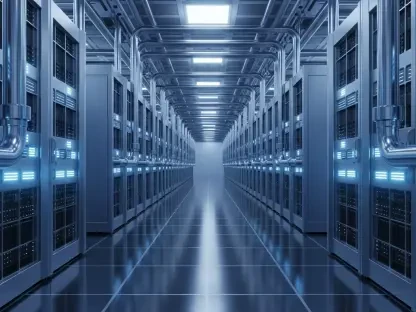
The insatiable computational appetite of artificial intelligence reached a critical tipping point this year, fundamentally reshaping the data center from a standardized utility into a highly specialized, performance-driven engine of innovation. The confluence of forces driving this transformation, led by the explosive growth of AI workloads, made 2025 a foundational year for hardware innovation. No longer a background consideration, the specific choices made in silicon, networking, and cooling have become central determinants of competitive advantage, dictating not only raw performance but also the critical balance of energy efficiency and operational sustainability. The era of the general-purpose data center has given way to an age of specialization, where every component is scrutinized for its role in a much larger, integrated system.
This monumental shift established a new paradigm where the hardware stack itself is the primary strategic battleground. The year’s developments revealed that solving the challenges of next-generation AI is not merely a software problem but a deeply physical one, rooted in the capabilities of the underlying infrastructure. This exploration delves into the defining trends of 2025: the relentless push toward hardware specialization to meet the unique demands of AI, the strategic move by vendors to offer complete full-stack solutions rather than just components, and the emergence of radical new technologies in cooling and networking that have become as crucial as the processors they support.
The Year of Foundational Shifts A Deep Dive into 2025s Hardware Revolution
The AI Accelerator Arms Race Beyond Raw Power to Full Stack Dominance
The market for AI accelerators was dominated by an intense competitive dynamic, with Nvidia moving aggressively to solidify its leadership by framing its offerings not as discrete chips but as components of a complete “AI factory.” The company’s multi-year roadmap, showcased prominently this year, underscores this full-stack strategy. With the late 2025 arrival of the Blackwell Ultra chip delivering significant performance gains, Nvidia immediately set its sights on the 2026 Vera Rubin platform and the subsequent Rubin Ultra for 2027, promising exponential leaps in computational power. However, the true strategy lies in the ecosystem built around this silicon, including integrated DGX SuperPOD systems and sophisticated management software, designed to provide customers with a turnkey solution for deploying massive AI workloads.
In stark contrast to Nvidia’s open-market approach, Google pursued a strategy of proprietary integration with its specialized Tensor Processing Units (TPUs). The latest generation of these custom-designed chips powers Google’s internal AI initiatives and its public cloud platform, optimized for the large-scale matrix calculations inherent in machine learning. By keeping its most powerful TPUs exclusive to its own cloud ecosystem, Google creates a tightly coupled environment where hardware and software are co-designed for maximum efficiency. This walled-garden approach presents a different value proposition, offering performance advantages for specific workloads while tying customers directly to its cloud services, creating a distinct competitive moat against hardware-centric rivals.
This rapid pace of innovation has given rise to a critical secondary market, as enterprises grapple with the high cost and rapid obsolescence of top-tier accelerators. The emergence of a sophisticated GPU aftermarket reflects a strategic need to maximize the return on these significant investments. Organizations are now actively developing strategies for repurposing and monetizing accelerators after their primary deployment cycle ends. These approaches range from reselling hardware on a robust secondary market, where components retain substantial value, to reassigning older GPUs to less demanding inference tasks or even offering them as a service to smaller companies, effectively creating a new tier of cloud computing resources built on previously deployed assets.
The CPU Battleground Reimagined Intels Strategic Pivot and AMDs Market Expansion
Intel responded to intense competitive pressure this year by executing a strategic pivot, most visibly demonstrated by the completion of its two-tiered Xeon 6 processor family. This lineup was deliberately segmented to address distinct market needs, with high-performance P-cores targeting demanding enterprise AI and database workloads, while energy-efficient E-cores were tailored for the density and efficiency required by cloud-native applications. This bifurcation represents a direct acknowledgment that a one-size-fits-all approach is no longer viable in a specialized market, allowing Intel to compete more effectively against rivals who had made significant inroads by focusing on specific workload advantages.
Further signaling a fundamental shift in its strategy, Intel initiated a major leadership overhaul within its data center group. The move to bring in new leadership and establish the group as a standalone entity was widely interpreted as a strategic reset. It reflects a broader industry trend away from selling individual components toward providing integrated, solutions-oriented offerings that combine hardware and software. This restructuring aims to make Intel more agile and better equipped to compete not just in the traditional CPU market against AMD but also in the broader AI infrastructure space dominated by full-stack providers like Nvidia.
While Intel restructured to defend its core markets, AMD expanded its footprint by identifying and capturing an underserved segment of the industry. The launch of the Epyc 4005 series was a calculated move to bring enterprise-grade server capabilities to the small and medium-sized business (SMB) market. By offering a lower-cost, lower-power solution, AMD filled a critical gap for organizations that require on-premises server capabilities but do not have the budget or scale for high-end data center processors. This market expansion demonstrates a keen understanding of a maturing market, where growth opportunities exist not only at the performance frontier but also in making powerful technology more accessible.
Solving the Bottlenecks Radical Innovations in Cooling and Networking Infrastructure
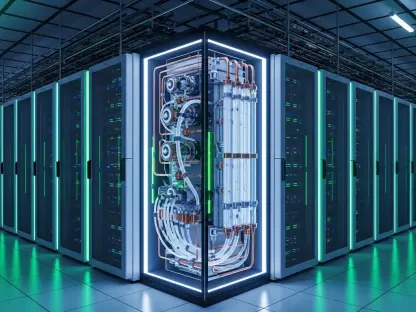
This year, a groundbreaking development from Microsoft challenged the conventional approach to thermal management, highlighting its emergence as a primary enabler of future chip design. The introduction of “microfluidic” on-chip cooling, which embeds liquid-filled channels directly into the silicon, represents a radical departure from traditional air and liquid cooling methods. By bringing coolant into direct contact with the heat source, this technology dramatically improves thermal efficiency, paving the way for denser, more powerful processors that would otherwise be impossible to operate reliably. This innovation confirms that thermal design is no longer an ancillary concern but a core architectural driver for the next generation of high-performance computing.
Simultaneously, the networking landscape evolved to address the massive bandwidth and resiliency requirements of distributed AI workloads. Cisco’s push into the hyperscale AI networking market with its new deep-buffer routing systems illustrates a distinct architectural philosophy. These systems are designed to support sprawling “scale-across” deployments where AI training jobs run across multiple data centers. The deep-buffer approach provides a crucial layer of resilience, absorbing traffic surges during network events to prevent job failures—a key differentiator from low-buffer designs favored by some competitors. This focus on robust, wide-area connectivity for AI clusters underscores how network architecture is becoming a critical factor in overall system performance and reliability.
These advancements collectively challenge the long-held industry focus on processing power as the sole metric of data center capability. The developments of 2025 demonstrated conclusively that performance is a systemic attribute, fundamentally limited by the ability to manage heat and move data efficiently. As a result, thermal management and network architecture have transitioned from supporting roles to become primary drivers of innovation and competitive differentiation. The ability to solve these physical bottlenecks is now as important as the computational speed of the chips themselves, dictating the practical limits of what can be achieved with AI at scale.
A Glimpse of Tomorrow The Dawn of Practical Quantum Advantage in the Data Center
Marking a pivotal moment in the history of computing, Google announced a landmark achievement with its Willow quantum chip, demonstrating “verifiable quantum advantage” for the first time. This breakthrough signifies a crucial transition from theoretical research and limited demonstrations to a real-world application where a quantum system verifiably and repeatedly outperformed the most powerful classical supercomputers on a specific, meaningful problem. By solving a complex physics simulation thousands of times faster than was possible with conventional methods, this achievement provides the first concrete evidence of practical quantum utility, moving the technology beyond the laboratory and toward a future role in enterprise computing.
The implications of this breakthrough for enterprises are profound, signaling that the era of planning for quantum integration has begun. While broad, fault-tolerant quantum computing remains a distant goal, the proven ability of specialized quantum processors to solve certain classes of intractable problems necessitates a strategic response. Organizations in fields like materials science, drug discovery, and complex financial modeling must now consider the unique operational requirements of integrating quantum systems. This includes planning for specialized infrastructure, such as cryogenic cooling and electromagnetic shielding, as well as developing the hybrid classical-quantum workflows that will be necessary to harness this new computational paradigm.
This achievement provides a clear, comparative benchmark against the broader landscape of conventional computing. It reinforces that quantum systems are not intended to replace classical data centers but to augment them, acting as specialized accelerators for a narrow but critical set of problems that are beyond the reach of even the most powerful supercomputers. The verifiable advantage demonstrated by the Willow chip establishes a tangible value proposition, clarifying the role of quantum computing as a tool for solving previously unsolvable challenges, thereby opening up entirely new avenues for scientific and industrial innovation.
Strategic Imperatives for the New Era Navigating the Post 2025 Hardware Landscape
The primary takeaways from this year’s whirlwind of innovation crystallize into a set of clear strategic imperatives. First, the necessity of hardware specialization is now undeniable; general-purpose infrastructure is no longer sufficient for competing at the frontier of AI. Second, the market has irrevocably shifted toward integrated ecosystems, where hardware, software, and networking are delivered as a unified stack. Finally, the link between performance and sustainability has become inseparable, with next-generation cooling and power-efficient designs emerging as critical enablers rather than secondary considerations. These trends collectively demand a new approach to infrastructure strategy.
In response, organizations must evolve their hardware evaluation processes, moving beyond component-level analysis focused on raw specifications. The new imperative is a holistic, full-stack assessment that considers how different elements of the technology stack interact to deliver real-world performance on specific workloads. This requires a deeper understanding of the interplay between processors, networking fabrics, cooling systems, and the software that orchestrates them. Evaluating a solution based on its entire ecosystem, including vendor support and future roadmap, is now essential for making sound, long-term investments.
Looking forward, proactive planning for the infrastructural demands of next-generation technologies is crucial for maintaining a competitive edge. Organizations should begin architecting their data center environments to accommodate the requirements of advanced cooling solutions, high-bandwidth networking fabrics, and, eventually, specialized quantum systems. Early investment in flexible and scalable infrastructure will provide a critical advantage, enabling enterprises to adopt these transformative technologies more quickly and effectively as they mature. Failure to anticipate these foundational shifts risks creating significant technological debt and falling behind in an increasingly hardware-defined future.
The Unmistakable Verdict Hardware as the Bedrock of AIs Future
The events of this year delivered an unmistakable verdict: 2025 solidified hardware as the central pillar defining both the capability and the long-term viability of the modern, AI-driven data center. The narrative shifted decisively from software-centric innovation to a renewed appreciation for the foundational role of silicon and systems engineering. It became clear that progress in artificial intelligence is fundamentally gated by the physical limits of the infrastructure on which it runs, making hardware strategy synonymous with business strategy.
This renewed focus on the physical layer had profound effects, as the trends of specialization and deep integration reshaped vendor relationships and enterprise IT priorities. The move toward full-stack “AI factories” and purpose-built solutions accelerated, forcing a reevaluation of traditional procurement models. Companies were no longer just buying chips; they were investing in entire ecosystems, creating tighter partnerships with vendors who could provide a complete, optimized, and supported platform for their most critical workloads.
Ultimately, the most significant insight from this transformative year was the irrevocable blurring of the line between hardware and software strategy. The two are now so deeply intertwined that they must be addressed with a unified approach. Building the AI-powered infrastructure of tomorrow demands a holistic vision that treats the data center not as a collection of discrete components, but as a single, cohesive computational instrument, where every element is optimized to work in concert toward a common goal.