
We are joined today by Matilda Bailey, a networking specialist at the forefront of the technological race powering artificial intelligence. As enterprises grapple with the immense infrastructural demands of AI, we’ll explore the groundbreaking hardware innovations designed to meet this challenge. Our conversation will touch on the fierce competition in networking silicon, the strategic shift toward unified Ethernet standards for massive GPU clusters, and the critical role of liquid cooling in building sustainable, high-performance data centers. We will also examine the proactive steps being taken to secure these powerful networks against future quantum threats and the overarching goal of creating a cohesive, scalable ecosystem for distributed AI.
The new Silicon One G300 chip is said to rival top competitors with 102.4 Tbps performance. Beyond raw speed, what specific programmability and efficiency features will give it a competitive edge in AI workloads, and can you share a practical example of how this works?
It’s true that hitting the 102.4 Tbps threshold is a major milestone, putting it on par with the top silicon from competitors. But where this chip truly shines isn’t just in that headline number. The real differentiation is how it handles the unique, demanding traffic patterns of AI workloads. Its programmability allows it to be incredibly agile, rerouting network data in mere milliseconds. In a practical sense, this means we can expect AI computing to be sped up by as much as 28%. This isn’t just about moving data faster; it’s about moving it smarter, achieving about 33% better link utilization, which is a massive gain when you’re coordinating thousands of GPUs.
With high-performance Ethernet now closing the performance gap with InfiniBand, what are the key advantages for data centers moving toward a unified Ethernet standard for massive GPU clusters? What are the biggest challenges they might face during this transition?
The primary advantage is a fundamental shift away from proprietary, black-box systems. For years, InfiniBand held a performance edge, but that often locked customers into a single vendor’s ecosystem. Now that high-performance Ethernet has reached parity, it signals a major architectural pivot for the entire industry. Data centers can move toward a unified, more open standard for their massive GPU clusters, which simplifies management, promotes interoperability, and fosters more competition. The biggest challenge, however, is the transition itself. This isn’t just a component swap; it’s a strategic overhaul of the network fabric. Operators will need to re-architect their systems and develop new expertise to manage these sprawling, Ethernet-based AI environments effectively.
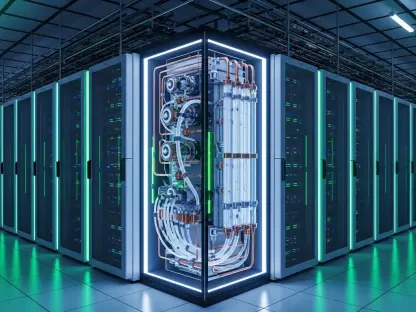
The latest systems can use 100% liquid-cooled designs, promising significant energy efficiency gains. Can you walk us through how this technology helps operators overcome the “power wall” limiting AI data center scale and what operational shifts are required for adoption?
The “power wall” is a very real barrier. As we pack more and more powerful processors into a rack, the heat density becomes astronomical, and traditional air cooling simply can’t keep up without consuming an enormous amount of energy. By moving to a 100% liquid-cooled design, we can see energy efficiency improvements of up to 70%. This is a game-changer. It directly addresses the sustainability issue and allows operators to build denser, more powerful AI clusters without their power costs spiraling out of control. Operationally, this requires a shift in data center design and maintenance protocols. Staff will need to be trained on handling liquid cooling infrastructure, but the long-term gains in performance and efficiency set a new industry benchmark that will be hard to ignore.
New routers and switches are being introduced with full-stack post-quantum cryptography. Why is future-proofing against quantum threats a priority for enterprise networking right now, and what tangible steps does this technology take to secure data against future decryption attacks?
It might seem like a distant threat, but the “harvest now, decrypt later” attack model makes it an immediate concern. Malicious actors are already capturing encrypted data today with the expectation that a future quantum computer will be able to break current encryption standards. For enterprises with sensitive, long-term data, this is an unacceptable risk. Implementing full-stack post-quantum cryptography (PQC) within the network hardware itself is a crucial, proactive step. This means the very foundation of the network, from the routers to the switches running the latest operating systems, is built with cryptographic algorithms believed to be resistant to quantum attacks. It’s about building a foundation of trust that will endure for decades, ensuring that today’s secure communications remain secure tomorrow.
Looking beyond individual high-performance components, a key challenge is integrating disparate AI clusters. What is the strategy for creating a cohesive, scale-across ecosystem, and how will it simplify the management of large-scale, distributed AI infrastructure for your customers?
This is the next frontier. Having the best silicon or the fastest switch is only part of the solution. The real challenge, and the greatest opportunity, is in creating a unified fabric that can connect and manage what are often disparate AI clusters. The strategy is to move from selling high-performance components in isolation to providing an integrated, scale-across ecosystem. This means ensuring that the core silicon, like the G300, is at the heart of multiple systems, from data center switches to provider-edge routers. For customers, this approach simplifies everything. Instead of wrestling with a complex patchwork of different systems, they get a cohesive infrastructure that is easier to deploy, manage, and scale, regardless of whether they are running traditional or disaggregated deployments.
What is your forecast for the AI networking industry over the next five years?
Over the next five years, I foresee three major trends reshaping the industry. First, the move toward a unified Ethernet standard for AI clusters will accelerate, displacing proprietary solutions as performance becomes democratized. Second, sustainability will move from a talking point to a core design principle; the “power wall” will force widespread adoption of advanced technologies like liquid cooling, making energy efficiency a key competitive differentiator. Finally, as AI becomes more central to critical infrastructure, integrated, future-proof security, particularly post-quantum cryptography, will become a non-negotiable, foundational element of any network design. The focus will shift from raw component speed to the creation of intelligent, efficient, and secure ecosystems.