
The relentless expansion of artificial intelligence is fundamentally reshaping the data center, placing unprecedented strain on the networking infrastructure that serves as its central nervous system. As AI models grow in complexity and their applications move from centralized training facilities to widespread enterprise deployment, the network’s role has evolved from a simple data pipeline to a critical arbiter of performance and efficiency. Recognizing this pivotal shift, Cisco has introduced a comprehensive suite of networking technologies engineered specifically for the demands of modern AI and machine learning workloads. This strategic launch includes next-generation silicon, advanced high-capacity switches with innovative cooling options, and a sophisticated management platform, all designed to create a more intelligent, scalable, and efficient fabric for the next wave of AI innovation. The initiative aims to support not only the hyperscale cloud providers that pioneered large-scale AI but also the growing number of enterprises, neoclouds, and sovereign entities building out their own dedicated AI infrastructure.
The Core of the Innovation Silicon and Systems
At the foundation of this new strategy lies the Silicon One G300, a formidable 102.4-terabit-per-second (Tbps) Ethernet switching chip designed to power the backbone of massive “scale-out” AI clusters. While competitors are also pursuing 100-terabit-class silicon, Cisco is emphasizing that its key differentiator is not merely raw bandwidth but the intelligence embedded directly within the hardware. This is delivered through a feature set named Intelligent Collective Networking, which integrates a shared packet buffer, advanced path-based load balancing, and granular telemetry. These capabilities are meticulously engineered to handle the bursty, unpredictable, and often synchronized traffic patterns characteristic of distributed AI training and inference jobs. By intelligently managing data flows to prevent congestion and optimize resource use, the company claims this approach can yield a 33% increase in network utilization and, more critically, a 28% reduction in AI job completion times compared to non-optimized network environments. Furthermore, the G300 is fully programmable, providing customers with a degree of future-proofing by allowing the hardware to be adapted to new networking standards and functionalities after deployment.
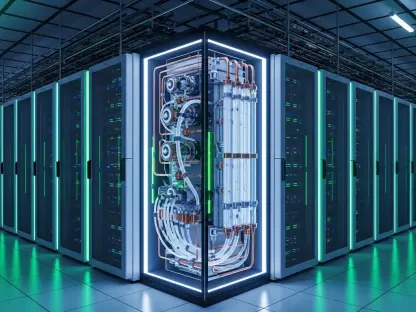
The new G300 chip serves as the engine for the next generation of fixed and modular switching platforms within Cisco’s Nexus 9000 and Cisco 8000 product lines. These systems are designed to deliver the full 102.4Tbps switching capacity demanded by today’s most advanced AI clusters. A significant innovation in this hardware release is the availability of fully liquid-cooled configurations alongside traditional air-cooled models. This strategic move directly addresses the immense thermal challenges posed by densely packed, high-performance GPU servers, which are the computational heart of AI infrastructure. Cisco asserts that the liquid-cooling option not only enables significantly higher bandwidth density but can also improve energy efficiency by nearly 70% over previous generations. This efficiency is so profound that a single liquid-cooled system can deliver the same bandwidth that formerly required six separate systems, drastically reducing physical footprint and operational costs. On the software side, the platforms offer flexibility, with the Nexus switches running the Linux-based NX-OS and the Cisco 8000 series also supporting open-source alternatives like SONiC (Software for Open Networking in the Cloud), catering to diverse customer preferences and operational models.
Expanding the AI Fabric Connectivity and Efficiency
Recognizing that modern AI infrastructure is becoming increasingly geographically dispersed, Cisco is bolstering its “scale-across” solutions with new systems based on its Silicon One P200 chip. This 51.2 Tbps networking processor is specifically tailored for connecting AI data centers over long distances, enabling them to operate as a single, cohesive fabric. This capability is becoming critical as organizations build distributed AI clusters to leverage regional resources, comply with data sovereignty regulations, or enhance resiliency. Research from International Data Corp. (IDC) validates this trend, indicating that enabling scale-across use cases is a top priority for organizations, with a significant majority planning to substantially increase their inter-data center bandwidth. The new P200-powered systems allow multiple AI data centers to be interconnected seamlessly, creating a unified resource pool that optimizes infrastructure utilization and allows for flexible workload distribution across different physical locations without performance degradation.
To support the massive connectivity required within these sprawling AI clusters, Cisco has also introduced new optical modules designed for extreme density and efficiency. This includes 1.6-terabit octal small form factor pluggable (OSFP) modules, which provide the ultra-high-speed links needed between switches and powerful GPU-accelerated servers. In a parallel move to address the critical challenges of power consumption and operational cost, the company unveiled new 800-gigabit linear pluggable optics (LPO). These advanced modules are engineered to reduce the power consumption of the optics themselves by 50% compared to traditional retimed modules. This substantial saving at the component level contributes to an overall switch power reduction of approximately 30%. For organizations running AI infrastructure at scale, where power and cooling constitute a major portion of operational expenditures, such efficiency gains are not just beneficial but essential for sustainable and cost-effective growth.
Unified Management and Market Context
To manage the inherent complexity of these advanced AI networks, Cisco has updated its Nexus One management platform to deliver a unified operating model across environments that may span both on-premises data centers and public clouds. The platform is designed to simplify the deployment and ongoing administration of AI fabrics while simultaneously enhancing security and observability. Key new capabilities include unified fabric management, extensive API-driven automation for streamlined operations, and a feature called AI job observability. This function correlates deep network telemetry data directly with the behavior of specific AI workloads, enabling network administrators and data scientists to rapidly troubleshoot performance bottlenecks. A significant enhancement is the native integration with the Splunk data analytics platform, which allows network teams to analyze vast amounts of telemetry data where it resides, avoiding the high costs and complexity associated with ingesting massive data volumes into a separate, centralized system. This update effectively consolidates the capabilities of the former Nexus Dashboard and Nexus Hyperfabric into a single, comprehensive management solution.
These technological advancements reflect a pivotal, overarching trend in the technology industry: the democratization of AI infrastructure. While the initial wave of large-scale AI was driven by a handful of hyperscale cloud providers, the technology is now being adopted by a much broader range of organizations, including traditional enterprises and sovereign entities building their own national AI capabilities. Analyst commentary from firms like IDC and Dell’Oro Group confirms that as this customer base expands, the need for efficient, scalable, and manageable networking solutions becomes paramount. There is a clear consensus that the next phase of AI networking will be defined less by raw speed and more by intelligent features that optimize performance, reduce operational friction, and control costs. The industry-wide move toward liquid cooling is another key trend, signaling a convergence in the design philosophies of networking and compute hardware to collectively manage the immense power and heat densities of modern AI systems.
A Vision for the Future of AI Networking
In launching this comprehensive portfolio, Cisco strategically positioned itself to compete more aggressively in an AI networking market historically dominated by specialists like Nvidia and Arista Networks. Cisco’s primary competitive advantage lies in its ability to offer a complete, integrated stack—spanning custom silicon, high-performance systems, advanced optics, and sophisticated management software. This end-to-end approach, combined with its deep-rooted presence and established trust within enterprise data centers, provides significant leverage. As enterprise IT teams embark on their AI journeys, many may prefer to evolve their infrastructure with an incumbent, trusted vendor capable of providing a holistic and well-supported solution rather than integrating components from multiple niche suppliers.
The company’s vision extended beyond the immediate demands of current AI workloads. A future was anticipated where the rise of agentic AI—autonomous software agents performing tasks continuously—would fundamentally alter network traffic patterns and challenge existing security paradigms. This evolution was expected to create a “multiplicative effect” on network utilization and necessitate a shift away from centralized security appliances like firewalls. Instead, security models would need to be distributed across the network, with policy enforcement embedded directly into the network fabric itself. The products and technologies announced represented a clear and forward-looking roadmap, designed not only to solve today’s challenges but also to provide the foundational architecture for the more dynamic and intelligent networks of the future.