
The insatiable computational appetite of modern artificial intelligence is quietly creating an existential challenge that is less about silicon performance and more about the raw electrical power required to sustain it. As AI models grow in complexity, the infrastructure supporting them is being pushed to its absolute physical limits, forcing a foundational re-evaluation of how electricity is delivered from the grid to the chip. This review explores the monumental shift from legacy power systems to a new, more efficient paradigm, analyzing its core principles, the technological hurdles to its adoption, and its profound implications for the future of hyperscale computing.
The Imperative for Change
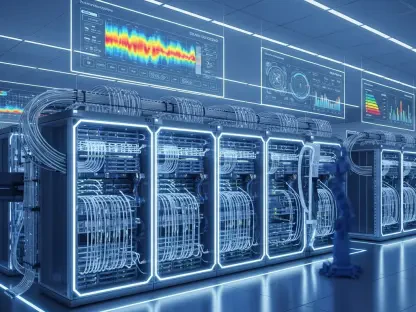
The core driver for this architectural revolution is the exponential growth in power consumption directly attributable to AI workloads. Traditional data centers, which have historically operated in the 10 to 25-megawatt range, are being dwarfed by the new generation of hyperscale “AI factories.” These massive facilities can demand well over 100 megawatts today, with credible projections showing a near-term need for gigawatt-scale operations to support the next wave of generative AI.
This trend is even more pronounced at the rack level. Where a server rack once drew a few kilowatts, the demands of advanced AI accelerators are pushing densities toward one megawatt per rack—an energy footprint equivalent to that of nearly 1,000 average American homes concentrated into a few square feet. This unprecedented density renders legacy power distribution models not just inefficient but fundamentally unsustainable, creating an urgent need for a new approach.
Analyzing Core Architectural Models
At the heart of this industry-wide transformation is a direct comparison between the incumbent alternating current (AC) architecture and an emerging high-voltage direct current (HVDC) model. Understanding the differences in their operational principles and inherent efficiencies reveals why the industry is rapidly moving toward the latter, driven by both economic and physical imperatives.
The Limitations of Traditional AC Power Distribution
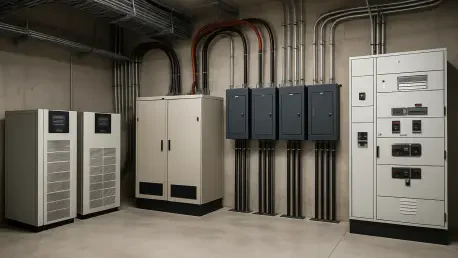
For decades, data centers have relied on an AC power architecture that is a relic of a different technological era. In this model, electricity from the utility grid undergoes a tortuous and wasteful journey. It typically arrives as medium-voltage AC, is stepped down, and then converted to DC to charge the uninterruptible power supply (UPS) batteries. From there, it is converted back to AC for distribution throughout the facility, only to be converted back to low-voltage DC one final time inside the server power supplies.
This convoluted path can involve five or more energy conversion steps. With each conversion, a percentage of energy is lost as waste heat, creating a cascade of inefficiency. As power demands escalate into the hundreds of megawatts, these cumulative losses become a significant operational expense. Furthermore, every watt of energy lost to heat must be actively removed by cooling systems, which themselves consume more power. This vicious cycle has shifted the primary concern of data center operators from optimizing physical space to maximizing energy efficiency.
The Shift Toward High-Voltage DC Architecture
The proposed solution to this systemic inefficiency is a paradigm shift toward distributing high-voltage direct current power. Industry leaders are coalescing around an 800 VDC standard, with discussions already underway for future implementations at 1000 VDC or even 1500 VDC. This approach streamlines the power path, eliminating multiple wasteful AC-DC conversion stages and dramatically improving end-to-end efficiency by a projected 3% to 5%. At the gigawatt scale, this improvement translates into tens of millions of dollars in annual energy savings.
The benefits of HVDC are grounded in fundamental physics. Since power is the product of voltage and current, increasing the voltage significantly reduces the current required to deliver the same amount of power. Lower current allows for the use of much thinner and lighter copper conductors, resulting in massive material savings—an estimated 200 kilograms of copper per megawatt rack. For a gigawatt-scale AI factory, this could reduce copper consumption by as much as half a million tons, offering substantial cost and supply chain advantages.
Emerging Trends and an Industry Consensus
The move toward HVDC is no longer a theoretical debate but an accelerating trend driven by urgent necessity. Across the technology sector, a strong consensus has formed among hyperscale cloud providers, chip manufacturers, and data center operators that this architectural redesign is the only viable path forward. The industry is collectively moving away from incremental upgrades and is now focused on a foundational overhaul of power distribution to meet the demands of AI.
This alignment signals a clear and definitive direction for the entire data center ecosystem. It is an acknowledgment that the problem of powering AI is not one that can be solved with minor tweaks to existing systems. Instead, it requires a coordinated, industry-wide effort to develop and standardize a new generation of power infrastructure built from the ground up for efficiency and scale.
Applications in Next-Generation AI Factories
The most immediate and critical application of HVDC architecture is in the design and operation of the massive data centers being built exclusively for AI and high-performance computing. These next-generation facilities are being designed around the concept of extreme power density, which is a prerequisite for training and deploying the largest and most complex AI models.
HVDC architecture directly enables this vision by providing an efficient and scalable way to deliver megawatts of power to individual racks of servers. By simplifying the power chain and minimizing energy loss, it allows operators to pack more computational power into a smaller physical footprint without overwhelming the facility’s cooling capacity. In essence, HVDC is the foundational electrical technology that makes the modern “AI factory” possible.
Overcoming Key Technological Hurdles
While the vision for an HVDC-powered future is clear, its widespread adoption hinges on overcoming significant technological challenges. This transition is not an incremental upgrade but a disruptive one, requiring the creation of an entirely new ecosystem of high-voltage components, many of which are not yet commercially available at the required scale or cost.
The industry faces a multi-faceted innovation challenge that spans power conversion, circuit protection, and standardization. Successfully navigating these hurdles will require focused research, development, and collaboration across multiple engineering disciplines to build the foundational blocks of this new electrical paradigm.
Developing High-Voltage AC-to-DC Conversion
A critical missing piece in the HVDC puzzle is a new class of power conversion technology. Specifically, the industry needs a commercially viable system that can efficiently convert the 13.8 kV AC power from the utility grid directly to 800+ VDC at the edge of the data center. This would replace several intermediary transformers and converters in the traditional AC power chain.
Developing such a system requires advanced power electronics, including sophisticated semiconductor devices and complex control circuits. While the underlying technology is feasible, engineering these systems to be reliable, cost-effective, and scalable for gigawatt-level facilities represents a major research and development effort that is now a top priority for power equipment manufacturers.
Reinventing DC Circuit Protection
Perhaps the most fundamental technical hurdle is reinventing circuit protection for high-voltage DC environments. In an AC system, the current naturally crosses zero 120 times per second, creating a brief moment where a mechanical circuit breaker can safely interrupt a fault. DC power, in contrast, is a constant flow of energy that never crosses zero, making it far more difficult to interrupt safely.
Attempting to open a high-voltage DC circuit with a traditional breaker can create a dangerous and sustained electrical arc. The solution lies in the development of advanced, purpose-built solid-state circuit breakers. These devices use powerful semiconductor technology to interrupt the flow of current nearly instantaneously without an arc, providing the critical safety mechanism needed to manage and protect HVDC infrastructure.
The Critical Role of Industry Standardization
Beyond the core technology, a significant logistical challenge lies in creating and adopting a new set of industry standards. For an HVDC ecosystem to thrive, there must be widespread agreement on common voltage levels, connector designs, safety protocols, and communication interfaces. This alignment is essential to ensure interoperability between equipment from different vendors.
Without standardization, data center operators would be locked into proprietary, single-vendor solutions, which would stifle innovation, increase costs, and slow down market adoption. Consequently, collaborative efforts through industry consortiums and standards bodies are now underway to establish the common ground rules that will enable a reliable, competitive, and scalable marketplace for HVDC components.
Future Outlook and the Next Era of Computation
Looking ahead, the trajectory of data center power architecture is firmly set on a high-voltage DC course. The coming years will be defined by rapid advancements in the development and commercialization of the key enabling technologies, from solid-state transformers to advanced DC circuit breakers. These breakthroughs are expected to accelerate the transition, making HVDC the de facto standard for all new large-scale AI and high-performance computing deployments.
The long-term impact of this successful transition will be profound. By creating a more energy-efficient and scalable power infrastructure, HVDC will enable the sustainable growth of artificial intelligence, allowing for the development of ever-larger and more powerful models. This, in turn, will reshape the future of data center design, influencing everything from facility layout and cooling strategies to supply chain logistics and global site selection.
A Fundamental Electrical Revolution
This review revealed that the rise of artificial intelligence presented an electrical challenge, not merely a computational one. The extraordinary power requirements of modern AI workloads exposed the inherent inefficiencies of legacy AC power distribution, making it an unsustainable model for the future. The industry’s pivot toward a high-voltage DC architecture was not just a logical progression but an urgent and necessary revolution. While significant engineering hurdles remained in developing a new ecosystem of components and standards, the path forward was defined by a clear industry consensus. The successful navigation of this transition proved to be the critical enabler for the next era of computing.