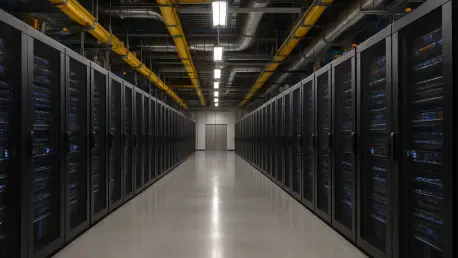

A profound and disruptive tug-of-war is currently unfolding within the humming corridors of the world’s multi-tenant data centers, fundamentally reshaping the industry’s landscape for years to come. This escalating conflict pits the steady, predictable needs of thousands of traditional enterprise clients against the voracious, high-density demands of a handful of hyperscale giants. Operators find themselves caught in the middle, struggling to serve two masters whose technological requirements are diverging at an unprecedented rate. The core of this challenge lies in a radical evolution of computing power, where the standard server rack of yesterday is being eclipsed by the supercomputing pod of tomorrow, creating a battle for space, power, and cooling that threatens to leave many businesses behind.
The Great Divide in Computing Demands
The physical and operational chasm separating the two primary customer segments in the data center market has never been wider. On one side stands the traditional enterprise, the historical backbone of the colocation industry, with its relatively modest and standardized infrastructure. On the other are the hyperscalers, whose relentless pursuit of AI and high-performance computing (HPC) capabilities is driving power and cooling requirements to previously unimaginable levels. This divergence is forcing data center operators to fundamentally rethink every aspect of their design and operations, from the power distribution busways and cooling loops to the very structure of the data hall itself. The era of a one-size-fits-all approach is definitively over, replaced by a complex balancing act with enormous financial and logistical stakes.
The Enterprise Footprint
For decades, the typical enterprise customer has relied on a consistent and well-understood model of data center consumption. Their IT infrastructure is housed in standard-sized racks that are almost universally air-cooled, drawing a manageable 10 to 20 kilowatts (kW) of power per rack. This level of density allows for predictable facility design, straightforward power distribution, and established cooling methodologies that efficiently manage ambient heat. The needs of these clients, while critical to their operations, have scaled in a linear, predictable fashion. This stability formed the bedrock of the multi-tenant data center business model, allowing operators to build facilities with a clear understanding of capacity planning, power provisioning, and return on investment. This entire paradigm, however, is now being challenged by the explosive growth of a new class of tenant with an insatiable appetite for power and a completely different technological profile that traditional air-cooling infrastructure simply cannot support.
The Hyperscale Onslaught
In stark contrast to the enterprise model, hyperscale clients are driving a technological revolution defined by extreme density. Fueled by the demands of artificial intelligence and advanced computing systems like Nvidia’s Vera Rubin platform, these tenants require racks that consume over 200 kW—a tenfold increase over the enterprise standard. Industry projections suggest this figure is on a rapid trajectory to reach a staggering 1 megawatt (1,000 kW) per rack in the near future. Such immense power density renders traditional air cooling completely obsolete, making advanced, direct-to-chip liquid cooling an absolute necessity. This shift impacts the entire data center ecosystem, requiring fortified floor loading to support heavier equipment, massive upgrades to electrical distribution systems, and the integration of complex plumbing for coolant delivery and heat rejection. Accommodating these needs is not merely an upgrade; it is a fundamental re-engineering of the data center from the ground up, a change that operators must embrace to attract and retain these lucrative but demanding clients.
Navigating the Capacity Crunch
The intense competition for data center resources has created a market environment defined by scarcity and urgency. Hyperscalers, with their immense capital and long-term strategic plans, are moving aggressively to secure future capacity, often pre-leasing entire facilities and even entire campuses years before they are built. This land grab has created a significant squeeze for traditional enterprises, which often operate on shorter planning cycles and may lack the scale to compete for such large blocks of space and power. The result is a market with critically high occupancy rates and dwindling availability, forcing enterprises to adopt a more strategic and forward-looking approach to their infrastructure planning or risk being shut out of key markets altogether.
A Scramble for Space
The voracious demand from hyperscalers is pushing data center occupancy to unprecedented levels, with industry estimates projecting that rates will surge past 92% by the end of next year. This intense competition for any available capacity is starkly illustrated by the situation at major operators like NTT Global Data Centers, which reports that less than 2% of its entire global portfolio is currently available for new leases. The pressure is compounded by the fact that new supply cannot keep up with demand; a staggering 80% of NTT’s 750 MW development pipeline is already pre-leased, primarily to hyperscale tenants. This reality presents a formidable obstacle for enterprises that require new or expanded capacity. The days of easily finding available space in a primary market on short notice are gone, replaced by a highly competitive environment where long-term planning is essential for survival.
The Imperative for Proactive Strategy
For enterprises caught in this capacity crunch, the most effective defense has become a proactive and long-term offense. The new market reality demands a fundamental shift in planning, moving away from reactive procurement to strategic, forward-looking engagement with data center providers. The prevailing advice is for businesses to communicate their needs and growth projections to operators at least 12 to 24 months in advance. This extended timeline provides operators with the critical visibility needed to manage their capacity pipeline effectively. By understanding when existing leases might end and new capacity will come online, they can plan around customer churn and strategically reserve future inventory for these enterprise clients. This foresight allows businesses to secure a foothold in a market increasingly dominated by hyperscale pre-leasing, ensuring their digital transformation initiatives are not derailed by a simple lack of available space and power.