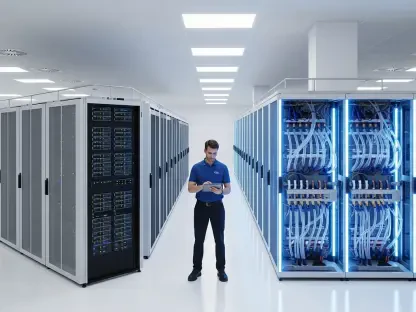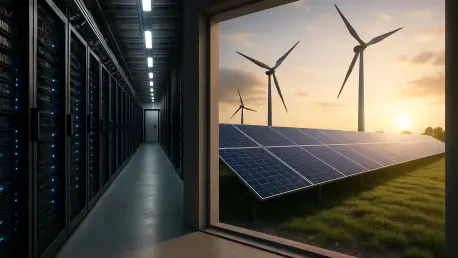

The global infrastructure powering our digital existence is currently grappling with a fundamental paradox where the very intelligence it creates consumes more energy than the systems it was designed to replace. This tension is most evident within the walls of data centers, the massive industrial hubs that serve as the engines of the modern economy. For years, the industry operated under the myth of the “limitless cloud,” an assumption that digital expansion could continue indefinitely without regard for the physical constraints of the power grid. However, as of 2026, the reality of resource scarcity has forced a reevaluation of how these facilities function, pushing them toward a necessary evolution from manual oversight to automated survival.
Beyond the Digital Ceiling: The High-Stakes Race for Power
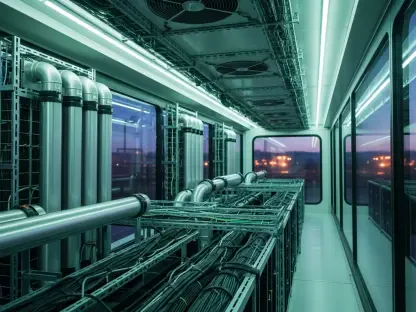
The digital ceiling is no longer a theoretical concept but a tangible barrier affecting the expansion of global tech giants. Every byte of data processed and every machine learning model trained requires a specific amount of electricity and a corresponding volume of water for cooling. This physical reality has ended the era of invisible computing, making energy the most valuable currency in the technology sector. Facilities that once focused primarily on uptime and speed are now forced to prioritize power density and thermal management to avoid hitting a wall that prevents any further growth.
This transition marks the end of traditional facility management. In the past, human operators could monitor gauges and adjust cooling systems based on historical trends, but the sheer complexity of current operations has rendered this reactive approach obsolete. The current high-demand era requires a shift toward intelligent, self-regulating systems that can balance the needs of high-performance hardware against the limitations of the local power grid. Survival in this landscape depends on the ability to move beyond simple monitoring and into the realm of real-time, automated resource allocation.
The Perfect Storm of AI Growth and Aging Infrastructure
The statistical reality of this growth is staggering, with data center energy use projected to rival the total consumption of entire G7 nations by 2030. In 2026, the industry is witnessing the consequences of connecting high-density AI chips to legacy power grids that were designed for a far less demanding era. These aging grids struggle to handle the erratic, high-intensity loads required by modern neural networks. The mismatch between 21st-century computing and mid-20th-century infrastructure has created a precarious environment where even minor fluctuations in demand can threaten the stability of the entire regional power network.
Beyond the external pressure on the grid, internal inefficiencies exacerbate the problem. Within many facilities, information regarding power distribution and HVAC performance remains siloed, creating invisible energy leaks that drain resources without providing any operational value. This “data deluge” is ironic; while data centers process information for the world, they often struggle to interpret their own internal telemetry. These hidden gaps in efficiency increase the cost of operation and shorten the lifespan of expensive hardware, making the need for integrated, transparent data management more urgent than ever.
Turning Intelligent Machines on Themselves: AI as the Chief Energy Officer
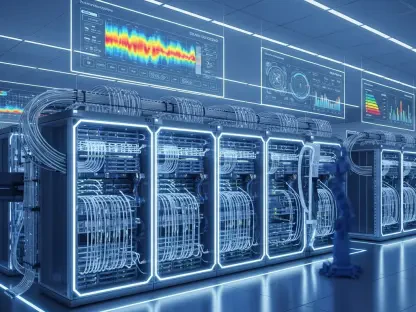
Artificial intelligence is now being deployed as a primary tool to manage its own energy footprint. By breaking down data silos through AI-driven analytics, operators are identifying hidden patterns in cooling and power distribution that were previously invisible to human eyes. These systems move beyond reactive “firefighting” and instead implement proactive load management. Machine learning models analyze thousands of variables simultaneously, adjusting cooling outputs in real time to match the heat generated by specific server racks, thereby eliminating the waste associated with cooling empty space.
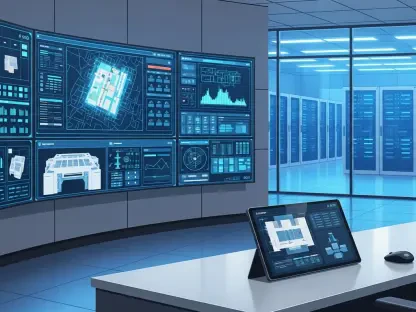
Predictive maintenance has also become a cornerstone of modern energy strategy. By using machine learning to forecast equipment degradation before a failure occurs, facility managers can prevent the massive energy spikes and cooling losses associated with malfunctioning hardware. This approach allows local optimizations to be scaled across global portfolios, ensuring that a lesson learned in one facility is immediately applied to dozens of others. The rise of the Integrated Building Management System (IBMS) provides a single interface where security, power, and cooling are coordinated in a synchronized dance, ensuring that every watt of electricity is used as efficiently as possible.
Expert Perspectives on the Shift to Intelligent Automation
The International Energy Agency (IEA) has highlighted the significance of the 945 TWh consumption milestone, noting that the industry’s trajectory requires a fundamental change in operational philosophy. There is a growing consensus among industry leaders that simply collecting data is no longer a substitute for interpreting it. The facilities that will thrive in the coming years are those that view energy management as a core strategic pillar rather than a utility cost. Superior power management has become a competitive advantage, often determining which companies are granted access to increasingly scarce grid connections.
Furthermore, the shift toward intelligent automation is viewed as the only way to meet modern performance standards. Experts emphasize that the speed at which AI workloads fluctuate makes manual human intervention impossible. The ability to coordinate IT workloads with cooling output in real-time synchronization is now a baseline requirement for any high-density facility. As the gap between leaders and laggards widens, the market is beginning to value efficiency as much as raw computing power, rewarding those who can deliver more intelligence per kilowatt-hour.
A Framework for Implementing AI-Driven Energy Strategies
The first step in modernizing energy management involved auditing the fragmented landscape to map every disparate system, from backup generators to individual sensors. Establishing advanced interoperability ensured that IT and cooling systems could communicate without manual intervention, creating a foundation for continuous optimization. This allowed facilities to implement automated feedback loops that adjusted to fluctuating renewable energy sources, such as solar or wind, ensuring that the most intensive tasks were performed when green energy was most available.
Finally, these intelligent platforms were leveraged to meet increasingly stringent regulatory and ESG standards. By using AI-generated reports to track carbon footprints and energy efficiency in real time, operators turned compliance into a streamlined process. These data-driven insights allowed organizations to prove their sustainability claims to investors and regulators with unprecedented accuracy. These proactive measures transformed energy management from a reactive necessity into a sophisticated strategy that ensured the long-term viability of the digital world.