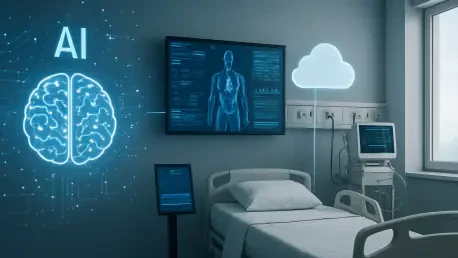

Modern surgical suites and bedside monitors require instantaneous data processing that cannot tolerate the latency associated with sending information to remote servers. As medical environments become increasingly saturated with high-resolution sensors and robotic systems, the reliance on legacy siloed infrastructures has become a significant bottleneck for clinical innovation. The current shift toward a connected, intelligent ecosystem is fundamentally altering how medical teams interact with data, moving from a reactive model to a proactive, real-time diagnostic framework. This evolution is facilitated by the integration of Edge-to-Cloud AI architectures, which effectively balance the need for immediate feedback at the patient’s bedside with the massive computational resources found in centralized data centers. By distributing workloads across this hybrid environment, healthcare providers are now able to harness sophisticated algorithms that improve the speed of decision-making while maintaining the rigorous standards required for patient safety. This paradigm shift represents more than just a technical upgrade; it is a holistic reimagining of the hospital as a software-defined entity where every device functions as a standardized node in a global network of medical intelligence.
The Critical Role of Edge Computing in Clinical Settings
The transition to edge-centric computing in healthcare is driven by the absolute necessity of reliability and speed in life-critical scenarios. In an era where every second counts, the ability to process complex data locally ensures that interventions are based on the most current physiological information available. Unlike administrative or billing applications, clinical tools must remain functional regardless of external connectivity issues, making the edge a vital sanctuary for operational continuity. This localized approach allows hospitals to implement advanced technologies like computer vision and automated diagnostics without the risk of network jitter or bandwidth congestion. Furthermore, as the volume of data generated by modern medical imaging and wearable sensors continues to explode, the edge acts as a critical filter, processing the vast majority of raw information on-site and only transmitting essential summaries to the cloud for deeper analysis. This efficiency not only preserves network resources but also strengthens the overall security posture of the institution by keeping sensitive raw data within the physical confines of the hospital whenever possible.
Real-Time Precision: Supporting Robotic Interventions
The implementation of robotic surgery platforms serves as the premier example of why edge computing has become a non-negotiable requirement for modern operating rooms. These systems require sub-millisecond response times to translate a surgeon’s movements into precise mechanical actions, a level of performance that remote cloud servers simply cannot provide due to physics-based latency constraints. By utilizing high-performance edge servers located within the surgical suite, these robots can execute complex AI algorithms that identify critical anatomical structures and provide real-time haptic feedback to the practitioner. This immediate local processing also enables “active constraints” or virtual boundaries that prevent a surgical tool from accidentally damaging sensitive nerves or blood vessels. Because the computation happens centimeters away from the patient rather than miles away in a data center, the risk of a lag-induced error is virtually eliminated. This localized intelligence effectively extends the capabilities of the surgical team, allowing for minimally invasive procedures that were previously deemed too risky due to the precision required.
Spatial Intelligence: Enhancing Patient Safety and Monitoring
Beyond the operating room, edge-based spatial intelligence is transforming the way bedside monitoring is conducted in intensive care units and general wards. By deploying smart cameras and microphones equipped with local AI processing, hospitals can now monitor patient movement and environmental sounds to predict and prevent adverse events such as falls or respiratory distress. These systems utilize computer vision to track whether a patient is attempting to leave their bed unassisted or if a caregiver has followed proper hand-hygiene protocols before approaching a bedside. Because the edge devices process the video feed locally and only send metadata or alerts to the nursing station, the system maintains strict patient privacy while providing twenty-four-hour surveillance. This continuous, intelligent monitoring alleviates the burden on nursing staff, who can focus on high-level clinical tasks rather than manual observations. The ability to detect subtle changes in a patient’s posture or breathing pattern through localized spatial AI ensures that the clinical team is alerted the moment a potential issue is identified, significantly improving outcomes and reducing hospital stay durations.
Strategic Distribution of AI Workloads
A sophisticated Edge-to-Cloud strategy recognizes that not all artificial intelligence tasks are created equal, necessitating a tiered approach to workload distribution. The architectural decision of where to execute a specific algorithm depends on the required latency, the volume of data involved, and the level of security necessary for the particular clinical context. Real-time perception and immediate device control belong exclusively at the edge, where the proximity to the patient guarantees a rapid response. In contrast, massive data aggregation and the training of foundational AI models are better suited for the cloud, where the sheer volume of GPUs and storage can handle the computational “heavy lifting” that would overwhelm local hardware. Between these two extremes lie on-premises data centers, which act as regional hubs for a hospital system, providing the necessary infrastructure for institution-wide inferences and long-term data storage. This distribution ensures that every component of the healthcare ecosystem operates at its maximum potential, preventing any single part of the network from becoming a bottleneck during periods of high clinical activity.
Optimizing Local Inference for Immediate Alerts
Localized inference is the cornerstone of modern clinical alert systems, allowing for the immediate detection of life-threatening arrhythmias or sudden drops in oxygen saturation. By running inference engines directly on the bedside monitor or a dedicated local edge server, the system can analyze continuous EKG and plethysmography waveforms without the need for an external internet connection. This ensures that the alarm sounds the exact microsecond a deviation is detected, providing the clinical team with the maximum amount of time to respond. Localized inference also allows for the integration of multiple sensor streams, where the AI can correlate a drop in blood pressure with a change in heart rate to provide a more accurate and nuanced clinical warning. This multi-modal analysis reduces the prevalence of “alarm fatigue,” as the local AI can filter out false positives caused by sensor displacement or patient movement. By refining these alerts at the point of care, hospitals ensure that their staff is only mobilized for genuine clinical events, preserving human resources and improving the overall quality of care delivered to the patient.
Utilizing Centralized Power for Model Training
While the edge is ideal for the execution of AI, the cloud remains the indispensable environment for the creation and refinement of the underlying models. Training a foundation model for medical imaging or genomic analysis requires processing petabytes of diverse data, a task that demands the massive scalability and high-throughput networking only found in centralized cloud infrastructures. Once a hospital system has collected a significant amount of de-identified clinical data, this information can be moved to the cloud to retrain algorithms, ensuring they remain accurate across different patient demographics and evolving medical standards. This cloud-based refinement process allows for “global learning,” where insights gained from one clinical setting can be baked into a model and then deployed back to the edge devices in hundreds of other facilities. The cloud also serves as a critical sandbox for complex simulations, where researchers can test new surgical protocols or drug interactions in a virtual environment before they are ever applied in a real-world setting. This continuous loop between the localized execution at the edge and the centralized intelligence of the cloud creates a self-improving system that evolves alongside the latest medical research.
Driving Force Behind Technological Adoption
The rapid acceleration of AI adoption in the medical sector is not merely a result of technological progress but a direct response to the systemic challenges facing modern healthcare. As the global population ages and the prevalence of chronic diseases increases, the demand for medical services is reaching a level that traditional manual workflows can no longer support. This pressure has created an environment where automation and intelligent data processing are viewed as essential survival tools for healthcare organizations. The convergence of high-speed 5G networking, powerful mobile processors, and advanced machine learning frameworks has finally reached a point of maturity where these solutions can be deployed reliably in a professional clinical setting. Furthermore, the move toward value-based care models, which prioritize patient outcomes over the volume of services provided, has incentivized hospitals to invest in technologies that reduce errors and improve efficiency. This systemic “pull” from the industry ensures that the transition to Edge-to-Cloud AI is not a fleeting trend but a fundamental shift in the operational philosophy of modern medicine.
Mitigating the Global Health Staffing Crisis
The global healthcare industry is currently navigating an unprecedented labor shortage, making the efficiency gains provided by AI a primary driver for institutional survival. With projections suggesting a significant shortfall of doctors and nurses by the period from 2026 to 2030, hospitals must find ways to extend the reach of their existing staff without compromising the quality of patient care. Edge-to-Cloud AI addresses this capacity gap by automating routine administrative tasks and providing intelligent decision support that helps clinicians work more effectively. For example, AI-powered transcription services can automatically document patient encounters, saving physicians hours of manual data entry every day. Similarly, automated triage systems can analyze patient data in the emergency department to ensure that the most critical cases are seen first, even when the facility is at peak capacity. By offloading these time-consuming and cognitively demanding tasks to intelligent systems, healthcare providers can dedicate more of their attention to the human elements of medicine, such as patient counseling and complex diagnostic reasoning. This technological support is essential for maintaining a resilient healthcare system in the face of dwindling human resources.
Protecting Privacy Through Synthetic Data Generation
As hospitals seek to innovate with AI, the protection of patient privacy remains a paramount concern and a significant legal hurdle for researchers. To overcome the challenges of utilizing sensitive Personal Health Information, the industry has turned to the generation of synthetic data and the implementation of federated learning. Synthetic data involves the creation of artificial datasets that mirror the statistical properties of real-world patient records without actually containing any identifiable information. This allows developers to train and validate AI models in the cloud using massive amounts of data that carry zero risk of privacy breaches. Federated learning takes this a step further by allowing models to be trained across multiple hospital sites without the raw data ever leaving the local edge servers. Only the learned parameters of the model are shared with a central server, which aggregates the findings and distributes an updated, more accurate model back to all participating institutions. These privacy-preserving techniques ensure that medical research can continue at a rapid pace while fully complying with international data sovereignty regulations and maintaining the trust of the patient community.
Building a Future-Proof Healthcare Infrastructure
The successful integration of Edge-to-Cloud AI requires a complete departure from the “black box” approach to medical device procurement. Historically, hospitals purchased standalone machines that operated on proprietary, closed architectures, making it nearly impossible to update their capabilities or integrate them into a broader digital ecosystem. Today, the shift toward software-defined medical systems allows hospitals to treat their hardware as a flexible platform that can be continuously improved through software updates. This approach requires an investment in a unified, cloud-native infrastructure that spans the entire facility, from the patient’s bedside to the on-premises data center. By building a common architecture, hospitals can ensure that they are not locked into a single vendor and can instead run a variety of AI applications from different developers on the same standardized hardware. This flexibility is essential for future-proofing the institution, as it allows clinical leaders to deploy new diagnostic tools and therapeutic protocols the moment they are approved, rather than waiting for the next hardware replacement cycle.
Transitioning to Software-Defined Medical Systems
A software-defined medical environment transforms the physical infrastructure of a hospital into a programmable asset that can adapt to the changing needs of the clinical staff. In this model, the value of a medical device is found in its software capabilities and its ability to communicate within a larger network, rather than its mechanical components alone. This transition allows for the centralization of management and security, where IT departments can monitor the health and performance of every medical device in the facility from a single dashboard. When a new AI model for detecting early signs of sepsis is developed, it can be pushed out to every compatible bedside monitor in the hospital system simultaneously, ensuring that all patients benefit from the latest medical breakthroughs immediately. Furthermore, this architecture facilitates better interoperability, as data from various devices can be aggregated and analyzed in a unified clinical context. By breaking down the silos between different departments, software-defined systems provide a holistic view of the patient’s health, leading to more accurate diagnoses and more personalized treatment plans that were previously impossible with fragmented hardware.
Establishing Foundation Models Through Collaboration
The complexity of medical AI means that no single institution can develop all the necessary tools in isolation, leading to a new era of industry-wide collaboration. Major technology providers and academic medical centers are now working together to create “foundation models”—large-scale AI systems trained on massive, diverse datasets that can then be fine-tuned for specific clinical applications. These collaborations are building the world’s largest repositories of de-identified medical data, including surgical video, radiological images, and genomic sequences. By contributing to these shared resources, individual hospitals gain access to sophisticated algorithms that have been validated across a wide range of clinical scenarios, significantly lowering the barrier to entry for smaller facilities. This collaborative spirit is also fostering the development of open-standard APIs and containerized applications, which simplify the deployment of AI at the edge. As these foundation models become more accessible, they will serve as the “operating system” for modern healthcare, providing a standardized base upon which specialized applications can be built to address the unique challenges of every medical specialty and patient population.
Strategic Implementation: Practical Steps for Clinical Leaders
Healthcare leaders who successfully navigated the transition to Edge-to-Cloud AI prioritized the establishment of a multidisciplinary governance framework as their foundational move. They realized that the deployment of intelligent systems was not merely an IT project but a clinical transformation that required the active participation of surgeons, nurses, and legal counsel from the earliest stages of planning. By creating a unified front, these organizations ensured that the technology was implemented in a way that addressed specific clinical pain points while maintaining the highest standards of data security and regulatory compliance. The focus was consistently placed on building a robust infrastructure that could support a variety of workloads, rather than chasing individual standalone gadgets. This strategic foresight allowed these institutions to scale their AI initiatives rapidly as the technology matured, providing them with a significant competitive advantage in terms of operational efficiency and patient outcomes.
The implementation process also involved a rigorous commitment to full-lifecycle security, which was integrated at the silicon level before any software was ever deployed. Successful teams utilized hardware-based roots of trust and secure boot sequences to ensure that every device on the hospital network was verified and protected against unauthorized access. They established continuous monitoring protocols to detect model drift, ensuring that the AI’s diagnostic accuracy remained consistent as patient demographics and clinical protocols changed. By treating AI models with the same scrutiny as traditional medical devices, these leaders built a culture of trust among the clinical staff, who felt confident in utilizing these tools to assist in life-altering decisions. Looking forward, the organizations that moved early to adopt these standardized platforms found themselves better prepared for the next wave of medical innovation, as their software-defined environments allowed for the seamless integration of new capabilities without the need for costly and disruptive hardware overhauls.