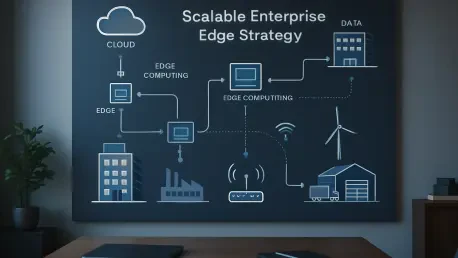

In the rapidly evolving landscape of enterprise technology, the shift toward autonomous business models has placed edge computing at the center of the conversation. Matilda Bailey, an expert in infrastructure and operations (I&O) strategy, specializes in bridging the gap between raw technical capabilities and long-term digital transformation. With a deep background in cellular, wireless, and next-generation networking solutions, she helps organizations navigate the complexities of decentralized data and real-time processing. Today, we explore how leaders can move beyond siloed experiments to build a cohesive, scalable edge strategy that drives genuine business value.
The transition to a robust edge environment requires a disciplined focus on five core pillars: a unified vision, rigorous use-case prioritization, proactive risk mitigation, the establishment of multidisciplinary standards, and the ability to scale from pilot to production. In this discussion, we break down how to align these elements to ensure operational resilience and agility.
Moving toward autonomous business requires edge computing to be more than just a series of siloed experiments. How do you align a unified vision with long-term digital transformation, and what specific steps ensure that infrastructure investments support operational resilience without draining resources?
To avoid the trap of resource-draining silos, a unified edge strategy must begin with a vision that is co-authored by both I&O leaders and business stakeholders. We start by reviewing current initiatives and identifying specific alignment opportunities where edge capabilities can directly accelerate digital transformation. This involves assessing how evolving roles—such as the integration of AI—will influence our team structures and deployment models. By establishing these priorities early, we ensure that every dollar spent on infrastructure reinforces a roadmap designed for long-term resilience rather than short-term experimentation.
Latency, data volume, and privacy requirements often dictate where edge deployment becomes necessary. When evaluating use cases like real-time analytics, what specific criteria justify the expansion of edge sites, and how do you measure the technical success of these deployments against broader enterprise goals?
We justify the expansion of edge sites by filtering every potential use case through four critical drivers: latency, data volume, autonomy, and privacy or security. If a project like real-time analytics requires immediate processing to function or involves massive data volumes that are too costly to backhaul, the edge becomes a necessity. Technical success is then measured by how well these deployments meet specific enterprise requirements, such as reduced lag for customer experiences or improved operational efficiency in local environments. This disciplined evaluation prevents the unnecessary “sprawl” of edge sites, which keeps both complexity and management costs under control.
Managing edge-native capabilities introduces unique risks that traditional data centers rarely face. What frameworks should be implemented for incident response and lifecycle management across multiple locations, and how can leaders develop the necessary skills to handle an increasing diversity of use cases?
Leaders must implement robust risk assessment frameworks that specifically address the distributed nature of edge-native capabilities. This means developing standardized processes for incident response, continuous monitoring, and lifecycle management that can be executed consistently across hundreds of diverse locations. To handle the growing diversity of use cases, I&O leaders need to invest in a management discipline that prioritizes skills development, particularly in areas where IT and operational technology overlap. By treating risk as an ongoing focus rather than a one-time checklist, we can ensure that every deployment meets strict governance and security standards.
Establishing a multidisciplinary team that bridges IT and operational technology is often a major hurdle. How do you structure a “fusion team” to include stakeholders like data scientists and business leaders, and what strategies help this group create shared standards for the entire organization?
The most effective structure is what we call a Digital Edge Fusion Team, or DEFT, which requires direct buy-in from the CIO to ensure it has the authority to lead. This team isn’t just IT; it brings together experts from networking, security, data science, application development, and even business leadership to share responsibility for the edge roadmap. We foster shared standards by directing this group to document best practices from both internal pilots and external industry sources. This collaborative approach ensures that the standards we set are technically sound while remaining focused on the overarching business objectives of the enterprise.
Scaling a project from a proof of concept to full production creates significant management challenges. What guardrails should be in place to monitor workloads and data as they grow, and how do you architect these systems to remain extensible for emerging requirements like AI inference?
Scaling requires moving beyond simple technical feasibility to demonstrating reliable performance under the pressure of full-scale production. We implement a phased rollout strategy that includes specific guardrails for monitoring changes in workloads, data growth, and shifting use case requirements over time. Architecturally, we prioritize extensibility by choosing solutions that are governed to accommodate emerging needs, such as local AI inference or advanced IoT orchestration. By planning for how a project will operate at its maximum capacity during the initial design phase, we build a foundation that supports agility and long-term growth.
What is your forecast for edge computing?
I believe edge computing will become the primary engine for the autonomous business era, moving away from being a “niche” deployment to a foundational layer of the enterprise stack. As AI inference becomes more localized, we will see a massive shift where the edge is no longer just a source of data, but the place where the most critical business decisions are made in real time. Organizations that successfully implement multidisciplinary teams and standardized governance today will see significant improvements in their top and bottom lines. Ultimately, the edge will be defined by its ability to seamlessly blend IT and operational technology, creating a truly agile and responsive infrastructure.