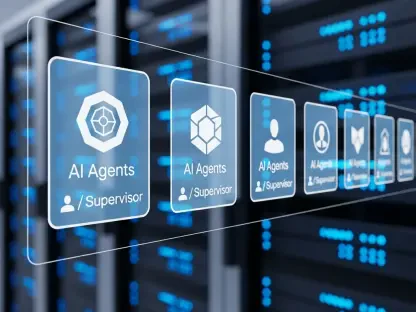

As enterprise networks have grown increasingly intricate and the demands from new AI initiatives multiply, a significant transformation is underway within IT departments, pushing traditional network automation methods to their limits. The era of managing complex digital infrastructures with manual scripting and fragmented tools is rapidly drawing to a close, proven insufficient to handle the scale, speed, and sophistication required by modern business. In response to this escalating pressure, organizations are strategically moving beyond these legacy approaches. They are augmenting their existing toolkits with advanced generative AI and sophisticated agentic systems to forge automation frameworks that are not only more powerful and adaptable but also substantially simpler to implement and manage. This evolution marks a pivotal transition for AI-driven network management, moving it from a forward-looking concept discussed in strategy meetings to a present-day necessity deployed in live production environments. The core principle fueling this revolution is not the wholesale replacement of human IT staff but the intelligent augmentation of their capabilities. AI is being strategically deployed to absorb the burden of repetitive, time-consuming operational tasks, thereby liberating skilled professionals to concentrate their expertise on higher-value strategic work that drives innovation and business growth. This pragmatic “get more done with less” approach is steadily gaining traction, guided by a cautious yet optimistic adoption strategy where trust is cultivated gradually through proven use cases, consistent human oversight, and a relentless focus on measurable results.
From Theory to Practice Real World AI Implementations
A major U.S. insurer provides a compelling example of AI’s practical and profound impact on critical security operations, moving the technology from a theoretical benefit to a tangible asset. The company had long struggled with a manual, slow, and arduous process for creating and reviewing security policy rule changes, a workflow that frequently consumed hours of analyst time and was prone to human error. To fundamentally solve this operational bottleneck, they deployed specialized AI agents from the cybersecurity firm Airrived. These agents have completely transformed the workflow by automatically interpreting business requests for new rules, conducting comprehensive impact analyses across a complex, multi-vendor firewall environment, and generating pre-approved, compliant rule sets ready for immediate deployment. The results of this implementation have been nothing short of dramatic and are entirely quantifiable. The time required for the entire policy change lifecycle has been slashed from hours to mere minutes. The insurer reports an astounding 90% acceleration in policy changes, a three-fold reduction in configuration errors, and the newfound ability to propagate new security rules across its entire hybrid environment in real time. These remarkable efficiency gains translate directly into what the company describes as “expense avoidance” and a “flattened expense curve,” contributing positively to its return on investment. Furthermore, the automation freed up the equivalent of half a full-time employee, who was then strategically reassigned to other valuable security initiatives rather than being eliminated.
Rakuten Symphony illustrates a more mature, methodical, and trust-centric approach to integrating AI into its sophisticated incident management processes. Forged out of the necessity of building and operating a massive mobile network with limited resources during the pandemic, the company invested heavily in automation from its inception. It now employs a sophisticated, multi-stage agentic system that initiates when machine learning algorithms first identify a data anomaly within the network. From there, generative AI agents take control, performing a comprehensive analysis that includes reviewing historical data of similar incidents, researching potential diagnoses from a vast knowledge base, conducting a thorough root cause analysis, and ultimately formulating a detailed remediation plan. A key feature of this advanced system is that multiple AI agents cross-validate each other’s work to ensure accuracy and reliability. Central to Rakuten’s entire strategy is a human-in-the-loop model governed by a dynamically calculated confidence score. If the AI’s confidence in its recommended solution is exceptionally high, typically above 90%, it can trigger a pre-approved, automated action from a library of solutions. However, if the confidence level is lower or the potential impact of the action is deemed significant, the issue is seamlessly escalated to a human engineer for final review. The AI enriches the support ticket with all of its findings, enabling the engineer to make a faster, more informed decision. This system has processed approximately 6,000 incidents over the past year, with its success rate impressively improving from an initial 88% to over 95%.
The Broader Landscape Industry Data and Adoption Trends
A growing body of industry data confirms this accelerating reliance on AI-powered automation as a cornerstone of modern IT strategy. A recent comprehensive survey from the Enterprise Strategy Group found that an overwhelming 93% of networking professionals now believe network automation is absolutely essential for managing the constant pace of change and complexity in their environments. Furthermore, 89% of these professionals acknowledge that networking’s strategic importance within the business is increasing specifically because of the immense demands being placed on the infrastructure by a new wave of internal and external AI initiatives. When asked about their most desired outcomes from automation, respondents overwhelmingly pointed to proactive outage prevention, predictive maintenance to foresee and mitigate hardware failures, and vastly improved security posture and response capabilities. This reflects a clear shift in mindset from reactive troubleshooting to a more predictive and preventative operational model, a transition that is largely unachievable without the analytical power of artificial intelligence. The data paints a clear picture of an industry that not only recognizes the need for change but is actively seeking intelligent automation solutions to address its most pressing operational and strategic challenges.
The promise of generative AI, in particular, resonates strongly across the entire industry as a transformative force multiplier for existing automation efforts. The same Enterprise Strategy Group survey revealed that a near-unanimous 99% of respondents believe generative AI will significantly enhance the benefits they can achieve with network automation, moving beyond simple scripting to more intuitive, context-aware operations. The most anticipated benefits highlight a focus on complex, high-value tasks, including improved security policy compliance (cited by 56% of respondents), accelerated troubleshooting and root cause analysis (51%), and faster, more reliable testing and auditing of network changes (51%). However, despite this widespread enthusiasm, current adoption rates present a more nuanced and mixed picture of the market. A NANOG survey, which primarily represents smaller companies, shows that adoption is still in its nascent stages, with only 3% of organizations having any AI in production for network operations. In stark contrast, a survey by Dimensional Research focusing on medium to large enterprise companies indicates that these larger organizations are considerably further along their adoption journey, with 22% already beginning to use AI and 5% having deployed fully autonomous AI-powered automation systems.
Navigating the Hurdles Key Challenges to Widespread Adoption
Despite the clear and compelling benefits demonstrated by early adopters and the high level of interest across the industry, the most significant barrier to the widespread adoption of AI in network management remains a fundamental lack of trust. The Dimensional Research survey starkly highlighted this issue, finding that a substantial 71% of networking professionals have limited trust in AI-based functionality for their day-to-day operations. This deep-seated skepticism has a direct and limiting impact on implementation strategies. It means that organizations are often only comfortable automating simple, low-risk, and routine tasks such as data collection, report generation, and basic information sharing. They remain hesitant to relinquish control over mission-critical functions like automated remediation of outages, proactive configuration changes, or autonomous security responses. This trust deficit effectively prevents organizations from realizing the full, transformative potential of AI. Until confidence can be built through transparent, reliable, and verifiable systems—often involving a carefully managed human-in-the-loop process—the adoption of more advanced, autonomous networking will continue to proceed at a cautious and incremental pace, leaving significant efficiency and resilience gains on the table.
Beyond the pervasive issue of trust, organizations face a formidable array of operational and human challenges that further complicate the path to intelligent automation. Tool and vendor sprawl has created a highly fragmented and chaotic operational environment. A recent Riverbed survey revealed that the average enterprise now uses 13 different observability tools from nine different vendors to monitor its network. This complexity creates isolated data silos, hinders the development of a unified view of network health, and makes it exceedingly difficult to implement a cohesive, end-to-end automation strategy that can seamlessly interact with all parts of the infrastructure. Moreover, especially in smaller organizations, the most significant barriers are often less about technology and more about people and processes. The NANOG survey identified critical skills gaps (cited by 27% of respondents), organizational challenges and inertia (20%), and deep-seated cultural resistance to change (14%) as the primary impediments to automation, ranking them well ahead of purely technical challenges (10%). This is compounded by a lack of dedicated resources, with a striking 43% of these smaller organizations reporting that they have zero full-time staff dedicated to automation efforts, making it nearly impossible to build and sustain any meaningful momentum.
The Dawn of a New Operational Paradigm
The industry found itself at a pivotal moment where the escalating complexity of network infrastructure and the strategic demands of AI initiatives made the need for AI-driven management undeniable. The substantial benefits demonstrated by early adopters, who achieved dramatic improvements in efficiency and response times, provided a clear and compelling blueprint for others to follow. While significant challenges related to deep-seated trust issues, convoluted tool ecosystems, and organizational readiness remained formidable, the momentum had become irreversible. As more platform vendors embedded sophisticated AI capabilities directly into their core offerings and as enterprises continued to build confidence through carefully managed, human-in-the-loop implementations, AI was firmly set on a trajectory to become an indispensable and foundational component of modern network operations. This shift ultimately enabled a new era of unprecedented efficiency, security, and resilience across the digital landscape.