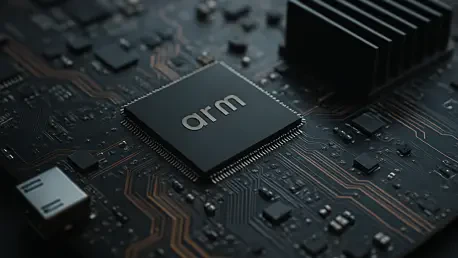

Imagine a world where your smartphone doesn’t just connect to the cloud for smart responses but thinks for itself, right in your pocket, with no lag or privacy worries. That’s the future Arm, a titan in semiconductor and software design, is crafting through its latest breakthroughs in on-device artificial intelligence (AI), unveiled this November. By embedding powerful AI capabilities directly into edge devices—think smartphones, IoT gadgets, and even automotive systems—Arm is steering away from the old reliance on cloud processing. This isn’t just a tweak; it’s a bold reimagining of how technology interacts with daily life, promising quicker responses, tighter security, and unwavering performance. The shift to local processing tackles some of tech’s biggest headaches, setting a new benchmark for what edge computing can achieve. Let’s unpack how Arm’s innovations in hardware, software, and ecosystem support are reshaping the landscape, and why this matters for users, developers, and entire industries pushing the boundaries of intelligent systems.
Unleashing the Potential of Local AI Processing
Arm’s drive to bring AI processing directly onto devices marks a seismic shift in edge computing, addressing critical challenges that have long plagued the industry. Moving computations from remote cloud servers to the device itself slashes latency, bolsters data privacy, and cuts down on the hefty costs of constant cloud dependency. This means a smartphone or IoT sensor can react in real time, without waiting for a round trip to a data center halfway across the globe. Moreover, keeping sensitive data local minimizes the risk of breaches during transmission over vulnerable networks. For applications where split-second decisions are crucial—like autonomous driving or real-time health monitoring—this is a transformative leap. Arm’s focus on on-device processing isn’t just about speed; it’s about building trust and reliability into every interaction, ensuring that technology serves users without compromising their security or draining their resources in an always-connected world.
This push for localized AI also reshapes how industries approach operational efficiency and user experience. Take smart home devices, for instance, which often stutter or fail when internet connectivity dips; with Arm’s advancements, these gadgets can maintain functionality offline, processing commands on the spot. Beyond convenience, this reduces bandwidth demands, a boon for regions with spotty internet or strict data regulations. Additionally, businesses stand to save significantly by trimming cloud service expenses, redirecting funds to innovation rather than infrastructure. Arm’s strategy cleverly balances performance with practicality, making edge devices not just endpoints but active hubs of intelligence. This isn’t a distant dream but a tangible shift, already evident in the latest Arm-powered tools and platforms. As this approach gains traction, it’s clear that the future of computing hinges on empowering devices to think independently, right where the action happens.
Making Advanced AI Accessible to All
Arm isn’t just innovating behind closed doors; it’s throwing open the gates to advanced AI, ensuring everyone from casual users to seasoned developers can tap into cutting-edge tools like large language models (LLMs) and generative AI. The AI Chat app for Android and ChromeOS stands as a prime example, letting users experiment with multiple LLMs directly on their devices, no internet required. This offline capability breaks down barriers, enabling intelligent interactions in remote areas or during connectivity outages. It’s not hard to see the impact—students, small businesses, or even hobbyists can now leverage AI without pricey subscriptions or constant data plans. Arm’s vision of democratizing technology ensures that sophisticated features aren’t locked behind a paywall or tethered to the cloud, but are instead woven into the everyday fabric of accessible devices.
Beyond language models, Arm’s partnerships push the creative envelope, showcasing what local AI can achieve in diverse fields. Collaborating with Stability AI, Arm has enabled on-device audio generation, allowing content creators to craft music or soundscapes directly on Android devices without cloud support. This isn’t just a tech demo; it’s a signal of how localized generative AI can empower artists and innovators to work freely, unshackled by connectivity constraints. Such advancements hint at a broader ripple effect—think of musicians in underserved regions producing tracks or developers prototyping apps without latency hiccups. By placing these powerful tools in users’ hands, Arm fosters a wave of creativity and experimentation that cloud-dependent systems often stifle. The message is clear: intelligence shouldn’t be a privilege but a baseline, and Arm is paving the way for a future where edge devices are as imaginative as they are functional.
Engineering Hardware for the AI Revolution
At the core of Arm’s transformative vision lies hardware explicitly engineered to handle the rigors of AI workloads, proving that power doesn’t always need bulky, specialized gear. The Scalable Matrix Extension 2 (SME2) is a standout innovation, enhancing CPU performance for the intricate matrix calculations that fuel neural networks and AI algorithms. By integrating these capabilities directly into the CPU, Arm reduces reliance on dedicated GPUs or other accelerators, slashing energy consumption in the process. This makes AI viable across a spectrum of devices, from tiny, battery-sipping IoT sensors to robust automotive systems. SME2 isn’t just a technical spec; it’s a commitment to efficiency, ensuring that even the smallest gadgets can punch above their weight with intelligent processing, all while keeping power usage in check for a greener footprint.
This hardware prowess extends Arm’s reach into scenarios where resources are tight but demands are high. Consider wearable health trackers that must analyze vital signs in real time—thanks to tailored designs like SME2, these devices can run complex AI models without draining the battery or needing constant cloud support. This opens doors for broader adoption in critical fields like healthcare, where reliability is paramount. Furthermore, by embedding AI-ready hardware into everyday tech, Arm ensures scalability; a single architecture can adapt from a smart thermostat to a car’s navigation system without missing a beat. This flexibility is key for manufacturers aiming to future-proof their products in an era where AI is no longer optional but expected. As Arm continues to refine its hardware, it’s evident that the foundation of edge computing rests on making every device not just smart, but sustainably and powerfully so.
Cultivating a Robust AI Ecosystem
Arm’s ambitions stretch far beyond individual devices, aiming to nurture a sprawling ecosystem where developers and industries can thrive with seamless AI integration. Through initiatives like hybrid compute explorations with leading tech players, Arm bridges CPUs and GPUs to tackle complex AI tasks, blending power with precision. Tools like the Virtual FAE within Arm IP Explorer further streamline the process, helping partners design chips tailored for AI across edge devices, automotive tech, and high-performance computing. This isn’t just about handing out tools; it’s about fostering collaboration, ensuring that whether it’s a startup crafting a niche IoT solution or a carmaker building AI-defined vehicles, the path to innovation is clear and supported. Arm’s ecosystem approach signals a shift toward interconnected intelligence, where every player contributes to a larger, smarter whole.
The ripple effects of this strategy touch diverse sectors, each with unique needs but a shared reliance on edge AI. In automotive, for instance, real-time inference and sensor fusion demand local processing for safety and efficiency—Arm’s scalable solutions meet this head-on, embedding intelligence directly into vehicles. Meanwhile, developers gain from accessible platforms that simplify coding AI applications, lowering the barrier to entry for groundbreaking ideas. This ecosystem doesn’t just empower; it anticipates challenges like privacy and connectivity, baking solutions into its framework. By aligning hardware, software, and support, Arm crafts a cohesive environment where technology doesn’t just adapt but leads. Looking back, Arm’s efforts this year laid a sturdy groundwork, showing that redefining edge computing isn’t a solo act but a collective journey, one that invites industries to build smarter systems together while eyeing sustainable, secure growth ahead.