
The relentless push for real-time intelligence in industrial automation, robotics, and autonomous systems has created a significant engineering bottleneck, forcing developers to compromise between processing power, physical size, and thermal efficiency. For years, the standard approach involved cobbling together multiple discrete components—a powerful CPU for general-purpose tasks, a separate GPU for visualization, and a dedicated AI accelerator card for machine learning inference. This fragmented methodology not only inflates the system’s footprint and power consumption but also introduces critical latency issues as data shuttles between different processors. As applications grow more complex, demanding instantaneous decision-making at the network’s edge, the need for a unified, compact, and powerful solution has become more pressing than ever. The recent unveiling at CES 2026 of a new Mini-ITX motherboard, the SAPPHIRE EDGE+ VPR-7P132, suggests that a breakthrough in consolidating these disparate functions into a single, cohesive platform may have finally arrived, potentially reshaping the landscape for intelligent edge system development.
A New Paradigm in Hybrid Architecture
At the heart of this new platform lies a revolutionary hybrid architecture that co-locates an AMD Ryzen AI Embedded P132 Series processor with an AMD Versal AI Edge Series Gen 2 adaptive SoC on a single board, a design choice that directly addresses the core challenges of modern edge workloads. This multi-processor approach is not merely about adding more cores; it is about creating a symbiotic system where tasks are intelligently distributed across the most suitable processing units. The CPU and GPU can manage the operating system, complex application logic, and high-resolution visualization, while the dedicated AI engines and programmable logic handle real-time data processing and machine learning inference with deterministic, low-latency performance. This division of labor is critical in applications like robotic surgery or automated quality control on a manufacturing line, where a millisecond delay can have significant consequences. By integrating these specialized units onto one compact platform, developers can build systems that are not only more powerful but also more predictable and reliable under demanding, real-world conditions.
The processing muscle for this innovative board is provided by the formidable AMD Ryzen AI Embedded P132 APU, a system-on-a-chip that integrates next-generation Zen 5 CPU cores, AMD RDNA 3.5 graphics, and a potent AMD XDNA 2 Neural Processing Unit. It is this NPU that truly unlocks the platform’s potential for edge intelligence, delivering over 50 TOPS of AI performance. This substantial computational power allows for complex machine learning models to be executed directly on the device, eliminating the latency and security risks associated with cloud-based processing. For example, a sophisticated machine vision system could use the NPU to analyze multiple high-resolution video streams in real-time to detect defects, while the Zen 5 cores simultaneously run control algorithms and the RDNA 3.5 graphics engine powers a detailed human-machine interface. This ability to concurrently manage intensive AI tasks alongside general-purpose and graphics workloads on a single, efficient chip marks a significant step forward in creating truly autonomous edge systems.
A Compact Powerhouse with Expansive Connectivity
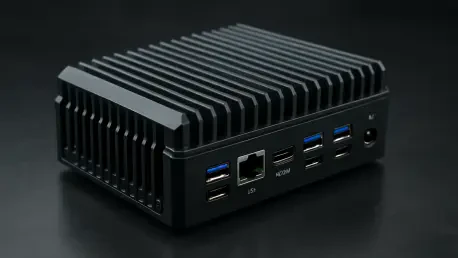
Despite packing an immense amount of processing power, the EDGE+ VPR-7P132 adheres to the compact 170 × 170 mm Mini-ITX form factor, making it an ideal foundation for space-constrained industrial, automotive, and commercial deployments. This small footprint does not come at the cost of connectivity, as the board offers a remarkably rich selection of I/O options designed for modern, data-intensive applications. It includes dual 10Gb Ethernet ports for high-speed networking, versatile USB4 for rapid data transfer and peripheral connection, and a PCIe Gen 4 expansion slot for adding further specialized hardware like high-speed storage or custom accelerator cards. Furthermore, with native support for up to five display outputs, the platform is well-suited for advanced visualization tasks, such as multi-screen control rooms or complex digital signage. This combination of a dense, powerful processing core with extensive, high-performance I/O in a standardized form factor provides a versatile and robust base for a wide array of intelligent systems.
Recognizing that advanced edge applications often require a diverse array of sensors and specialized interfaces, the platform’s design incorporates a significant degree of scalability through an optional I/O daughter board. This expansion module dramatically enhances the system’s capabilities, adding support for up to 12 cameras, multiple CAN-FD ports, and additional mini DisplayPort outputs. This level of extensibility is crucial for building sophisticated perception systems in robotics and autonomous vehicles, where data from numerous cameras, LiDAR, and other sensors must be fused and processed in real time. The inclusion of CAN-FD ports is particularly important for automotive and industrial automation, providing a reliable, high-speed communication bus for vehicle or machine control networks. This thoughtful approach to modular expansion ensures that developers can tailor the platform to meet the precise requirements of their application, creating a highly customized solution without the need for a fully custom-designed board, thus accelerating development and reducing time-to-market.
Navigating the Shifting Hardware Landscape
The introduction of this highly integrated platform occurred at a pivotal moment for the hardware industry. While demand for AI-centric components has surged, the broader PC hardware market faced significant headwinds, with soaring DDR5 RAM prices contributing to a sharp 40-50% downturn in general-purpose motherboard sales. This market bifurcation highlighted a crucial trend: value is increasingly found not in commodity components but in specialized, high-performance solutions tailored for specific, high-growth sectors like edge AI. The launch of the EDGE+ VPR-7P132 was a clear reflection of this strategic shift, demonstrating a move away from the volume-driven consumer market and toward the high-value, high-margin world of industrial and embedded systems. This platform provided a powerful, scalable, and reliable foundation that underscored a future where success depended on delivering complete, application-ready solutions rather than just individual parts.