
The fundamental challenge of modern food production lies in the difficulty of gathering precise environmental data across millions of acres of geographically isolated and topographically diverse farmland. For decades, agricultural operations relied on manual sampling or expensive, localized hardware that struggled to communicate over significant distances without significant investment. Today, the LoRa Alliance is redefining the role of LoRaWAN, moving it beyond a specialized sensor protocol to become a robust, global connectivity layer for smart agriculture. This strategic shift directly addresses the logistical and environmental hurdles that have traditionally hindered large-scale technology adoption. By integrating terrestrial gateways with sophisticated satellite-backed connectivity, the industry created a unified platform capable of managing crop health, livestock tracking, and resource conservation within a single, cohesive ecosystem. This evolution provides a scalable framework that allows producers to monitor vast territories with precision and minimal costs.
Infrastructure Maturity: Economic Efficiency
Historically, agricultural technology suffered from fragmented, siloed applications where every individual sensor type required a separate network and a unique proprietary contract with a specific vendor. This fragmentation made it nearly impossible for farmers to scale their operations without facing a mountain of administrative and technical complexity that often outweighed the benefits of the data. The maturity of the current LoRaWAN ecosystem allows for a revolutionary “build once, use many times” approach, which significantly lowers economic barriers for agricultural enterprises of all sizes. When a single network architecture can handle everything from weather stations and soil moisture probes to automated irrigation valves simultaneously, the return on investment becomes much more attractive for large-scale growers. By consolidating these functions into a single backbone, the industry eliminated the redundancy that once defined ag-tech, allowing for a more streamlined flow of information from the field to cloud systems.
Infrastructure Maturity: Technical Connectivity
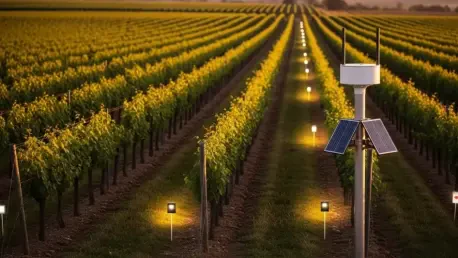
This infrastructure-centric model specifically solves the chronic issues of rural wireless deployment, such as extreme range requirements and the lack of reliable power sources in remote locations. By utilizing unlicensed spectrum and low-power hardware, LoRaWAN allows field devices to run for many years on small batteries or minimal solar energy, even in environments with high levels of interference or physical obstructions. Furthermore, the integration of satellite connectivity as a data backhaul has closed the coverage gap in remote grazing lands and isolated orchards, effectively bypassing the need for expensive cellular towers in unpopulated areas. This hybrid approach ensures that data can be transmitted from the middle of a desert or a dense forest without requiring a massive terrestrial footprint. As a result, the physical limitations that once restricted high-tech farming to regions with developed infrastructure have been removed, enabling global deployment across varied terrains and different climates.
Global Ecosystems: Standardization and Scale
The massive scale of this technology is evidenced by the more than 125 million LoRaWAN devices connected globally by the beginning of this year, representing a massive leap in adoption. With hundreds of certified device types and a vast network of member companies, the ecosystem offers a level of interoperability that is vital for the survival of industrial farming operations. This diversity effectively prevents vendor lock-in, allowing farmers to mix soil probes and GPS tags from different manufacturers while ensuring they all communicate across the same basic network layer seamlessly. The ability to swap components without rebuilding the entire network creates a competitive marketplace that drives down costs and encourages rapid innovation. Furthermore, the standardization provided by the LoRa Alliance ensures that security protocols remain consistent across the entire chain, protecting sensitive agricultural data from potential cyber threats while maintaining the integrity of long-term historical records.
Global Ecosystems: Case Studies in Versatility
Real-world deployments highlight the incredible versatility of the standard, ranging from disease prevention in banana crops in Ghana to tracking cattle across the vast Australian outback. In Malaysia, automated sensors have replaced thousands of hours of manual labor on durian estates, providing real-time feedback on nutrient levels and hydration that were previously impossible to track at scale. Meanwhile, in Bulgaria, unified platforms now monitor moisture and light levels for vegetable growers, ensuring that resources are used only when absolutely necessary to maximize the crop yield. These diverse cases demonstrate how consistent data benchmarking can directly optimize agricultural outputs while reducing the need for constant manual oversight in the field. By providing a common language for these varied sensors, the technology has enabled a level of precision that helps farmers mitigate the risks of climate variability and pests, ensuring that global food supply chains remain more resilient in the face of environmental challenges.
Future Strategies: Engineering for Longevity
For the broader Internet of Things industry, this rapid evolution has created new mandates for hardware durability and service delivery that are reshaping how engineers approach product design. Manufacturers are now prioritizing long-term survival in harsh outdoor environments over high-speed data transmission, focusing on hardware that can withstand extreme temperatures, moisture, and dust for a decade or more. This shift ensures that the physical components of the network are as reliable as the software driving the data analysis, reducing the maintenance burden on rural operators who cannot afford frequent hardware failures. Engineering teams are increasingly adopting ruggedized casings and specialized battery chemistries to meet these demands, ensuring that the technology remains functional even in the most unforgiving climates. This focus on longevity rather than throughput marks a significant turning point in IoT development, where the value of a device is measured by its consistency and operational lifespan.
Future Strategies: The Rural-as-a-Service Model
Service providers and system integrators adjusted their business models to offer comprehensive “rural-as-a-service” packages that blend local network clusters with satellite extensions for maximum coverage. The focus shifted from selling individual gadgets to designing the physical architecture of the farm, including optimal gateway placement and long-term application sequencing that allowed for gradual expansion. Stakeholders recognized that the success of the “Internet of Fields” depended on creating a practical, scalable reality that grew alongside the evolving needs of global agriculture. Moving forward, the industry moved toward deeper integration with artificial intelligence to automate decision-making based on the massive influx of LoRaWAN data. Organizations that invested in these durable network backbones discovered they were better positioned to implement predictive maintenance and precision harvesting. The path toward a sustainable agricultural future required a commitment to interoperable standards and ruggedized infrastructure.