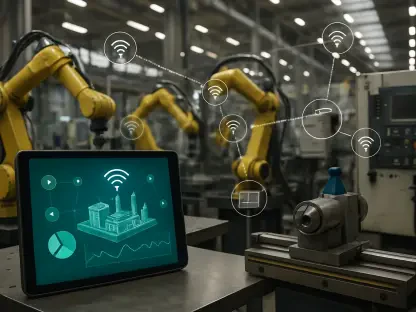
A fundamental technological transformation is reshaping our physical world, moving artificial intelligence from the distant, centralized cloud directly into the machines that interact with our daily lives. This migration to the network’s “edge” is giving rise to a new paradigm known as Physical AI, where vehicles, robots, and industrial equipment are no longer pre-programmed automatons but are becoming perceptive, adaptive entities capable of making complex, real-time decisions. This is not a gradual evolution but a seismic shift, catalyzed by a new generation of incredibly efficient, low-power silicon that has shattered the long-standing barriers of performance, energy consumption, and thermal management. This breakthrough in hardware is the primary enabler, making it possible to deploy immense computational power in constrained environments and paving the way for a strategic decentralization of intelligence that addresses critical flaws in cloud-dependent models, such as latency, privacy vulnerabilities, and reliability issues.
The Hardware Foundation of a New Era
At the core of this revolution, Qualcomm has established a new benchmark for industrial-grade processors with its 4nm Dragonwing IQ-X Series, which delivers an impressive 45 Tera-Operations Per Second (TOPS) of AI performance with exceptional thermal stability. The most significant strategic manifestation of this technology is the Arduino Uno Q, a “dual-brain” development board that ingeniously pairs a powerful Qualcomm Dragonwing application processor, capable of running sophisticated Linux-based AI models, with an STM32U575 microcontroller for precise, real-time control loops. Offered at a sub-$50 price point, this hybrid architecture effectively democratizes access to high-performance edge AI, lowering the barrier to entry for a vast community of developers, students, and startups. This move is designed to foster a new generation of engineers fluent in the Qualcomm ecosystem, solidifying the company’s position in the mid-range industrial and robotics markets by making advanced tools widely accessible.
Meanwhile, at the premium end of the spectrum, NVIDIA’s Jetson AGX Thor, based on the new Blackwell architecture, delivers an unprecedented 2070 TFLOPS of compute power within a flexible 40W to 130W thermal envelope. Critically, Thor is not merely a more powerful version of its predecessors; it is purpose-built for the unique demands of Physical AI. Its architecture features dedicated hardware acceleration for transformer models, which have become the industry standard for enabling robots and vehicles to understand complex 3D space, interpret visual inputs, and comprehend human intent through natural language. This specialized design solidifies NVIDIA’s leadership in the most demanding high-end applications, from autonomous driving to advanced industrial automation. A key industry trend reflected in both companies’ strategies is the departure from general-purpose processing toward specialized silicon designed for “multimodal awareness,” allowing a single chip to simultaneously handle disparate, high-demand tasks without performance degradation.
A Redrawn Competitive Landscape
These technological shifts have triggered a series of strategic acquisitions and partnerships that are fundamentally redrawing the industry’s competitive map. The central battle is being waged between Qualcomm and NVIDIA for dominance over the burgeoning Physical AI market. Qualcomm’s acquisition of Arduino is a masterful strategic stroke, directly challenging the Internet of Things and prototyping markets long held by competitors while simultaneously creating both a defensive moat and an offensive front against NVIDIA’s well-established Isaac and Jetson robotics platforms. By cultivating a massive, grassroots developer community through accessible and affordable hardware, Qualcomm is playing a long game, aiming to make its software and hardware stacks the default choice for the next wave of AI-powered physical devices. This ecosystem-first approach turns market penetration into a powerful competitive advantage that is difficult for rivals to replicate.
In response, other industry giants are actively recalibrating to remain competitive, leading to rapid market consolidation around the two main ecosystems. NXP Semiconductors bolstered its automotive cabin offerings by acquiring edge inference specialist Kinara for $307 million, a move aimed at enhancing its capabilities in in-vehicle AI. Teradyne, the parent company of collaborative robot leader Universal Robots, has solidified its market position by releasing the UR AI Accelerator. This kit, which notably integrates an NVIDIA Jetson AGX Orin, provides a 100x performance increase in motion planning, enabling its robots to tackle previously insurmountable “unstructured” tasks like palletizing mixed-sized boxes. Similarly, industrial robotics giant FANUC has partnered with NVIDIA to integrate Physical AI onto its factory floors, empowering robots to perform complex tasks like autonomous kitting with unprecedented flexibility by “seeing” and adapting to parts on moving assembly lines.
Reshaping Industries and Human-Machine Interaction
The rise of decentralized, capable Physical AI extends far beyond the technology sector, carrying profound implications for manufacturing, labor, and privacy. The advanced capabilities of these new AI-powered robots are a direct response to global labor shortages that have impacted supply chains and production schedules. By enabling robots to operate safely alongside humans as “cobots” and navigate unstructured, human-centric environments, automation can now be deployed in sectors and for tasks previously deemed too complex or costly. This allows manufacturers to bridge critical gaps in their workforce, enhance productivity, and build more resilient operations. These machines are no longer confined to repetitive, caged tasks but can now handle dynamic responsibilities in warehouses, on assembly lines, and in logistics, fundamentally altering the calculus of industrial automation.
Furthermore, this paradigm shift directly addresses primary consumer and regulatory concerns regarding data privacy and system reliability. In the automotive sector, localized processing guarantees that sensitive data, such as in-cabin conversations and video feeds from driver monitoring systems, remains securely within the vehicle, a critical feature for building consumer trust. For both automotive and industrial applications, the elimination of cloud-related latency ensures the reliability and instantaneous response required for safety-critical systems. This move is more significant than previous technological waves like the mobile revolution because it involves the delegation of physical agency to machines. The ability of a car to navigate a complex city intersection without cloud assistance or a robot to work in a dynamic warehouse without a safety cage represents a fundamental redefinition of humanity’s relationship with its technology.
The Road Ahead: Opportunities and Unresolved Challenges
As the industry moved forward, the trajectory pointed toward the mass deployment of general-purpose humanoid robots, with initiatives like NVIDIA’s Project GR00T leading the way. These advanced machines, powered by the latest generation of low-power silicon, were expected to find their initial applications in complex logistics and healthcare environments. In parallel, the trend of “TinyML” was set to continue its maturation, pushing sophisticated AI models onto even smaller, milliwatt-power microcontrollers. However, significant challenges remained. The industry recognized the urgent need to develop rigorous and standardized frameworks for “AI safety” at the edge to ensure that autonomous decisions were both explainable and fail-safe. In the near term, a consensus formed around the proliferation of “Edge-to-Cloud” hybrid models. This approach leveraged edge devices for immediate perception and action while using the cloud for fleet-wide data analysis, long-term learning, and model optimization, representing the most pragmatic path forward. The era’s defining challenge had shifted from whether AI could think to whether it could act—safely, reliably, and efficiently—in the physical world.