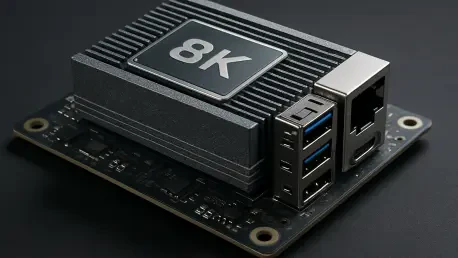

The increasing demand for sophisticated, real-time processing directly on IoT devices has created a significant gap between powerful but cumbersome multi-board systems and less capable off-the-shelf modules, challenging manufacturers to deliver next-generation experiences without prohibitive costs and complexity. Addressing this very challenge, Quectel Wireless Solutions has introduced its new-generation flagship smart module, the SP895BD-AP, engineered to embed smartphone-class computing and graphics capabilities into high-end multimedia and edge AI applications. This module represents a pivotal step in the evolution of the Internet of Things, providing a unified solution that combines immense processing power with advanced media features, set to redefine what is possible in sectors ranging from professional conferencing and digital signage to smart retail and industrial automation.
Unleashing Next-Generation Performance
The Power of an Advanced Processing Core
At the heart of the SP895BD-AP module lies the formidable Qualcomm Dragonwing™ Q-8750 processor, a component that sets a new standard for performance and efficiency in the embedded systems market. Fabricated on a cutting-edge 3nm process, this processor features an 8-core high-performance Oryon™ CPU architecture, which delivers a remarkable 45% improvement in raw CPU performance over its predecessors. This substantial leap in processing power enables the module to execute complex, multi-threaded algorithms and handle concurrent demanding tasks with unprecedented speed and responsiveness. Just as crucial is the 44% optimization in energy efficiency, a critical factor for edge devices that often operate under strict power and thermal constraints. This balance ensures that devices built around the module can sustain peak performance for extended periods without succumbing to thermal throttling or excessive power drain. This capability is essential for applications such as real-time video analytics, sophisticated machine vision systems, and interactive digital experiences that require continuous, high-intensity computation directly at the edge, moving beyond the latency limitations of cloud-based processing.
Revolutionizing On-Device Graphics and Imaging
Complementing its powerful CPU, the module integrates an Adreno™ Series 8 GPU, which achieves a significant 40% enhancement in both graphics processing power and energy efficiency. This advancement unlocks the ability to drive ultra-high-definition displays, including 8K and immersive 3D screens, with exceptionally smooth and lifelike rendering. The SP895BD-AP establishes a new industry benchmark with its media processing capabilities, supporting 8K video encoding at 30 frames per second and, even more impressively, 8K decoding at a fluid 60 frames per second. This ensures low-latency video transmission and high-fidelity restoration, meeting the stringent requirements of professional-grade video conferencing systems, large-scale 4K/8K digital signage, and advanced medical imaging displays. The module’s imaging prowess is further amplified by three built-in Image Signal Processors (ISPs). This sophisticated setup allows the simultaneous processing of three separate 48-megapixel video streams, while a single camera can capture still images at a breathtaking resolution of up to 108 megapixels, enabling a new class of multi-camera devices with superior visual intelligence.
Accelerating Innovation at the IoT Edge
Driving the Shift from Cloud to Edge
The launch of the SP895BD-AP serves as a powerful catalyst for the ongoing industry-wide migration of advanced processing workloads, such as complex video analytics and synthetic imaging, from centralized cloud servers to the device edge. This module effectively closes the performance gap that previously existed between expensive, custom-built edge AI hardware and more accessible, standard off-the-shelf modules. By providing a potent, all-in-one solution, it empowers original equipment manufacturers (OEMs) to consolidate multiple, disparate system boards—which often include separate CPU, GPU, ISP, and codec boards—into a single, highly integrated, and compact module. This consolidation yields significant benefits, most notably by dramatically shortening product design cycles, reducing system complexity, and lowering the overall bill of materials. As a result, companies can accelerate their time-to-market for a new generation of intelligent edge products, innovating more rapidly and efficiently while delivering the low-latency, high-performance experiences that modern applications demand, without the dependency and recurring costs associated with cloud computing.
Designed for Seamless Integration and Versatility
Beyond its raw performance, the SP895BD-AP is meticulously designed for flexible and straightforward integration into a wide array of product forms. It is delivered in a compact LGA (Land Grid Array) package, making it suitable for designs where physical space is at a premium. The module is equipped with a comprehensive suite of peripheral interfaces that provide extensive connectivity options for developers. These include multiple MIPI DSI and CSI ports for connecting high-resolution displays and cameras, PCIe for high-speed peripherals like solid-state storage, and a full range of standard interfaces such as USB, I2S, UART, and SPI. This wealth of I/O options ensures the module can be adapted to numerous IoT applications, from interactive retail kiosks and smart home hubs to advanced industrial control systems. Further broadening its appeal and accessibility, the module offers native support for both the Android 15 and Linux operating systems. This dual-OS compatibility significantly lowers the technical barrier to entry for development teams across a diverse industry ecosystem, allowing them to leverage their existing software expertise and toolchains to build sophisticated applications more quickly.
A Foundation for Future Smart Devices
The introduction of this high-performance smart module marked a significant turning point in the embedded systems landscape. It effectively dissolved the long-standing barriers between the computational power reserved for flagship mobile devices and the requirements of the industrial and commercial IoT sectors. The module’s launch demonstrated that resource-intensive tasks, including real-time 8K media manipulation and sophisticated on-device AI inferencing, had become not only possible but also practical for a much broader range of applications. This development provided engineers and product designers with a powerful, integrated foundation upon which they could build a new generation of intelligent devices. As a result, concepts that were previously constrained by the high cost and complexity of custom hardware—such as multi-camera intelligent security systems, interactive digital signage, and advanced telehealth platforms—were made more accessible, paving the way for accelerated innovation across the industry.