
In a digital landscape where malicious actors are already siphoning encrypted data with the intent to break it using future quantum computers, the search for a commercially viable, forward-looking security solution has become an urgent priority for global enterprises. The era of quantum computing is no longer a distant theoretical concept but an impending reality that threatens to render current encryption standards obsolete. Against this backdrop, Toshiba’s Quantum Key Distribution (QKD) system emerges not merely as a new product but as a foundational technology for a new era of secure communications, promising a defense mechanism that is, by the laws of physics, unbreakably secure.
Evaluating a Quantum-Ready Security Solution
The objective of this review is to conduct a thorough assessment of Toshiba’s Quantum Key Distribution technology, moving beyond its theoretical elegance to evaluate its practical performance, commercial viability, and strategic value. The core question is whether this advanced security solution represents a necessary and timely investment for organizations responsible for protecting critical data infrastructure. As the timeline for cryptographically relevant quantum computers shortens, with some projections anticipating their arrival by 2030, the need for proactive security measures has never been more pressing.
This analysis scrutinizes the technology’s ability to serve as a bulwark against the “harvest now, decrypt later” threat, where adversaries collect today’s encrypted data to break it with tomorrow’s quantum machines. The review will therefore focus on whether Toshiba’s QKD system is ready for real-world deployment, capable of integrating into existing networks without compromising performance, and if it provides a tangible return on investment by future-proofing an organization’s most valuable digital assets against an inevitable and disruptive technological shift.
Dissecting Toshiba’s Quantum Key Distribution System
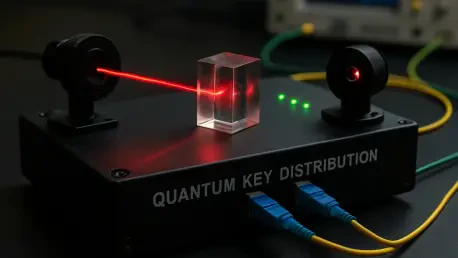
At its heart, Toshiba’s QKD system leverages the fundamental principles of quantum mechanics to achieve a level of security that classical cryptography cannot promise. Instead of relying on mathematical complexity, the technology uses photons—single particles of light—to transmit a secret key between two parties. The act of intercepting or even observing these photons inevitably disturbs their quantum state, an intrusion that is immediately detectable. This physical property ensures that any attempt at eavesdropping is revealed, allowing the system to discard the compromised key and generate a new one, thereby guaranteeing the integrity of the key distribution process.
The system’s architecture is designed for integration with today’s infrastructure, a critical factor for commercial adoption. This was demonstrated in a landmark collaboration with Quantum Corridor, where the QKD technology was deployed over a live 21.8-kilometer commercial fiber optic network connecting Illinois and Indiana. This setup proves that the solution is not confined to laboratory environments but can operate effectively over standard, commercially available fiber, making it a practical upgrade for existing telecommunication and data center networks rather than a solution requiring a complete infrastructure overhaul.
Real-World Performance and Network Integration
Performance under real-world conditions is the ultimate test for any new technology, and in this regard, Toshiba’s QKD system delivered exceptional results. During the live demonstration, the system consistently generated secure cryptographic keys at an average rate of 1,500 kilobits per second (kbps). This rate is more than sufficient to support the demanding encryption requirements of high-speed, high-volume data transmissions, proving its suitability for mission-critical applications.
Moreover, the technology demonstrated seamless interoperability with established commercial hardware. The quantum-generated keys were successfully integrated into a Ciena Waveserver5, a widely used 800G encryption platform, to secure the data traffic. The system was configured to refresh the tamper-proof QKD keys every 90 seconds, providing continuous and dynamic protection. Most importantly, over a sustained 48-hour test period with encrypted traffic, the network maintained 100% line-rate throughput with zero packet loss. This result is paramount, as it confirms that implementing this quantum-secure layer does not introduce latency or degrade the high-performance standards expected of modern commercial networks.
Strengths and Strategic Considerations
The primary strength of Toshiba’s QKD lies in its ability to provide “forward security”—a definitive protection against future threats that current algorithms cannot guarantee. By creating physically secure keys, it neutralizes the risk of “harvest now, decrypt later” attacks, ensuring that data protected today remains secure even after quantum computers become widely available. This makes it an indispensable tool for sectors handling sensitive, long-term data, such as government, finance, and healthcare. Furthermore, the technology serves as a critical enabler for the next generation of computing, providing the secure connective tissue needed for a distributed quantum computing ecosystem, where remote quantum processors can securely collaborate.
However, organizations must also weigh strategic considerations. The adoption of QKD technology involves a significant upfront investment in specialized hardware and integration. Decision-makers must balance this cost against the timeline of the quantum threat, which, while increasingly clear, is not yet precisely defined. The decision to invest becomes a matter of risk management: it is akin to purchasing insurance against a highly probable and catastrophic future event. Waiting for the threat to fully materialize means it will be too late to build the necessary resilient infrastructure.
Final Verdict a Milestone in Commercial Quantum Security
The successful live demonstration of Toshiba’s Quantum Key Distribution system on a commercial network marks a pivotal moment for cybersecurity. The trial proves that QKD is no longer an experimental technology confined to research labs but a mature, robust, and deployable solution ready to address real-world security challenges. Its demonstrated high-speed key generation, seamless integration with existing network hardware, and flawless performance without packet loss confirm its commercial readiness.
This achievement represents a significant and practical step toward building a truly quantum-secure internet. By validating its functionality across state lines in a major metropolitan area, Toshiba and its partners have established a new benchmark for secure communications. The technology stands as a viable and powerful defense against the impending threat of quantum computing, offering a clear path for organizations to begin future-proofing their critical data infrastructure today.
Recommendations for Proactive Adoption
Early adoption of quantum-resilient technologies like Toshiba’s QKD is a strategic imperative for organizations that are custodians of sensitive, high-value data. Sectors such as data centers, financial institutions, government agencies, and healthcare providers, whose data has a long shelf-life and high confidentiality requirements, stand to benefit most from being at the forefront of this transition. For these entities, the risk of data exfiltration and future decryption is not a distant concern but an active and present danger.
Investing now in a quantum-secure networking foundation is not just a defensive move; it is a forward-thinking strategy that builds a competitive advantage. It establishes the secure infrastructure necessary to leverage future technologies like distributed quantum computing and advanced AI collaborations. The evidence is clear: the time to plan for the quantum future is not in a few years, but now. Proactively building a quantum-resilient posture is the only logical course of action for any organization serious about long-term data security.