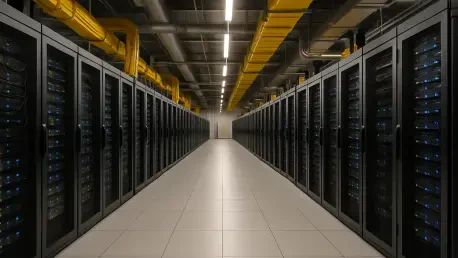

The digital backbone of the modern economy is demanding an unprecedented capital infusion, with projections pointing toward a staggering $3 trillion investment need over the next five years to keep pace with innovation. This monumental financial requirement signals the arrival of an investment supercycle, an era of explosive growth driven by the insatiable computational demands of artificial intelligence and the exponential increase in digital data generation. The following analysis dissects the key market drivers behind this surge, analyzes the fundamental shifts in development strategy, explores the future challenges facing the industry, and assesses the rapid financial maturation of the data center sector.
The Anatomy of a Global Supercycle
The Statistical Case for Explosive Growth
The scale of the impending expansion is immense. Global data center capacity is projected to nearly double over the next four years, surging from its current 103 gigawatts (GW) to an estimated 200 GW by 2030. Artificial intelligence serves as the primary catalyst for this growth, with AI-related workloads expected to consume half of all global capacity by 2030, a sharp increase from their current share of approximately 25%. This rapid adoption is creating a dynamic environment where infrastructure needs are constantly evolving.
A critical inflection point is anticipated around 2027, when AI inference—the operational use of trained models—is forecast to surpass AI training as the dominant compute workload. This shift has significant implications for facility design and power requirements. Underpinning this AI-driven demand is the relentless proliferation of digital information, which continues to expand at a 24% compound annual growth rate (CAGR), effectively doubling the world’s total volume of data every four years and necessitating a continuous build-out of foundational infrastructure.
Real-World Market Health and Investor Confidence
Despite the torrid pace of development, the market exhibits robust fundamentals that suggest sustained, healthy demand rather than a speculative bubble. Global occupancy rates are holding steady near 97%, an exceptionally high figure that indicates supply is struggling to keep up with absorption. This strong demand is further validated by the fact that a remarkable 77% of the entire global construction pipeline is already pre-leased, a clear signal of long-term tenant commitment that significantly de-risks new development projects for investors and financiers.
These tight market conditions are translating directly into strong financial performance. Driven by persistent supply constraints, particularly in established primary markets, lease rates are forecast to grow at a steady 5% CAGR through 2030. This reliable growth trajectory provides investors with confidence in the long-term value proposition of data center assets, reinforcing the sector’s appeal as a destination for large-scale capital deployment.
Expert Insight Power Becomes the New Prime Real Estate
The criteria for successful data center development have fundamentally changed. According to industry leaders like Sean Farney, JLL’s vice president of data center strategy, power availability has eclipsed all other factors, including location. He emphasizes this paradigm shift, stating, “Without committed power, there is far too much risk to finance a build.” This reality has forced a strategic pivot across the industry, where securing access to massive amounts of electricity is now the first and most critical step in any new project.
This power-centric approach is also sparking a revolution in facility design. As the power density required per cabinet escalates to support advanced computing, the era of static, one-size-fits-all designs is over. “I can’t emphasize enough what a big change this has been for the industry,” Farney notes, highlighting the move toward flexible, future-proofed infrastructure capable of adapting to evolving technological requirements over a facility’s lifecycle.
The Future Outlook Challenges Innovations and Regional Dynamics
Navigating the Power and Supply Chain Bottleneck
In response to power saturation in traditional hubs, the industry is shifting to a “power opportunistic” site selection model. Developers are increasingly expanding into non-traditional markets like Wisconsin and Louisiana, where ample power is available, moving away from primary markets where grid connection delays can exceed four years. To further circumvent these bottlenecks, operators are pursuing innovative solutions like on-site power generation and “Bring Your Own Power” models.
Compounding the power challenge are significant supply chain issues that continue to plague the industry. With global average lead times for critical equipment, such as generators and switchgear, now at 33 weeks, project timelines are frequently extended. This forces developers to de-risk their schedules by integrating design, sourcing, and delivery more tightly and securing power commitments much earlier in the planning process.
The Maturation of an Asset Class
The immense scale of required investment has triggered an evolution in capital strategies. Core investment funds, which target stable, long-term assets, now represent nearly 25% of all fundraising activity in the sector, a substantial increase from less than 10% in previous years. This demonstrates a growing perception of data centers as a reliable, mainstream infrastructure class rather than a niche real estate segment.
The financial maturation of the sector is also evident in the increasing use of sophisticated financial instruments. Asset-backed securities (ABS) and commercial mortgage-backed securities (CMBS) are becoming common financing mechanisms, signaling the industry’s integration into broader capital markets. This development provides the liquidity and scale necessary to fund the multi-trillion-dollar supercycle.
A Forecast of Global Expansion
Regionally, the Americas are poised to continue their market dominance, projected to account for half of the world’s total data center capacity by 2030. The United States is the primary engine of this growth, comprising an estimated 90% of the region’s capacity. This reflects the concentration of major technology companies and cloud service providers within the U.S.
Meanwhile, other regions are set for substantial growth. The Asia-Pacific (APAC) region is expected to see its capacity expand significantly, from 32 GW to 57 GW, driven by rapid digitalization and economic growth. The Europe, the Middle East, and Africa (EMEA) market is also anticipated to add approximately 13 GW of new supply as hyperscalers expand their footprint and digital transformation initiatives accelerate across the region.
Conclusion A New Era of Critical Infrastructure
The analysis revealed an industry in the grip of an AI-fueled supercycle, one defined by massive investment requirements and unprecedented demand. Power availability emerged as the primary constraint shaping the sector’s future, forcing a fundamental reevaluation of site selection, design, and operational strategy.
This trend underscored the sector’s profound transformation into a mature, critical infrastructure asset class, which attracted significant and increasingly sophisticated institutional capital. The growing use of complex financial instruments and the pivot toward core investment strategies marked the data center’s arrival as a cornerstone of the modern global economy.
Ultimately, the path to success in this new era depended on innovating beyond traditional real estate strategies. The operators who thrived were those who effectively solved the complex interplay of power acquisition, flexible facility design, and resilient supply chain management, proving that adaptability was the key to capitalizing on this historic wave of growth.