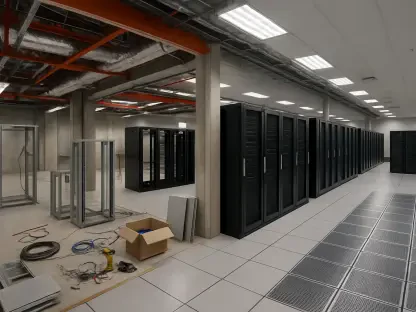

The global technology landscape is undergoing a seismic shift, with the very foundations of the digital world being rebuilt to accommodate an insatiable new demand. This transformation is not a fleeting trend but the beginning of a prolonged, capital-intensive expansion of cloud computing infrastructure, a race projected to last at least a decade. Championed by industry leaders like Amazon Web Services CEO Matt Garman, this strategic outlook is driven by the explosive and computationally demanding nature of artificial intelligence. The implications are profound, signaling an extended period of aggressive investment, fierce competition, and a complex web of logistical, environmental, and technological challenges that will redefine the digital economy for years to come.
The New Reality AI as the Unstoppable Driver
An Industry-Wide Consensus
Across the cloud computing sector, a firm and shared understanding has emerged: the industry is at the dawn of an unprecedented and sustained surge in demand for data center capacity. This is not business as usual; it is a fundamental reordering of priorities, with the computational requirements of artificial intelligence serving as the primary catalyst. This consensus, articulated clearly by market leader AWS and mirrored in the strategic actions of competitors like Microsoft Azure and Google Cloud, revolves around several core themes. The most prominent is the dramatic pivot from traditional computing workloads to power-intensive AI models, which has in turn elevated the availability of electrical power from a simple operational cost to the single most critical bottleneck for growth. This shift has created a domino effect, influencing everything from global supply chains and real estate markets to financial planning and environmental regulations. Garman’s public forecast serves as a clear industry-wide signal that the hyperscale cloud providers are preparing for a marathon of infrastructure construction, not a short-term sprint, with strategic decisions being made today that will fundamentally shape market dynamics well into the 2030s.
The actions of the major cloud players underscore this long-term commitment, moving beyond mere rhetoric to massive capital allocation. This unified direction indicates that the industry sees the current AI-driven demand not as a bubble but as the new baseline for future growth. The competitive landscape is being redrawn around the ability to build and operate these next-generation facilities at an immense scale. Consequently, hyperscalers are no longer just technology companies; they are becoming major players in energy, real estate, and global logistics. The strategic imperative is to secure the foundational resources—land, power, and specialized hardware—years in advance of anticipated need. This forward-looking posture reflects a belief that the risk of being caught with insufficient capacity, and thus ceding market share in the lucrative AI services space, far outweighs the financial risk of overbuilding. The entire industry is therefore engaged in a high-stakes, long-term race where the winners will be those who can most effectively navigate the complex interplay of technology, finance, and resource management over the coming decade.
The Computational Engine of the Race
The primary engine propelling this decade-long infrastructure expansion is the unique and staggering computational intensity inherent in modern artificial intelligence. Unlike the relatively predictable and manageable workloads of traditional cloud computing, such as data storage or web hosting, the tasks associated with large language models (LLMs) and generative AI applications operate on an entirely different scale. Training a single advanced AI system requires massive parallel processing capabilities, often harnessing thousands of specialized graphics processing units (GPUs) that must work in perfect concert. This process consumes an exponential amount of electrical power and, as a byproduct, generates a correspondingly immense amount of heat. As a result, the data center designs that have served the industry for the past two decades are now functionally inadequate. This fundamental technological shift necessitates a complete rethinking of facility architecture, demanding entirely new approaches to power distribution, high-density server rack configurations, and, most critically, advanced cooling infrastructure to dissipate the intense thermal loads.
This escalating demand is not theoretical; it is a tangible force reshaping investment strategies. Market analysts project that AI-related compute demand could increase by a factor of ten within the next five years alone, a figure that directly substantiates the decade-long outlook for infrastructure expansion. This forecast explains the palpable urgency with which AWS and its competitors are moving to secure the essential building blocks for this new era. The race is on to acquire vast tracts of suitable land, secure long-term contracts for networking equipment, and, most importantly, gain access to massive and reliable sources of power. Every decision is being viewed through the lens of a long-term strategy, where the ability to deploy AI-ready infrastructure at speed and scale will be the primary determinant of competitive advantage. The aggressive acquisition of these foundational resources today is a direct investment in a company’s ability to capture the enormous market opportunity presented by the AI revolution tomorrow.
Navigating the Core Constraints and Consequences
The Great Power Bottleneck
Of all the challenges facing the cloud industry’s expansion, the single most significant constraint has become the availability of electrical power. The scale of energy required by a modern, AI-optimized data center is staggering; a single facility can demand a continuous supply of 100 megawatts or more, an energy footprint equivalent to that of a small city or tens of thousands of homes. This voracious demand is placing an immense and often unforeseen strain on regional power grids, many of which were not designed to accommodate such concentrated loads. Consequently, the primary bottleneck in the data center buildout is no longer the construction of the physical building but the complex and time-consuming process of securing long-term, stable power contracts and interconnection agreements with utility providers. This reality has forced cloud providers to evolve into major players in the energy sector, investing billions of dollars directly into renewable energy projects like solar and wind farms, exploring strategic partnerships for next-generation nuclear power, and even developing their own on-site power generation capabilities to ensure supply.
A critical challenge compounding this issue is the significant temporal mismatch between construction timelines and energy infrastructure development. A hyperscale data center can be planned and built in approximately three years. In stark contrast, bringing new large-scale power generation and transmission capacity online can take much longer, often five to ten years or more, due to regulatory hurdles, environmental reviews, and the sheer complexity of the engineering. This dynamic is fundamentally altering the calculus of site selection. Proximity to existing, robust electrical infrastructure has been elevated to a top-tier consideration, often outweighing traditional factors like fiber optic network connectivity or local tax incentives. Cloud providers are now compelled to engage in sophisticated, long-range energy planning, working directly with utilities and energy developers to forecast their needs and co-invest in the grid upgrades necessary to support their future facilities, making energy strategy a cornerstone of their long-term business plans.
Ripple Effects Across the Economy
Garman’s forecast of a decade-long buildout extends far beyond AWS, signaling an industry-wide imperative that is igniting fierce competition and reshaping adjacent markets. Microsoft has been particularly aggressive, driven by its deep strategic partnership with OpenAI, committing over $50 billion to capital expenditures in a single fiscal year, with the overwhelming majority allocated to its cloud and AI infrastructure. Google Cloud is similarly ramping up its spending to keep pace. This competitive dynamic creates a high-stakes balancing act for all providers. They must weigh the risk of overbuilding and potentially depressing their returns on capital against the far greater strategic danger of facing capacity constraints, which could drive enterprise customers and their valuable AI workloads to competitors. The public statements from AWS leadership indicate a firm conviction that the projected demand curve for AI services more than justifies the risks associated with this aggressive expansion, setting a bold pace for the entire market.
This massive buildout is producing tangible and often disruptive consequences for related economic sectors. In key technology corridors like Northern Virginia’s “Data Center Alley,” as well as in rapidly emerging hubs such as Phoenix and Atlanta, the intense competition for suitable land has caused commercial real estate prices to surge. Furthermore, the increasing complexity of modern AI facilities has extended typical construction timelines from 18-24 months to three years or more, meaning that investment decisions made today will directly dictate a provider’s competitive standing in the latter half of this decade. This expansion also places enormous and sustained pressure on global technology supply chains. Nvidia, the dominant provider of AI-accelerating GPUs like the #00 and ##00, has faced persistent challenges in meeting the overwhelming demand from hyperscalers. Consequently, lead times for other critical components—including advanced networking equipment, power distribution units, and specialized liquid cooling systems—have all lengthened as manufacturers worldwide struggle to scale their production capacity, creating significant forecasting risk for cloud providers.
Evolving Strategies for a New Era
The Financial and Regulatory Tightrope
From a financial perspective, Wall Street is closely monitoring the unprecedented and sustained capital intensity required to compete in this new era of cloud computing. The elevated capital expenditures necessary for this decade-long buildout will likely constrain free cash flow for the major cloud providers, potentially limiting funds that might otherwise be available for strategic acquisitions, research in other areas, or direct shareholder returns. This level of investment represents a significant long-term bet on the future of AI. However, the potential reward is substantial; the providers who successfully build out capacity ahead of the demand curve stand to capture a dominant share of the burgeoning and high-margin AI services market, securing a foundational role in the next wave of technological innovation. Investors are therefore tasked with balancing the short-term impact on financial metrics against the long-term strategic positioning of these companies in an AI-driven economy.
Simultaneously, the massive scale of these data center projects is attracting greater regulatory and environmental scrutiny from governments and communities worldwide. The immense power draw is causing utilities in some regions to deny or delay new interconnection requests pending major upgrades to the electrical grid, creating a new layer of uncertainty for development timelines. Water usage for cooling systems has also become a major point of contention, especially in arid or water-stressed regions. This has led some local and state jurisdictions to impose restrictions that force operators to move away from traditional evaporative cooling methods and adopt more complex and costly alternatives, such as air-cooling or closed-loop liquid systems. Navigating this evolving regulatory landscape has become a critical competency for cloud providers, requiring sophisticated engagement with policymakers and a demonstrable commitment to sustainable operating practices to secure the necessary permits and social license to operate.
Innovating from the Ground Up
In direct response to these formidable challenges, the very architecture of cloud infrastructure is undergoing a rapid and fundamental evolution. To improve efficiency and combat the constraints of power availability, hyperscalers like AWS are investing heavily in designing their own custom silicon. Chips such as AWS’s Trainium and Inferentia are meticulously optimized for specific AI workloads, aiming to deliver superior performance-per-watt compared to general-purpose processors. This vertical integration strategy allows them to fine-tune hardware to their software and service needs, wringing out maximum efficiency and reducing the overall energy footprint of their operations. This move toward custom hardware is not merely an engineering exercise; it is a critical business strategy aimed at mitigating the primary bottleneck of power consumption while simultaneously enhancing the performance and cost-effectiveness of their AI service offerings, creating a significant competitive differentiator in a crowded market.
Alongside hardware innovation, the networking fabric that connects servers within and between data centers is also being completely revolutionized. The distributed nature of training large-scale AI models requires the constant movement of petabytes of data between thousands of servers at ultra-low latency. Any bottleneck in this internal communication can bring a multi-million dollar training run to a grinding halt, wasting valuable compute time and energy. As a result, networking architecture has become a primary focus of innovation and a significant portion of the overall infrastructure cost. Cloud providers are developing bespoke networking technologies and topologies designed specifically to handle the massive east-west traffic patterns characteristic of AI workloads. This represents a profound shift from traditional data center networking, which was primarily optimized for traffic moving in and out of the facility, and underscores the holistic, ground-up redesign required to build the foundational platforms for the AI era.
A Blueprint for the Future
The message from the cloud industry’s leadership was unequivocal. The era of massive data center expansion had not ended but had instead accelerated into a new, more intense phase destined to last for at least another decade. Driven by the transformative power of artificial intelligence, this race was defined by a complex interplay of immense opportunity and significant constraints, including power availability, supply chain logistics, and mounting regulatory pressures. The companies that demonstrated the ability to masterfully navigate these challenges, manage monumental capital investments, and innovate in facility design and custom hardware emerged as the foundational platforms for the AI-driven economy of the future. Their success provided a blueprint for how to build the digital infrastructure required to power the next generation of technological progress.