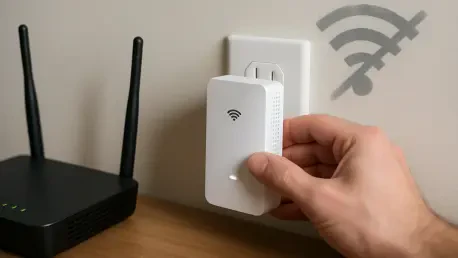

The relentless search for a stable wireless signal has become a familiar, often frustrating, ritual in the modern household, where everything from smart appliances to home offices demands uninterrupted connectivity. These perplexing areas, commonly known as Wi-Fi dead zones, are frustrating gaps in coverage where the signal from a router weakens or disappears entirely, frequently caused by physical obstructions like thick walls, metal appliances, or simply the distance from the source. While moving a router can sometimes provide a partial fix, this approach is often impractical due to cabling constraints and the architectural layout of a home. Consequently, many users turn to dedicated solutions designed to overcome these limitations. Wi-Fi extenders, also known as boosters or repeaters, have emerged as one of the most accessible and effective tools for this purpose, capturing the existing signal from a primary router and rebroadcasting it to fill in these coverage gaps, thereby creating a more robust and reliable network throughout the entire living space.
Enhancing Connectivity with Modern Extenders
Today’s Wi-Fi extenders have evolved far beyond their predecessors, offering sophisticated features that cater to the high-bandwidth demands of contemporary internet usage. Many modern devices are engineered to support transmission speeds suitable for data-intensive activities, delivering performance that minimizes buffering during 4K video streams, eliminates lag in competitive online gaming, and ensures clarity during important video calls. A key element of their effectiveness is their versatile functionality. Most extenders operate in a standard Repeater Mode, which captures the existing wireless signal and amplifies it to cover hard-to-reach areas. In addition, many now include an Access Point (AP) Mode. When connected to a router via an Ethernet cable, this mode allows the device to create an entirely new, high-speed wireless hotspot, which is particularly useful for providing a stronger, dedicated connection in a remote room or for devices that benefit from a wired backhaul. This dual-mode capability, combined with universal compatibility with virtually any standard Wi-Fi router or gateway, ensures a flexible and powerful solution for nearly any home network configuration.
Seamless Integration and User-Friendly Design
Beyond raw performance, the design and usability of network-enhancing devices are critical for a positive user experience, and manufacturers have made significant strides in simplifying their integration into daily life. The setup process, once a daunting task for non-technical users, is now often streamlined to a near-effortless procedure, frequently involving a simple one-touch connection using the Wi-Fi Protected Setup (WPS) button on both the extender and the router. For more granular control, many extenders are supported by intuitive mobile applications that allow users to manage their network settings, monitor connected devices, and adjust configurations directly from a smartphone or tablet. Security remains a top priority, with robust support for WPA/WPA2 encryption protocols to safeguard the network from unauthorized access. The physical design has also been thoughtfully considered, with many models featuring a compact, wall-plug form factor that blends discreetly into any room’s decor. Even minor details, such as LED indicators with a “Night Mode” to prevent sleep disturbances, demonstrate a commitment to creating technology that enhances a home environment without becoming an obtrusive presence.
A Comprehensive Network Realized
The decision to deploy a network extender was ultimately a strategic one that addressed the specific architectural challenges of the space, transforming previously unreliable areas into fully functional zones of connectivity. The selection process involved assessing the home’s layout, identifying the precise locations of signal degradation, and choosing a device with the appropriate speed and features to support the household’s digital activities. Once installed, the extender seamlessly integrated with the existing network infrastructure, and its impact was immediate. The frustration of dropped video calls in the home office and buffered streaming in the living room became a thing of the past. This successful resolution underscored the importance of not just having powerful technology, but understanding how to apply it effectively to create a truly comprehensive and dependable wireless environment. The final outcome was a home where the digital and physical worlds coexisted without conflict, a testament to how a small, well-chosen device could make a significant difference.