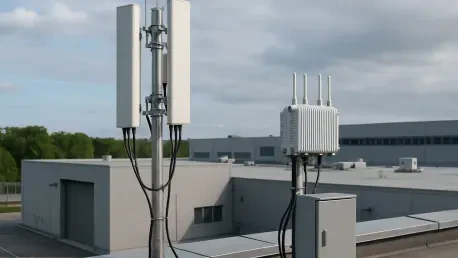

The widespread adoption of private wireless networks, particularly on the Citizens Broadband Radio Service (CBRS) spectrum, is revolutionizing enterprise operations by delivering unprecedented control and reliability for critical data applications. However, this technological leap forward has inadvertently created a significant connectivity blind spot within the very facilities it aims to empower. While these private systems provide a robust backbone for robotics, automated guided vehicles, and secure machine automation, they are fundamentally incapable of natively supporting the public carrier services essential for everyday communication. This critical flaw means that employees, visitors, and contractors often find their smartphones without a signal, severing their connection to vital voice calls, text messages, and, most alarmingly, emergency 911 services. This situation creates a stark disconnect, where a facility can be a model of operational efficiency yet a dead zone for basic human communication, posing serious safety risks and undermining the goal of a truly connected workforce.
The Private Network Paradox
Private networks have emerged as a superior alternative to traditional Wi-Fi for enterprises that depend on flawless data connectivity for their mission-critical functions. These dedicated systems offer a compelling suite of advantages, including lower latency, enhanced security, and guaranteed bandwidth, which are indispensable for modern industrial and commercial environments. By operating on dedicated or lightly licensed spectrum like CBRS, they avoid the congestion and interference common on public Wi-Fi networks, ensuring that data-intensive applications such as real-time video analytics, machine-to-machine communication, and automated inventory management systems operate without interruption. The ability for an organization to manage its own network infrastructure provides an unparalleled level of control over performance, security protocols, and device access, enabling a highly customized and optimized environment tailored specifically to its operational demands. This is why industries from manufacturing to logistics are increasingly viewing private wireless as a foundational technology for digital transformation.
Despite their clear advantages for operational data, the reliance on a private-only wireless strategy introduces a significant paradox that can cripple an organization’s overall communication capabilities. The very isolation that makes these networks secure and reliable for machines renders them useless for standard mobile devices connecting to public carrier networks. This creates a dual-network environment where operational technology thrives while personal and essential communication falters. An employee managing an automated system might have perfect data connectivity for their work terminal but be unable to receive an urgent call from a family member or contact emergency services from their smartphone. This limitation is not merely an inconvenience; it is a critical operational and safety liability. In a world where mobile devices are the primary tool for communication, collaboration, and emergency response, forcing personnel and visitors into a communication black hole is a step backward, directly conflicting with the objectives of creating a safe, efficient, and fully integrated workplace.
Bridging The Coverage Void
The root of this connectivity problem often lies in a simple economic reality: for major public carriers, providing dedicated, robust indoor cellular coverage for every enterprise facility is frequently not a justifiable expense. Warehouses, large manufacturing plants, and expansive corporate campuses often suffer from poor or non-existent macro network signals due to their construction materials and location, creating a pervasive “coverage void.” Public carriers must prioritize their network investments for broad public use, leaving individual enterprises to fend for themselves when it comes to in-building service. This places organizations in an untenable position, forcing them to choose between deploying a high-performance private network for their operational needs or forgoing those benefits to pursue a costly and complex solution for public cellular coverage. This dilemma effectively pits operational efficiency against fundamental communication, a trade-off that no modern business should have to make in its pursuit of a comprehensive mobility strategy.
Hybrid Distributed Antenna Systems (DAS) have emerged as the definitive and most efficient solution to bridge this critical gap, creating a unified and complete connectivity ecosystem. A hybrid DAS functions by capturing existing over-the-air signals from all major public carriers using a single donor antenna, then amplifying and distributing those signals uniformly throughout a facility via a streamlined fiber-optic infrastructure. This technology runs seamlessly in parallel with a private CBRS network, often sharing the same physical distribution layer to create a single, efficient radio frequency environment that serves both public and private needs without interference. The key advantage of this approach is its carrier-agnostic nature and cost-effectiveness. It provides comprehensive multi-carrier coverage without requiring any direct investment, equipment, or complex negotiations with the carriers themselves, offering a solution that is a fraction of the cost of a traditional, carrier-funded DAS installation.
A Unified Mobility Strategy Realized
The investigation into enterprise connectivity solutions conclusively showed that integrating a private wireless network with a hybrid DAS created the only truly comprehensive mobility framework. This synergistic approach effectively resolved the inherent conflict between securing specialized operational data streams and providing universal access to public carrier networks for voice, messaging, and emergency services. It became clear that as private network deployments accelerated, the hybrid DAS was not merely an add-on but an essential companion technology. The ultimate conclusion drawn was that for any enterprise that had planned a CBRS deployment, a strategy that failed to incorporate a hybrid DAS for public cellular coverage was correctly identified as an incomplete and fundamentally flawed approach to achieving modern, enterprise-wide connectivity. This unified model set a new standard, ensuring both operational excellence and universal human communication were fully supported.