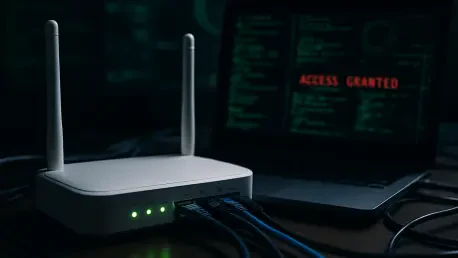

Matilda Bailey brings a wealth of knowledge regarding the intricate plumbing of the global internet, specializing in the high-speed transitions that define modern data centers. As carriers and enterprises migrate toward blistering 400G and 800G speeds, the stakes for securing the core infrastructure have never been higher. Our conversation explores the recent critical vulnerability in Juniper PTX series routers, focusing on how these high-performance machines can become silent accomplices for attackers if left unpatched. We dive into the strategic value of core infrastructure, the inherent risks of automated diagnostic features, and the difficult balancing act between maintaining constant uptime and applying essential security updates.
Since PTX core routers handle 400G and 800G traffic in major data centers, why is a root-privilege vulnerability at the network core significantly more devastating than one at the edge?
When you lose a device at the edge, you are looking at a localized fire, but a compromise at the network core is more like a structural failure of the entire building. These PTX series routers are the heavy lifters of the industry, designed specifically to manage the massive throughput of 400G and 800G migrations where every millisecond of latency counts. If an attacker gains root access here, they aren’t just hitting one server; they are sitting at a massive traffic vantage point where they can intercept, mirror, or redirect flows from thousands of sources simultaneously. This specific exposure shifts the risk profile from a simple data breach to a total loss of integrity for the entire network fabric, allowing for stealthy pivots into adjacent high-value environments without ever being noticed by traditional perimeter defenses.
The On-Box Anomaly detection framework is often enabled by default but may inadvertently expose ports to external network actors. What are the security trade-offs of having automated diagnostic tools active out of the box, and how should teams balance monitoring with attack surface expansion?
There is a bitter irony in finding a critical hole within a framework designed to detect anomalies, as these automated tools are supposed to be the “eyes” of the system. By having this service enabled by default, Juniper aims to provide immediate operational visibility, but this inadvertently opens a door for unauthenticated, network-based attackers to execute code as root. The trade-off is always between “day-zero” usability and the expansion of the attack surface, where a service that should only be reachable internally becomes exposed to the broader network. To balance this, security teams must treat every default service as a potential liability, ensuring that even diagnostic frameworks are strictly contained within internal routing instances rather than being reachable via external ports.
For organizations unable to immediately patch Junos OS Evolved, what is the operational impact of manually disabling services via the command line?
Disabling a core service is never a decision taken lightly, as it often feels like flying a plane while turning off some of the cockpit sensors. By running the command to disable PFE anomalies, administrators are effectively blinding themselves to certain hardware-level telemetry that might be crucial for troubleshooting during a real network event. However, this manual intervention is a necessary “tourniquet” to prevent a full system takeover while waiting for a maintenance window to install version 25.4R1-S1-EVO. Utilizing firewall filters alongside this serves as a secondary layer of armor, creating a “trusted circle” that explicitly permits only known hosts to communicate with the management plane while slamming the door on everyone else.
This specific vulnerability impacts the Evolved version of the operating system rather than the standard version. What architectural differences typically lead to these platform-specific holes, and what unique challenges do admins face when managing the security lifecycle of modular, high-performance routing hardware?
Junos OS Evolved is a modernized, Linux-based evolution of the classic operating system, designed to handle the modularity and extreme performance requirements of the Express family ASICs. This modularity allows for more granular control and better scaling for AI data center networking, but it also introduces different permission assignment structures that can lead to unique bugs like this “Incorrect Permission Assignment” flaw. Admins face a steep challenge because they are managing a system that is essentially a high-performance computer cluster disguised as a router, where each module and service must be individually hardened. The complexity of these 800G-optimized environments means that a patch isn’t just a software update; it’s a high-stakes synchronization of hardware and software states that requires rigorous testing.
Core network gear often has high uptime requirements that make frequent patching difficult for administrators. How do threat actors exploit these long maintenance windows to establish persistent footholds, and what behavioral indicators suggest that a core device has been compromised for traffic redirection?
Threat actors love the “set it and forget it” nature of core routers because once they establish a foothold, they can remain embedded for months or even years without a reboot. Because core gear is so painful to patch due to the risk of massive service outages, hackers use these long windows to install persistent rootkits that can survive standard reloads. A compromised device might show subtle behavioral shifts, such as unexplained spikes in CPU usage as the router processes mirrored traffic or small, millisecond-level increases in latency as packets are rerouted through an attacker’s control point. Detecting these anomalies requires a defense platform that doesn’t just look at the device’s health, but continuously monitors the “north-south” and “east-west” traffic patterns for any deviation from the established baseline.
What is your forecast for core router security?
As we move deeper into the era of 800G and AI-driven networking, the “black box” approach to core router security is going to become obsolete. We are going to see a much more aggressive move toward zero-trust principles applied directly to the hardware backplane, where every internal process must be authenticated before it can communicate with another. I expect that manufacturers will eventually move away from “enabled by default” management services, shifting the burden of security back to a “secure-by-design” philosophy where the attack surface is zero until an admin explicitly opens a port. Ultimately, the future of network integrity will depend on our ability to treat core routers not just as transit pipes, but as the most sensitive servers in the entire enterprise ecosystem.