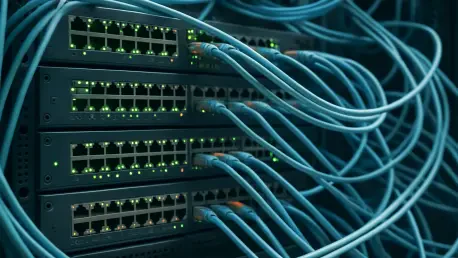

The silent exhaustion of modern AI clusters is rarely found in the chips themselves, but rather in the invisible gridlocks where trillions of data packets collide during the massive synchronization phases of model training. Deep networking represents a significant advancement in the data center infrastructure sector, moving beyond the limitations of legacy systems to address the specific demands of high-concurrency computation. This review explores the evolution of the technology, its key features, performance metrics, and the impact it has had on various applications. The purpose of this review is to provide a thorough understanding of the technology, its current capabilities, and its potential future development as a foundational element of the intelligence economy.
The Emergence of Path-Centric Architectures
The evolution of data center networking has reached a critical inflection point where the traditional switch-centric model no longer suffices for generative artificial intelligence. Historically, network design focused on the individual switch as an isolated unit of management, optimizing for local throughput while ignoring the holistic behavior of the fabric. In the context of large-scale AI training, however, the network must behave as a singular, cohesive entity. This realization has sparked the transition to path-centric architectures, which prioritize the end-to-end journey of data across the fabric rather than the performance of a single port.
This shift is largely driven by the emergence of AI factories—massive clusters containing tens of thousands of accelerators that require constant, low-latency communication to stay productive. In these environments, the network is not a passive pipe but an active participant in the training process. By focusing on the path rather than the device, deep networking platforms can orchestrate traffic with an awareness of the global state of the cluster, effectively eliminating the bottlenecks that previously crippled large-scale model training.
Core Pillars of Deep Networking Technology
Microsecond Telemetry and ASIC-Level Integration
The primary telemetry layer of deep networking platforms sets a new standard for visibility by embedding monitoring capabilities directly into Application-Specific Integrated Circuits (ASICs). Traditional monitoring tools like NetFlow operate on a coarse, post-mortem basis, often sampling data at intervals that miss the transient, high-intensity bursts characteristic of AI workloads. By running specialized code on ARM processors integrated within the ASIC, deep networking platforms capture telemetry at microsecond granularity, providing an unprecedented view into the fabric’s real-time state.
This granular visibility is essential for mitigating “incast” traffic patterns, where multiple nodes simultaneously send data to a single destination, overwhelming switch buffers in a matter of milliseconds. Because the telemetry is integrated at the hardware level, the system can detect these synchronized data bursts as they form, allowing the management layer to intervene before packet loss occurs. This proactive approach ensures that the high-bandwidth lanes of an AI cluster remain clear, maintaining the steady flow of data required for complex gradient updates.
Multi-Layered Intelligent Agents
Beyond simple monitoring, deep networking utilizes a hierarchy of autonomous agents to manage the complexities of modern fabrics. At the lowest level, link-level agents react in microseconds to physical layer events, such as transceiver fluctuations or port failures, rerouting traffic faster than any human operator or legacy protocol could manage. These agents act as the nervous system of the network, providing the rapid reflexes necessary to maintain uptime in high-density environments where even a momentary pause can stall an entire training job.
At the strategic level, flow agents optimize fabric distribution by intelligently placing heavy traffic loads across the available leaf-spine paths. Furthermore, the integration of cloud-level AI agents using Large Language Models (LLMs) has transformed how operators interact with their infrastructure. These agents are fed real-time, context-aware telemetry, enabling natural language querying for troubleshooting and performance optimization. Instead of manual log analysis, engineers can now ask complex questions about network health and receive accurate, data-driven insights that are grounded in the actual state of the hardware.
Shifting KPIs: From Bandwidth to Economic Efficiency
The maturation of deep networking has catalyzed a shift away from “vanity metrics” like raw bandwidth toward business-centric outcomes. In the previous era of networking, reaching higher gigabit speeds was the ultimate goal; however, in 2026, the focus has moved to Model FLOPS Utilization (MFU) and Token Efficiency. MFU represents the actual work being performed by expensive accelerators compared to their theoretical peak, and the network is often the deciding factor in whether that ratio remains high or collapses due to synchronization delays.
Analyzing the impact of these metrics reveals the true financial viability of AI enterprises. A network that fails to deliver data efficiently causes expensive XPUs to sit idle, creating a hidden “AI tax” that can cost organizations millions in lost productivity. By optimizing for token efficiency—the cost and speed at which an AI model produces output—deep networking platforms directly improve the return on investment for data center operators. This economic framing positions the network as a revenue generator rather than a mere utility cost.
Real-World Applications in AI Factories
Real-world applications of deep networking are most visible in the deployment of high-radix switches, which support 800G and 1.6T interfaces in massive XPU clusters. These high-density configurations reduce the number of “hops” a packet must take to reach its destination, significantly lowering tail latency and improving the overall stability of the fabric. In environments where every nanosecond counts, the ability to flatten the network hierarchy using advanced hardware is a primary competitive advantage for specialized cloud providers.
Unique use cases have also emerged in the realm of high-density thermal management. As next-generation ASICs push the limits of power consumption, deep networking platforms have integrated with liquid-cooled configurations to maintain performance in extreme environments. This hardware specialization ensures that the network can operate at peak capacity without thermal throttling, even when packed into the dense racks required for modern AI infrastructure. The role of specialized hardware in these scenarios is no longer optional; it is the prerequisite for scaling to the next level of computational power.
Implementation Hurdles and Technical Limitations
Despite the rapid progress, the technology faces significant implementation hurdles, including the persistent “AI tax” caused by legacy protocols that were never intended for the scale of current clusters. Physical thermal demands also pose a challenge, as the latest 102.4T ASICs generate immense heat that tests the limits of traditional air cooling. These technical limitations require a continuous cycle of innovation in both mechanical design and software optimization to ensure that the infrastructure remains viable as demands increase.
To address these challenges, some providers have pioneered the use of “Forward Deployed Engineers” who work directly within customer environments to bridge the gap between hardware capabilities and operational reality. This model accelerates the software update cadence, allowing for real-time refinements to be pushed based on live performance data. By shortening the feedback loop between the engineering lab and the data center floor, the industry is gradually refining the real-time performance of deep networking platforms, though the complexity of these systems remains a barrier to broader adoption.
Future Outlook: The Future of Specialized Infrastructure
As AI clusters scale toward hundreds of thousands of chips, the outlook for deep networking points toward even deeper hardware-software orchestration. The era of the general-purpose network is ending for high-performance computing, replaced by a specialized infrastructure where every layer of the stack is tuned for the specific characteristics of machine learning traffic. Future developments will likely include more sophisticated predictive modeling, where the network anticipates traffic spikes before they occur based on the specific training algorithm being utilized.
The potential for deep networking to become the global standard for competitive AI infrastructure is high, particularly as the cost of inefficiency becomes impossible to ignore. We are moving toward a reality where the network is effectively the “backplane” of a giant, distributed computer. In this future, the distinction between the server and the network will continue to blur, leading to a unified architecture that prioritizes the seamless movement of data over the boundaries of individual devices.
Final Assessment of Deep Networking Platforms
The transition of the network from a passive pipe to an active participant in computation represented a fundamental change in the design philosophy of the modern data center. This review established that deep networking platforms successfully addressed the systemic bottlenecks of legacy architectures by prioritizing path-centric designs and microsecond-level telemetry. The integration of autonomous agents and specialized hardware allowed organizations to recapture lost performance, significantly improving the economic efficiency of their AI investments.
Ultimately, the technology demonstrated its potential to redefine data center ROI by focusing on metrics that mattered to the bottom line of the artificial intelligence industry. While physical and protocol-level challenges remained, the move toward specialized, intelligent infrastructure proved to be the correct path for supporting the massive scale of contemporary model training. Deep networking was not merely an incremental upgrade; it functioned as the necessary foundation for the next generation of global computing, proving that the network was just as critical as the silicon it connected.