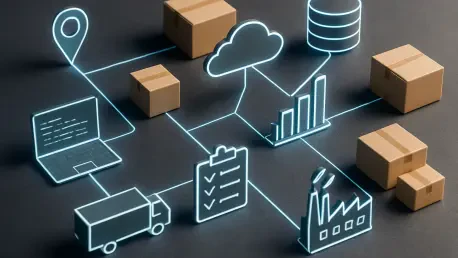

The sheer magnitude of investment poured into high-end silicon often masks a fundamental structural flaw in modern data centers where expensive GPUs spend a significant portion of their operational life waiting for data to arrive. While the hardware race continues to dominate headlines, the real bottleneck has shifted from the speed of the processor to the integrity and velocity of the information supply chain. Organizations frequently find that doubling their compute capacity does not lead to a doubling of output because the underlying network and storage layers are simply not designed for the frantic, non-linear demands of large-scale artificial intelligence.
Moving Beyond GPUs to Optimize the Total Flow of AI Data
The pursuit of high-performance artificial intelligence has sparked a global race to acquire the most powerful Graphics Processing Units (GPUs). However, raw compute power is only one piece of the puzzle; the true performance of enterprise AI is increasingly dictated by the information supply chain. This systemic infrastructure encompasses the entire journey of a data packet, moving from cold storage through high-speed fabric and eventually into the volatile memory of a compute node. When this chain is brittle, the most advanced chips on the planet become nothing more than expensive heaters, idling while the data they require is stuck in a digital traffic jam.
By viewing AI infrastructure as a systemic movement problem rather than a localized hardware issue, organizations can unlock the full potential of their existing investments. The success of a model is not just a factor of its parameters or the TFLOPS of the server hosting it; it is a function of how quickly those parameters can be refreshed and how efficiently the input data can be ingested. Shifting the focus toward the total flow of data allows architects to identify where latency is truly being born, moving away from the narrow-minded obsession with component-level benchmarks toward a more holistic view of system throughput.
The Shift from Static Infrastructure to Dynamic Token Logistics
Historically, IT infrastructure focused on silos where storage, networking, and compute were managed independently. In the era of Generative AI and Large Language Models (LLMs), these silos have become bottlenecks that starve GPUs, leaving expensive hardware idle while waiting for data. Traditional enterprise storage was built for the predictable patterns of databases and file shares, but AI requires a level of concurrency and random-access speed that legacy systems were never designed to provide. This mismatch creates a performance ceiling that no amount of additional compute can pierce without a fundamental redesign of how data is staged.
To understand why the information supply chain matters, one must recognize that data is now highly fragmented across multi-cloud environments and edge locations. This geographic dispersion introduces a time tax on every request, making the holistic management of data flow the primary challenge for modern enterprise architects. As models grow more complex and retrieval-augmented generation becomes the standard for accuracy, the distance between the data and the model becomes the most expensive variable in the equation. Managing this flow is no longer a task for the storage administrator alone; it is a core requirement for the AI engineer.
A Step-by-Step Framework for Optimizing Data Movement
Fixing the supply chain requires a methodical approach to identifying bottlenecks and re-architecting the path data takes to reach the model. It involves a transition from simply “having” data to ensuring that data is “available” at the exact millisecond the compute cycle begins.
1. Transitioning from Average Metrics to Tail Latency Analysis
The first step in fixing the supply chain is changing how performance is measured. Standard averages often hide the true user experience, which is dictated by the slowest responses. In a distributed system, a single slow server or a congested network switch can delay an entire batch of inference requests. If one focuses only on the mean, they remain blind to the outliers that cause a chatbot to hang or an autonomous system to stutter.
Prioritize Time to First Token (TTFT) and Time per Output Token (TPOT)
Focusing on these metrics ensures that the initial response feels instantaneous and the subsequent generation remains fluid for the user. TTFT is perhaps the most critical psychological metric in AI, as it defines the perceived responsiveness of the application. If the information supply chain is sluggish, the time it takes to fetch the initial context will balloon, leading to a poor user experience regardless of how fast the GPU can generate the subsequent text.
Monitor p95 and p99 Percentiles to Uncover Hidden Bottlenecks
By looking at the slowest 5% or 1% of requests, infrastructure teams can identify intermittent network congestion or storage queues that averages typically ignore. These “long-tail” latencies are often the first sign of a supply chain breakdown, indicating that the system is hitting a physical limit or a software conflict. Tracking p99 values allows an organization to build a resilient fabric that performs consistently even under heavy load, rather than a fragile one that only works well in a vacuum.
2. Aligning Infrastructure to Specific Traffic Shapes
Different AI tasks require different network and storage configurations. One size does not fit all when it comes to data flow, and treating all AI traffic as a single monolithic block is a recipe for inefficiency. Specialized workloads demand specialized pathways, much like how a city requires both high-speed highways for bulk transport and dense local streets for residential deliveries.
Optimize High-Bandwidth Paths for Training and Batch Analytics
Training requires massive, sequential data shuffles and frequent checkpointing, making raw throughput the most critical factor for success. During these phases, the system must handle a relentless firehose of information, where the total volume moved per second is the metric of merit. Using non-blocking network fabrics and high-performance file systems ensures that the data keeps pace with the aggressive consumption rates of massive GPU clusters.
Minimize Latency for Inference and Retrieval-Augmented Generation (RAG)
Inference is chatty and bursty, requiring high fan-out queries to vector databases where consistency and low latency are more important than total bandwidth. When a user asks a question, the system must instantly pull relevant shards from various locations and feed them to the model. Here, the challenge is not how much data can be moved at once, but how quickly a small, specific piece of data can be retrieved and delivered to the processing core.
3. Eliminating the “East-West” Latency Tax
In RAG-enabled systems, the internal communication between servers can accumulate significant delays that frustrate the end user. This “east-west” traffic represents the lateral movement of data within the data center, and every millisecond spent jumping between a database server and a compute node is a millisecond the user is left waiting.
Co-locate Vector Databases and Document Stores
Reducing the physical and logical distance between data services minimizes the cumulative latency of complex multi-step queries. By placing the searchable index and the actual source documents on the same physical rack or even the same server, an architect can bypass several layers of network overhead. This proximity ensures that the retrieval phase of the AI pipeline is as lean as possible, preventing the “network hop” penalty from stacking up.
Implement Service Shadowing and Asynchronous Retrieval
Processing data fetching in parallel or ahead of time prevents the sequential hopping that often leads to high p99 latency spikes. If the system can anticipate the data it will need and begin the retrieval process before the model specifically requests it, the perceived latency drops toward zero. This proactive approach to data logistics ensures that the information supply chain is always one step ahead of the compute demand.
4. Bypassing Traditional Storage Bottlenecks
Standard data paths often involve unnecessary handoffs between the CPU and system memory, which slows down the delivery of data to the GPU. Every time a data packet is copied from a storage controller to the system RAM and then to the GPU memory, it consumes CPU cycles and introduces micro-delays that aggregate into a massive performance penalty.
Adopt Direct Memory Access and GPUDirect Storage
Bypassing the CPU allows data to move directly from storage to GPU memory, eliminating processing overhead and reducing the storage queue. This direct-path technology is the equivalent of a dedicated express lane for data, ensuring that the heavy lifting of moving information does not interfere with the general-purpose processing tasks of the server. It effectively turns the storage system into an extension of the GPU’s own memory space.
Consolidate Block, File, and Object Storage into Unified Services
A unified data layer reduces the need for translation and copying, ensuring the right data is always physically near the compute nodes. When storage is fragmented into different protocols, the system must constantly translate formats, which acts as a drag on the information supply chain. Consolidating these services into a single, software-defined layer allows for a more fluid movement of data across the entire infrastructure.
Summary of Strategic Steps for Supply Chain Remediation
- Audit Metrics: Shift focus from mean values to p99 tail latency (TTFT and TPOT).
- Categorize Workloads: Separate training (throughput-heavy) from inference (latency-sensitive) traffic lanes.
- Collapse Hops: Co-locate retrieval services to eliminate unnecessary network round trips.
- Optimize Paths: Use DMA and GPUDirect technologies to remove CPU-related handoffs.
- Leverage Open Source: Utilize tools like vLLM for batching and Ceph for software-defined storage.
Future Trends in AI Infrastructure and Workload Placement
As the industry matures, the information supply chain will become increasingly automated and policy-driven. We can expect the standardization of AI-specific Service Level Objectives (SLOs) in enterprise contracts, making TTFT and TPOT legally binding performance markers. This shift will force service providers to guarantee not just uptime, but the specific speed of token generation, turning infrastructure into a performance-guaranteed utility. Furthermore, Content-Aware Storage will emerge, where storage systems extract semantic meaning from unstructured data at the source, reducing the need for redundant data copies.
Over the next two years, the landscape will likely move toward GPU-centric architectures that treat the network and storage as a single, integrated fabric designed specifically for the flow of tokens. We will see the rise of “intelligent fabrics” that can automatically reroute traffic based on the real-time needs of an LLM. This evolution will effectively blur the lines between storage and compute, creating a hyper-efficient environment where data is processed as it moves, rather than waiting to be processed after it arrives.
Implementing a High-Velocity Information Supply Chain
To fix the AI information supply chain, leaders must stop managing hardware and start managing flow. The ultimate goal is to ensure that data is never stuck in traffic while expensive GPUs wait for instructions. By making the network visible through granular metrics, isolating traffic lanes, and unifying data services, organizations can transform their AI from a slow experimental tool into a reliable, high-speed enterprise asset. Now is the time to audit your data paths and ensure your infrastructure is ready for the demands of real-time, scale-out AI.
The transition toward a streamlined information supply chain demonstrated that the most significant gains in AI performance were often found in the spaces between the chips. Architects who focused on reducing the hop count and implementing direct memory access paths successfully mitigated the tail latency issues that plagued early generative models. By treating the network as a first-class citizen of the AI stack, these organizations prepared themselves for a future where the speed of thought is no longer limited by the speed of the cable. Moving forward, the focus will remain on the seamless orchestration of tokens, ensuring that the supply chain is as intelligent as the models it serves.