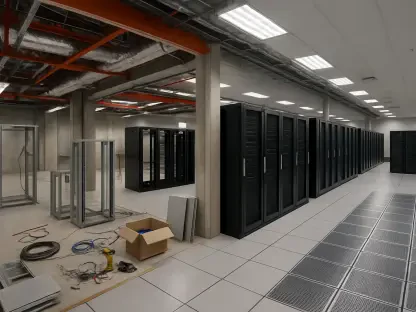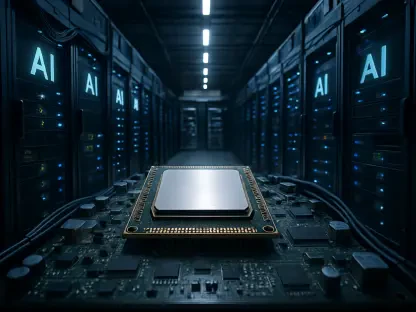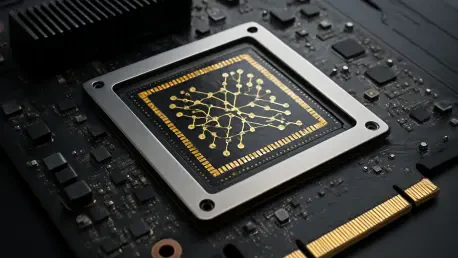

The foundational fabric of modern computation is being rewoven at an unprecedented pace, driven not by incremental software updates but by a ferocious arms race in the silicon powering the artificial intelligence revolution. This ongoing transformation has fundamentally reshaped technology, moving beyond general-purpose processors to an era of hyper-specialized hardware. This review will explore the evolution of this specialized AI hardware, its key architectural features, performance metrics, and the profound impact it has on data centers, cloud services, and the devices in our hands. The purpose is to provide a thorough understanding of the competitive landscape, the current capabilities of leading-edge silicon, and its potential future development.
The Competitive Landscape of AI Acceleration
The intense market dynamics driving innovation in AI-specific hardware have created a battleground where speed, efficiency, and scale are paramount. We have witnessed a definitive shift away from the reliance on general-purpose processors toward highly specialized architectures meticulously designed for the unique demands of AI workloads like model training and real-time inference. This transition is not merely a technical evolution but a strategic imperative for companies vying for dominance.
Underpinning this competitive frenzy are several overarching trends. The primary goal is the relentless pursuit of greater computational density, packing more processing power into smaller, more efficient packages. This is coupled with a critical focus on energy efficiency, as the power demands of large-scale AI models have become a significant operational and environmental concern. Furthermore, a strategic pivot toward the development of custom in-house silicon by major technology firms has emerged, allowing them to optimize performance for their specific ecosystems and gain a significant competitive advantage.
Architectural Showdown The Titans of Silicon
Nvidias Continued Dominance and Future Roadmap
Nvidia has maintained its formidable leadership position in the AI hardware market through a disciplined and aggressive strategy centered on a rapid architectural release cadence. The company’s current flagship, the Blackwell GPU microarchitecture, represents a monumental leap forward, delivering substantial performance and efficiency gains that have set a new industry benchmark. The flagship B300 series, built on this platform, accelerates a vast range of demanding tasks, from complex AI and data analytics to advanced scientific and quantum computing, solidifying Nvidia’s incumbency in the data center.
Never content to rest on its laurels, Nvidia’s forward-looking roadmap is already generating significant anticipation. The company has officially announced its next-generation superchip architecture, Vera Rubin, which is slated for release later this year. This ambitious platform will pair the Vera CPU with the Rubin GPU, the designated successor to the already powerful Blackwell. This strategy of telegraphing its next move keeps competitors on their heels and signals to the market that Nvidia’s pace of innovation is not slowing down.
AMDs Multi-Front Challenge
In contrast to Nvidia’s focused dominance, AMD has mounted an aggressive, multi-front challenge, expanding its AI hardware portfolio across both CPUs and GPUs to become a primary competitor. The company’s Zen 5 CPU microarchitecture set a new standard for performance upon its release, which was followed by the next-generation Ryzen AI Embedded processors. These chips target distinct, high-growth markets, with the P100 Series tailored for industrial automation and the more powerful X100 Series designed for compute-intensive applications like advanced robotics.
On the GPU front, AMD is taking direct aim at Nvidia’s top-tier accelerators. Its high-performance Instinct MI300 Series laid the groundwork for a serious challenge, but it is the recently launched MI350 series that truly enters the ring as a heavyweight contender. Featuring the MI355X chip, this series is engineered to be a direct rival to Nvidia’s Blackwell B100 and B200 GPUs, offering competitive performance for training the largest and most complex AI models and giving enterprise customers a viable high-performance alternative.
Intels Diversified Product Offensive
Intel is leveraging its decades of industry experience to mount a comprehensive and diversified product offensive aimed at capturing significant market share across the AI spectrum. For the data center, its high-core-count Xeon 6 processors provide the raw processing power and multitasking capabilities necessary for a wide range of enterprise workloads, enhancing both speed and efficiency in traditional server environments. This foundation in general-purpose computing provides Intel with a strong foothold from which to expand its AI-specific offerings.
In the dedicated AI accelerator space, Intel’s Gaudi 3 is positioned as a potent and cost-effective competitor to Nvidia’s widely adopted #00, with claims of faster training and inference performance at lower power consumption. The upcoming Jaguar Shores GPU is expected to build on this momentum with a sharp focus on improving energy efficiency. Simultaneously, Intel is playing a pivotal role in creating the emerging “AI PC” market with its Core Ultra AI Series 2 processors, which integrate powerful neural processing units directly into consumer CPUs to enable on-device AI capabilities for both mobile and desktop platforms.
The In-House Silicon Revolution
Alphabets Advances in Quantum and Inference
Alphabet is pursuing a dual-pronged approach to next-generation computing, pushing boundaries in both quantum mechanics and conventional AI. In the highly experimental realm of quantum computing, its Willow chip features a scalable architecture designed to accelerate the path toward fault-tolerant systems by enabling faster error reduction. This long-term investment represents a potential paradigm shift in computation, promising to solve problems currently intractable for even the most powerful supercomputers.
For today’s massive AI workloads, Alphabet’s latest innovation is the Ironwood Tensor Processing Unit (TPU). Developed specifically for the new age of inference, the Ironwood TPU is engineered for hyperscale performance. Its architecture allows for the creation of massive pods containing thousands of interconnected chips, creating a computational fabric more powerful than the world’s leading supercomputers and optimized to serve Google’s vast suite of AI-driven services efficiently.
AWSs Cloud Optimized Infrastructure
As the dominant force in cloud computing, Amazon Web Services leverages custom silicon as a cornerstone of its strategy to enhance its infrastructure and deliver superior value to its customers. The company’s EC2 Trn3 instances, powered by proprietary Trainium3 AI accelerator chips, are a testament to this approach. The latest Trn3 UltraServer configuration integrates 144 third-generation chips, delivering a four-fold performance increase over the previous generation while simultaneously improving energy efficiency by 40%, a critical factor for large-scale AI training in the cloud.
Beyond specialized AI training, AWS is also innovating in general-purpose cloud computing. The ARM-based Graviton4 processor, with its 96-core design, powers the company’s EC2 R8g instances. This chip provides a significant performance boost over its predecessor, offering customers enhanced efficiency and a lower total cost of ownership for a wide variety of cloud workloads, from application servers to microservices and high-performance computing.
Apples Ecosystem Driven Chip Design
Apple’s vertical integration strategy, centered on the design of its own custom M-series chips, has been a key differentiator, allowing the company to tightly control the user experience across its product ecosystem. The Apple Neural Engine has been pivotal to this success, and the latest M5 chip continues this legacy by integrating powerful Neural Accelerators into each of its GPU cores. This design delivers a significant increase in AI performance, enabling more sophisticated on-device machine learning features in its consumer products.
In a strategic move to optimize its own internal operations, Apple is also developing a specialized AI server chip, codenamed Baltra. This chip is designed to handle the company’s massive internal inference workloads, which power services like Siri and computational photography. By bringing this critical hardware in-house, Apple can further fine-tune its AI models and infrastructure, ensuring performance and efficiency that are perfectly aligned with its software and service goals.
Specialized Innovators and Emerging Challengers
Cerebras Systems Wafer Scale Architecture
Cerebras Systems has challenged conventional chip design with its radical wafer-scale approach, creating processors of unprecedented size and power. Its third-generation product, the WSE-3, integrates nearly a million AI-optimized cores onto a single piece of silicon. This design provides an extraordinary amount of on-chip resources, including thousands of times more memory bandwidth and hundreds of times more on-chip memory compared to traditional GPU designs. This unique architecture offers distinct advantages for training exceptionally large AI models by eliminating the communication bottlenecks that arise when data must be shuffled between multiple smaller chips.
IBMs Focus on Enterprise AI
Building on its long legacy in enterprise computing, IBM is developing specialized hardware tailored for on-premises, low-latency AI inference. The Telum II processor and the Spyre Accelerator, which contains dozens of AI accelerator cores, are designed to execute enterprise-critical tasks like real-time fraud detection and secure code generation directly within a company’s own data center. This focus addresses the growing need for privacy and speed in business applications. In addition, IBM is researching future-facing projects like the NorthPole architecture, an experimental design aimed at achieving breakthrough energy efficiency for AI workloads.
Qualcomms Edge to Cloud Efficiency
Qualcomm, a long-standing leader in the mobile sector, has successfully expanded its expertise into the broader AI hardware market, from the edge to the cloud. Its Cloud AI 100 chip has demonstrated market-leading performance-per-watt in industry benchmarks, making it a highly efficient solution for cloud inference workloads. This focus on efficiency is a critical differentiator in a market where power consumption is a major operational cost. In its traditional stronghold of mobile computing, Qualcomm continues to innovate with its Snapdragon platform. The latest generations have brought powerful on-device generative AI capabilities to smartphones, driving a new wave of intelligent mobile applications.
Tenstorrents AI First Computing Paradigm
Led by renowned chip architect Jim Keller, Tenstorrent is on a mission to build computers from the ground up specifically for AI. Using a RISC-V-based approach, the company is creating a cohesive ecosystem of hardware and software designed to break free from the limitations of legacy architectures. Its product suite includes the Blackhole AI accelerator and the highly scalable Wormhole processors. These components are integrated into its Galaxy server systems, which can house up to 32 interconnected processors, forming a powerful and flexible platform for developing and deploying next-generation AI models.
Core Challenges and Industry Hurdles
Despite the blistering pace of innovation, the AI hardware industry faces significant obstacles that could temper its growth. The immense research and development costs, coupled with the extreme manufacturing complexities of producing leading-edge silicon, create high barriers to entry and demand massive, sustained investment. This technology arms race is both expensive and fraught with risk, as a single misstep in a multi-year design cycle can leave a company far behind its competitors.
Furthermore, the operational challenges of deploying this powerful hardware at scale are becoming increasingly acute. Managing the enormous power consumption and subsequent heat dissipation of dense clusters of AI accelerators is a critical engineering challenge for data center operators. As computational demands continue to soar, finding sustainable solutions for power and cooling is essential for continued growth. Finally, the industry remains vulnerable to global supply chain bottlenecks, where shortages of key materials or manufacturing capacity can hinder production and delay the rollout of next-generation technologies.
The Future Trajectory of AI Hardware
Looking ahead, the trajectory of AI hardware development points toward ever-greater specialization and a holistic, system-level approach to performance. A clear trend is the continued divergence between hardware optimized for the massive parallel computations of AI training and chips designed for the low-latency, high-efficiency demands of inference. This specialization will allow for more finely tuned solutions tailored to specific stages of the AI lifecycle.
However, the raw performance of the silicon itself is only part of the equation. The critical role of software, including compilers, libraries, and development frameworks, will become even more pronounced in unlocking the full potential of next-generation hardware. Similarly, high-speed interconnects that link thousands of chips together into a cohesive system are becoming as important as the processors themselves. In the long term, the industry’s growth will likely be shaped by the exploration of novel architectures, such as in-memory computing and neuromorphic designs, as well as the development of new materials that could push beyond the physical limits of silicon.
Conclusion An Unprecedented Era of Accelerated Innovation
The landscape of AI hardware that has taken shape was defined by a fierce and dynamic competition that accelerated the pace of technological advancement to an unprecedented degree. The relentless innovation from established semiconductor giants, hyperscale cloud providers, and agile specialized startups fueled a new era of computing whose impact was felt across every sector of the global economy. This competitive pressure ensured that no single player could rest on its laurels, resulting in a continuous cycle of breakthroughs in performance, efficiency, and architectural design. The resulting ecosystem provided a powerful foundation for the next wave of artificial intelligence, with profound implications for science, business, and society at large.