
Every time a user streams a high-definition video or prompts an artificial intelligence to generate a complex image, a silent and invisible thirst is quenched by millions of gallons of water hidden within the mechanical bowels of the global internet. This digital backbone, while appearing ethereal, relies on a physical infrastructure that has become one of the most significant consumers of local liquid resources. The massive scale of modern computing requires a constant dissipation of heat, a process that historically leaned on the cooling power of evaporation. However, as the digital footprint expands, the strain on global water tables has moved from a quiet operational concern to a loud environmental crisis that demands immediate industrial reform.
The critical intersection of data and ecology has fundamentally shifted the priorities of facility designers and urban planners alike. Cooling efficiency was once strictly a technical necessity aimed at reducing electricity bills, but it is now a social and regulatory mandate that can determine whether a project receives its building permits. This analysis explores the industry’s transition away from evaporative cooling toward water-neutral technologies, highlighting how the sector is navigating a path toward a truly sustainable future where bits and bytes do not come at the cost of the local water supply.
The Scaling Crisis: Water Consumption Metrics and Market Shifts
Quantifying the Impact: Growth Trends and Resource Scarcity
The sheer volume of resource consumption in the hyperscale era is staggering when translated into human terms. A single 100-megawatt data center can rival the daily water usage of 6,500 local households, creating a direct competition for resources in areas where municipal infrastructure is already stressed. In legacy facilities, the reliance on latent heat evaporation results in approximately 530,000 gallons of fresh water being lost to the atmosphere every single day. This “evaporative tax” was once considered the price of doing business, but it is increasingly unsustainable as global demand for computing power continues its upward trajectory.
Moreover, the growing regulatory and community opposition in drought-prone regions serves as the primary driver for industrial change. Local governments are no longer offering a blank check for resource usage, frequently requiring developers to prove their water-neutrality before breaking ground. As a result, the industry is seeing a sharp decline in the approval of traditional “wet” facilities, forcing a market-wide pivot toward technologies that can maintain uptime without draining the local aquifer.
Real-World Modernization: From Open Towers to High-Efficiency Chillers
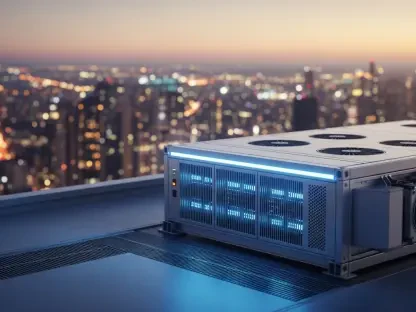
Hyperscale and co-location providers are leading the charge by phasing out open cooling towers, which are notorious for water loss, in favor of ultra-high-efficiency air-cooled chillers. These modern systems utilize advanced heat exchangers that allow the facility to reject heat into the ambient air without needing to evaporate water to achieve the desired thermal drop. This transition represents a fundamental change in how heat is managed, moving the industry toward a model that treats water as a precious, non-consumable asset rather than a disposable coolant.
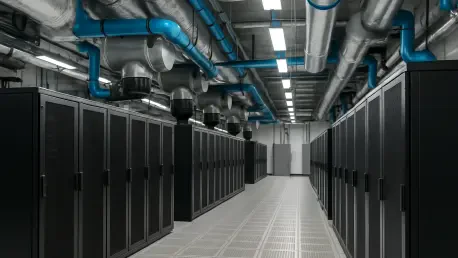
The adoption of closed-loop technology is scaling rapidly, mirroring the “radiator-style” cooling found in high-performance gaming PCs but on an enterprise-grade level. In these systems, a fixed volume of treated water or specialized coolant circulates through the servers and back to a heat exchanger, never leaving the system. To manage extreme thermal peaks during the hottest months, some operators employ hybrid heat rejection systems. These units prioritize dry air cooling for the majority of the year, only engaging water-assisted cooling as a secondary measure when ambient temperatures exceed specific thresholds.
Expert Perspectives: Balancing Cost, Density, and Responsibility
Thermal engineers and industry analysts largely agree that the traditional trade-off between energy efficiency and water conservation is no longer a viable defense for wasteful practices. While water-cooled systems historically offered a 15% cost advantage due to lower electricity requirements, that financial benefit is eclipsed by the rising costs of water rights and the potential for reputational damage. There is a growing consensus that the “low-cost” water model is a relic of an era that ignored the true environmental price of resource depletion.
Furthermore, experts emphasize that proactive infrastructure builds are the only way to handle the surging power densities required by modern AI and high-performance computing. Standard air-cooling units often struggle with the intense heat generated by modern server racks, necessitating a shift toward liquid-to-chip cooling methods. This technical evolution allows for greater thermal control and supports the industry’s shift in corporate responsibility, where Water Usage Effectiveness (WUE) is now monitored with the same rigor as Power Usage Effectiveness (PUE).
The Future Landscape: Towards Water-Neutral Data Centers
Looking ahead, the development of “dry” heat rejection technologies and advanced liquid-to-chip systems will likely eliminate the need for potable water in the cooling process entirely. These innovations allow data centers to operate in regions previously deemed too arid for industrial development, decoupling digital growth from local hydrological cycles. While air-cooled systems may require a slightly larger physical footprint or higher initial energy inputs, the long-term environmental relief and regulatory compliance they offer make them the only logical choice for next-generation builds.
The broader implications of this shift extend far beyond the data center walls, influencing municipal planning and the global push for resource-conscious digitalization. As facilities become more self-sufficient, they can integrate more seamlessly into urban environments without burdening the public utility grid. This evolution suggests a future where data centers contribute to the circular economy, perhaps even by exporting captured waste heat to warm nearby buildings, further maximizing the utility of every kilowatt-hour consumed.
The industry arrived at a pivotal crossroads where the transition from evaporative cooling to closed-loop and hybrid thermal management became mandatory for survival. It was determined that the long-term viability of the digital economy depended entirely on decoupling growth from resource depletion. Moving forward, the adoption of water-neutral standards will serve as a prerequisite for any new computing infrastructure, ensuring that the progress of the information age does not inadvertently dry up the world it intended to connect.