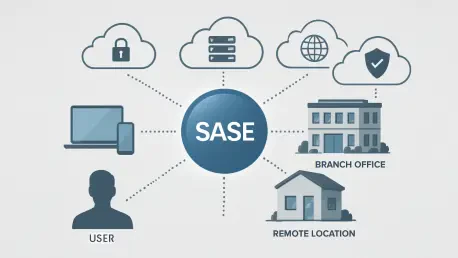

In an era where enterprise networks are increasingly distributed across multiple branches and remote endpoints, the challenge of maintaining consistent, high-level security has become more complex than ever before, prompting a significant shift toward Secure Access Service Edge (SASE) architecture. As organizations navigate this transition, the ability to validate the real-world performance of these sophisticated solutions is paramount. Recently, the Huawei Xinghe Intelligent Unified SASE Solution was subjected to one of the most comprehensive comparative analyses ever conducted by The Tolly Group, an esteemed international third-party testing organization. The evaluation, which benchmarked the solution against other mainstream offerings, focused on the critical pain points for modern enterprises: securing multi-branch interconnections, protecting local branch operations, and streamlining security O&M. The certified results from this rigorous process provide a clear, data-driven perspective on what distinguishes a leader in the crowded SASE market.
Excelling in Advanced Threat Detection
The foundation of any effective security solution lies in its ability to accurately and swiftly identify threats, and the Tolly Group’s testing placed this capability under intense scrutiny, revealing a significant performance gap among vendors. Huawei’s SASE solution demonstrated superior efficacy by successfully identifying 95% of threat samples sourced from a public third-party database. This figure stands in stark contrast to the average detection rate of 80% achieved by competing solutions under the same conditions. This 15-point difference is not merely a statistical victory; it represents a substantial reduction in risk, ensuring that a wider spectrum of known malware, ransomware, and other malicious code is stopped before it can infiltrate the network. For an enterprise, this higher detection rate translates directly into a more resilient security posture, minimizing the potential for breaches that could lead to data loss, financial damage, and reputational harm, proving the solution’s robust defense against a broad array of established cyber threats.
Beyond defending against known threats, the true test of a modern security architecture is its capacity to neutralize novel and evasive attacks that have yet to be cataloged. In this critical area, the comparative analysis highlighted an exceptional capability unique to Huawei’s offering. When challenged with unknown packed variants—malicious files intentionally obscured using commonly available tools to bypass traditional signature-based detection—the solution achieved a perfect 100% detection rate. Notably, it was the only vendor in the evaluation to reach this benchmark. This result underscores a sophisticated, behavior-based threat intelligence engine capable of recognizing malicious intent even in unfamiliar forms. For enterprises facing an ever-evolving threat landscape where zero-day exploits and polymorphic malware are the norm, this proactive defense mechanism is a crucial differentiator, providing a vital layer of protection against the most advanced and potentially damaging cyberattacks that often elude other security systems.
The Power of Unified Security Operations
A high threat detection rate is only part of the equation; operationalizing that intelligence efficiently is what truly empowers security teams. The evaluation highlighted Huawei’s unified management philosophy, embodied in the iMaser NCE-Campus platform, as a key advantage. This platform fundamentally changes the security paradigm by integrating both network and security controls into a single, cohesive dashboard. Instead of forcing administrators to pivot between disparate management consoles for firewalls, switches, and endpoint agents, it creates an environment of intelligent collaboration. This synergy allows for a holistic view of the entire network fabric, enabling security policies and responses to be orchestrated seamlessly across all components. By breaking down the traditional silos that exist between network and security operations, this unified approach fosters a more agile and coordinated defense strategy, reducing complexity and allowing for faster, more informed decision-making when incidents occur.
The practical benefit of this integrated approach was most evident in its streamlined threat remediation process. The test confirmed that Huawei’s SASE solution enables one-click threat handling, a capability that dramatically accelerates incident response. When a threat is detected at any single node—be it a firewall, a switch, or a HiSec Endpoint (EDR)—the iMaser NCE-Campus platform can automatically trigger network-wide immunity. This means a localized detection event can instantly propagate protective measures across the entire enterprise network, isolating compromised devices and blocking malicious traffic patterns before the threat can spread. This stands in stark contrast to competing solutions, which often require a cumbersome, manual process involving multiple management platforms and significant cross-team coordination. This automated, network-wide response not only minimizes the window of vulnerability but also significantly reduces the operational burden on security personnel, freeing them to focus on more strategic initiatives.
A New Benchmark for Secure Interconnectivity
The comprehensive testing and subsequent certification by The Tolly Group provided a clear and objective measure of what constitutes leadership in the SASE domain. The rigorous evaluation, described as the most thorough of its kind, moved beyond marketing claims to deliver empirical data on real-world performance. It revealed that a truly effective SASE solution must excel not only in identifying a high percentage of both known and unknown threats but also in translating that detection into a swift, simplified, and unified operational response. The findings established a new benchmark by which enterprises could measure potential solutions, emphasizing the critical importance of integrated platforms over a collection of disjointed security products. This detailed report became an invaluable resource, offering organizations a data-backed framework to enhance their security posture for complex multi-branch environments, ensuring their chosen architecture could meet the demands of a modern, distributed enterprise.