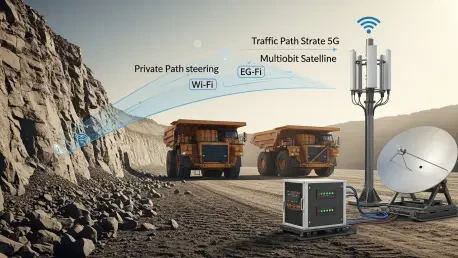

Autonomous trucks idling in a mine, cranes threading containers across a crowded quay, and pump stations stabilizing pressure on a remote pipeline all share a ruthless dependency on split-second data that cannot afford to drift, delay, or die. In these places the edge is not a branch office; it is a moving, obstructed, and sometimes hostile environment where decisions happen on the fly and safety margins shrink when links falter. This is the backdrop for Viasat’s Tactical Mission Fabric, a defense-born platform that treats connectivity as a fluid system rather than a set of fixed circuits. The proposition is straightforward yet consequential: orchestrate every available path—satellite in multiple orbits, private 5G, Wi‑Fi, and terrestrial backhaul—under a single policy engine that understands priority, predicts trouble, and keeps control loops intact even as conditions change.
Why Defense-Grade Design Fits Industry
Industrial sites increasingly mirror the constraints of contested operations, where communications degrade without notice and mobility shatters the assumptions of static networking. Haul trucks dive behind rock walls that scatter radio signals; rubber-tired gantries weave between steel canyons formed by stacked containers; service vessels roll under shifting skies that break line-of-sight. Defense systems have long met these realities with redundancy, encryption, and orchestration designed for persistence, not perfection. TMF follows that lineage, leaning on proven patterns like multipath routing, intent-based policies, and path health scoring to elevate uptime from a best-effort target to an engineered outcome. The difference is not only environmental but economic: downtime halts production and turns small link issues into outsized risk.
The defense-to-enterprise pipeline has repeatedly set commercial baselines, from GPS-guided fleets to TLS-encrypted sessions that now underpin online trade. TMF seeks a similar translation by offering a fabric that abstracts transport choices away from applications. Instead of hardwiring a camera feed to microwave or confining telemetry to cellular, the fabric maps flows to policies: a command stream may demand sub-100 ms round trips; a batch of maintenance logs can tolerate seconds. That shift unlocks architectural freedom. A port operator can mix a private 5G slice with Wi‑Fi 6E in the yard and augment coverage with LEO plus GEO beams overhead, all without rewriting application logic. In effect, industrial networking begins to look like mission networking, where the mission defines the route, not the medium.
Building the Fabric: Orchestration, Multi-Orbit, and Edge AI
At the core is orchestrated multi-path networking that treats links as a pool of resources dynamically combined to meet intent. TMF monitors signal-to-noise, jitter, and instantaneous throughput across Ethernet backhaul, private 5G, Wi‑Fi, and satellite paths in LEO, MEO, and GEO. When a reach stacker swings behind a container block and 5G fades, the fabric can front-run a drop by shifting steering and safety packets to an overhead LEO hop while shunting noncritical traffic to remaining paths. This is not classic SD‑WAN tuned for branch cost optimization; it is a physically aware control plane keyed to movement and occlusion. By elevating policy above transport type, the fabric also normalizes vendor differences, allowing operations to swap a radio, beam, or modem without reshaping data flows.
Orbit choice matters because latency and coverage trade in lockstep. LEO beams reduce round-trip delay, making centralized analytics and supervisory control feasible without overstuffing the edge with heavyweight compute. GEO retains reach and capacity, filling in where terrestrial circuits thin out, while MEO can balance the two. TMF’s value proposition is to blend these orbits with fiber or microwave backhaul so that delay-sensitive loops—such as collision avoidance or dynamic braking—hit the fastest paths, while bulk uploads and model retraining use wider, slower lanes. Edge AI closes the loop. Models embedded near sensors triage firehose telemetry, promoting anomalies and suppressing noise. Think of a slurry pump that monitors vibration spectra locally; the edge flags a bearing fault for immediate uplink, while routine signatures stay on premises until cheap bandwidth opens.
Security and Strategy: From Links to Policy
Path diversity does double duty as a security control. Splitting traffic across independent media and orbits eliminates single choke points and complicates interception or jamming. A control packet stream can be sharded, authenticated, and reassembled in the enterprise cloud, denying adversaries a clean target while preserving command integrity. Meanwhile, strict policy tiers enforce separation by consequence: video feeds for quality inspection ride commodity paths; emergency stop signals reserve low-latency slices with preemption rights. Because the fabric continuously measures path health, it can quarantine degraded links, rotate credentials, and reshuffle flows before an incident escalates. The outcome is not invulnerability but graceful degradation—critical functions stay alive, and everything else downgrades predictably instead of failing hard.
This approach also reshaped buying behavior. Instead of procuring satellite and terrestrial services through separate silos, enterprises converged connectivity under a single fabric with service-level objectives tied to operational priorities. Providers responded by moving up the stack, packaging orchestration, observability, and AI tooling alongside bandwidth to stay relevant as LEO capacity expanded. For technology leaders, the actionable path started with a candid site survey: map mobility, occlusion zones, and failure consequences at the asset level. From there, define policy tiers by latency, loss tolerance, and safety impact; pilot multipath orchestration on one high-value workflow; and embed edge models that rank signals by urgency. Done in that order, TMF-like fabrics delivered resilience gains without ripping and replacing, and positioned operations to scale autonomy with confidence.