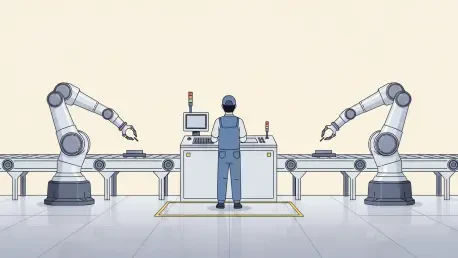

The rapid evolution of high-mix assembly lines has fundamentally altered the floor dynamics of modern manufacturing plants, placing human workers and sophisticated robotic systems in unprecedented proximity. While the integration of artificial intelligence into these environments promised a new era of fluid collaboration, the practical implementation of physical AI has faced a persistent hurdle in the form of data transfer speeds. Cloud-centric architectures, though highly effective for long-term predictive maintenance and enterprise-level analytics, have proven fundamentally inadequate for the split-second decisions required on a bustling factory floor. As industrial operations scale from 2026 to 2028, the industry is increasingly abandoning remote server reliance in favor of localized, edge-first communication loops. This transition ensures that the intelligence governing a robot is located as close to the physical sensors as possible, effectively bridging the gap between perception and action. By prioritizing local processing, manufacturers are finally moving away from rigid, isolated automation toward a more responsive and integrated workspace that prioritizes both safety and operational speed.
The Engineering Challenges of Robotic Latency
Quantifying the Physical Risks of Data Delay
The mathematical reality of latency in an industrial setting is strictly governed by established safety standards like ISO/TS 15066, which dictate the necessary separation between human operators and moving machinery. In many traditional setups, high-fidelity depth cameras are required to send massive streams of visual data to a remote server for processing, a journey that often introduces a round-trip latency of 200 milliseconds or more. While such a delay might be imperceptible in a digital office environment, it creates a dangerous physical “blind spot” in a factory where robotic arms often move at speeds of two meters per second. During that brief 200-millisecond window, a robot can travel nearly 16 inches before its system even registers that a human has entered a restricted zone. This spatial uncertainty forces safety engineers to program excessively large buffer zones, which drastically reduces the available floor space and forces machines to operate at a fraction of their potential capacity to ensure worker safety remains uncompromised.
These spatial inefficiencies lead to a phenomenon known as “stop-and-go” cycles, where the robot frequently halts or stutters because its safety system cannot process environmental changes quickly enough to maintain continuous motion. When a robotic system is forced to wait for cloud-based inference, the resulting idle time directly erodes the return on investment for collaborative technology. Instead of achieving a smooth, rhythmic workflow, the assembly line becomes a series of micro-interruptions that frustrate human workers and degrade overall throughput. To mitigate these bottlenecks, the engineering focus has shifted toward minimizing the distance data must travel. By processing vision data at the edge, the time required to detect a human hand or tool is slashed, allowing the robot to maintain higher operational speeds while technically adhering to safety distances. This reduction in the latency loop is the primary catalyst for reclaiming the lost productivity that has historically plagued collaborative installations in high-volume settings.
Overcoming the Legacy PLC Bottleneck
Programmable Logic Controllers have long served as the reliable backbone of industrial safety, but their architecture was originally designed for discrete, binary inputs rather than multidimensional AI data. For decades, these systems have excelled at managing simple signals from emergency stop buttons or light curtains, yet they struggle to handle the high-bandwidth requirements of modern skeletal tracking and micro-movement analysis. When an AI system at the edge generates a safety inference, that data must often be routed through the PLC’s internal scan cycles, which can add anywhere from 10 to 50 milliseconds of additional lag. This cumulative overhead destroys the determinism required for proactive safety measures, turning a sophisticated AI perception into a delayed reaction. The fieldbus protocols used by these legacy systems were never intended to act as high-speed data conduits for real-time kinematic adjustments, creating a structural bottleneck that prevents robots from reacting with human-like agility.
This architectural limitation creates a difficult binary choice for system integrators who must either run the robot at a crawl or accept frequent, productivity-killing interruptions. Because the PLC cannot process complex spatial data as quickly as an AI-powered vision system, the safest default is often to trigger a full system halt whenever any motion is detected. Breaking this bottleneck requires a fundamental shift toward a more fluid data path where high-level AI inferences can bypass the traditional PLC loop for non-emergency trajectory adjustments. By allowing the edge processor to communicate directly with the robot’s motion planner, engineers can implement nuanced changes to speed and torque without waiting for the next PLC scan cycle. This does not replace the safety-rated functions of the PLC but supplements them with a faster, more intelligent layer of control. This modern approach ensures that the deterministic reliability of industrial safety is maintained while providing the speed necessary for advanced, AI-driven collaboration.
Modern Architectures for Real-Time Safety
Implementing the Safety Coprocessor Model
A promising solution to the latency crisis involves the implementation of a dedicated safety coprocessor located directly at the robot work cell. This specialized hardware is designed to ingest multi-modal sensor data, including inputs from depth cameras, inertial measurement units, and force-torque sensors, and process it using localized AI models. By keeping the processing power within the cell, the system eliminates the need for external network calls, bringing end-to-end latency down to a remarkably low threshold of 30 milliseconds or less. This coprocessor acts as a high-speed intelligence layer that constantly monitors the workspace for human presence, fatigue, or unexpected movements. Because it operates independently of the main factory network, it remains immune to bandwidth fluctuations or connection drops that could otherwise compromise the safety of the human-robot interaction. This localized approach allows for much tighter integration between the perception system and the physical movement of the machine.
The success of this coprocessor model relies on high-speed industrial protocols like EtherCAT or PROFINET IRT, which provide the deterministic communication necessary for real-time motion control. By utilizing native robot APIs, such as URScript or RAPID, the edge processor can send instantaneous commands to the motion planner to nudge a robot’s path or slightly reduce its velocity. This creates a dual-track safety architecture where the primary PLC continues to manage certified emergency stops and power-off functions, while the edge coprocessor handles proactive, high-speed adjustments. This separation of concerns allows the system to be both safer and more efficient, as the robot can avoid collisions before they occur rather than just reacting to them after a safety violation has been triggered. This model is becoming the standard for manufacturers who require the highest level of responsiveness, providing a scalable framework that can be applied to various robot brands and diverse assembly tasks across the industrial landscape.
Transitioning to Adaptive Kinematics
Once the hardware and communication loops are optimized to close the latency gap, robotic systems can transition from reactive stopping to a more sophisticated state of adaptive kinematics. Edge-first AI enables a robot to do more than just detect an obstacle; it can analyze the velocity and trajectory of a human worker to predict their future position. If an operator begins to show signs of fatigue or moves erratically toward the end of a shift, the edge processor identifies these patterns through skeletal tracking and adjusts the robot’s behavior accordingly. This might involve reducing the maximum acceleration from five meters per second squared to a more conservative level or widening the approach angle to give the human more physical breathing room. Instead of a rigid machine that is either moving or stopped, the robot becomes a fluid partner that modulates its energy and path in real-time based on the immediate needs and physical state of the human collaborator.
This shift toward human-centric safety significantly reduces the collision energy of any potential interaction, as the robot can proactively lower its torque limits as a person draws near. By dynamically adjusting these parameters, the system minimizes the risks associated with accidental contact, which is essential for maintaining a safe environment without halting production. These kinematic adjustments are executed in milliseconds, ensuring that the rhythm of the assembly line is preserved even as humans move in and out of the shared workspace. This level of adaptability transforms the robot into a responsive tool that works with the human rather than a machine that the human must work around. Manufacturers who adopted these edge-driven kinematic strategies observed a marked decrease in total downtime and an improvement in worker morale, as the machines felt less like unpredictable hazards and more like intelligent assistants. The transition to adaptive kinematics was the logical progression of closing the latency loop, proving that speed and safety are not mutually exclusive in industrial AI.