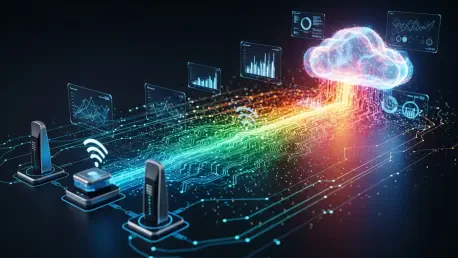

The global industrial sector has successfully navigated the initial hurdle of deploying millions of interconnected sensors, but the subsequent challenge of converting that massive telemetry stream into immediate, value-driving action continues to stifle organizational progress. While the hardware needed to capture information is more robust and affordable than ever, the architectural frameworks supporting these devices often rely on outdated methodologies that were never designed for the sheer density of modern data. This disconnect creates a situation where companies are data-rich but insight-poor, struggling with latencies that render critical information useless by the time it reaches a decision-maker. To move beyond this impasse, enterprises must abandon the simplistic model of treating the cloud as an all-encompassing destination and instead embrace a more fluid, decentralized approach. Modernization requires a fundamental rethinking of how data is prioritized, filtered, and processed, shifting the focus from mere collection to the generation of localized, high-velocity intelligence that can keep pace with the demands of a high-speed production environment.
Overcoming the Limitations of Legacy Architectures
The Impending Collapse: Why Centralized Models Fail
The traditional paradigm of funneling every byte of raw sensor data into a centralized cloud environment is no longer a viable strategy for organizations aiming for operational excellence in today’s competitive landscape. In the early stages of the Internet of Things, this “lift and stream” approach was acceptable because the number of connected devices was manageable and the complexity of the data was relatively low. However, the current reality involves massive deployments where thousands of sensors generate high-frequency vibration, temperature, and pressure readings every millisecond. When these streams are pushed through standard internet backhauls to a distant data center, the round-trip latency typically falls between 80 and 200 milliseconds. While this might seem negligible for general business applications, it is an eternity in industrial settings where a robotic arm or a high-pressure valve requires a corrective signal in under 10 milliseconds to prevent a catastrophic failure or a significant loss in product quality.
Furthermore, the centralized approach creates a single point of failure and a massive processing bottleneck that hinders the agility of the entire enterprise. As more devices are added to the network, the sheer volume of incoming telemetry can overwhelm the ingestion layers of cloud platforms, leading to dropped packets and incomplete data sets. This lack of reliability is particularly problematic for machine learning models that depend on high-fidelity data to provide accurate predictive maintenance alerts. Instead of receiving actionable insights, plant managers often find themselves looking at dashboards that reflect the state of the factory as it existed several minutes or even hours ago. This reporting delay, often disguised as real-time monitoring, prevents teams from reacting to emerging issues before they escalate. Transitioning away from this rigid structure is not just a technical preference but a necessity for any business that relies on precision timing and continuous uptime to maintain its market position and operational integrity.
Economic Realities: The High Cost of Bandwidth
The financial implications of maintaining a cloud-centric IoT architecture have become increasingly difficult for chief financial officers to ignore, especially as data egress and storage costs continue to rise. Industrial equipment like modern CNC machines or jet engines can generate several gigabytes of telemetry daily, and when this is scaled across multiple facilities and thousands of individual assets, the cost of moving that data across a network can quickly consume the majority of a project’s budget. Many organizations find themselves in a position where they are paying a premium to transport and store raw, noisy data that offers very little long-term analytical value. By the time they realize that most of this information could have been discarded or summarized at the source, they have already incurred significant expenses. This economic drain acts as a deterrent to scaling IoT initiatives, leaving many innovative projects stuck in the pilot phase because the projected return on investment is undermined by infrastructure overhead.
Beyond the direct costs of bandwidth and storage, the legal and regulatory landscape of 2026 places additional burdens on how data is handled and where it can reside. In sectors such as healthcare, defense, and critical infrastructure, strict data sovereignty laws often mandate that sensitive information remains within the geographical or organizational boundaries of its origin. A legacy cloud-only model frequently clashes with these requirements, forcing companies to implement complex and often fragile encryption and filtering layers after the data has already left the primary site. This reactive approach to compliance increases the risk of regulatory fines and data breaches. By modernizing the architecture to include robust local processing, enterprises can ensure that sensitive telemetry is analyzed and anonymized on-site. This not only significantly reduces the amount of data that needs to be transmitted but also aligns the technical infrastructure with the necessary legal frameworks, providing a more secure and cost-effective path toward global scalability.
Implementing a Tiered Edge-Cloud Continuum
Data Gravity: Navigating the Four Layers
Modernizing an IoT ecosystem requires a departure from binary thinking—choosing either the edge or the cloud—and moving toward a integrated continuum governed by the principle of data gravity. This principle suggests that data and the applications that process it should gravitate toward the most efficient point in the network based on the required response time and the complexity of the task. A sophisticated, tiered architecture typically begins at the device layer, where basic sensors handle raw signals and immediate hardware-level responses. Directly above this is the edge compute layer, which utilizes ruggedized local servers or gateways to perform heavy filtering and run local inference models. This layer is crucial because it can make autonomous decisions without needing a constant connection to the external world, ensuring that local operations continue smoothly even if the wider network experiences an outage or significant congestion.
As we move further up the hierarchy, the regional cloud serves as a vital coordination hub that aggregates data from multiple local edge nodes within a specific geographic or functional area. This tier is responsible for near-real-time analytics and correlating events across different production lines or facilities, providing a broader operational view that a single edge node cannot achieve. Finally, the global cloud represents the apex of the system, where the most computationally intensive tasks occur, such as training complex deep-learning models or conducting long-horizon strategic planning. By distributing intelligence across these four distinct layers, organizations can ensure that each tier handles the type of data processing for which it is best suited. This tiered model prevents the network from becoming a bottleneck and ensures that the most time-sensitive insights are delivered exactly where they are needed most, creating a more resilient and responsive industrial environment.
Localized Intelligence: Optimizing Information Flow
The shift toward localized intelligence allows organizations to drastically optimize the flow of information by ensuring that only high-value insights are transmitted to the upper layers of the architecture. Instead of streaming a continuous, high-frequency vibration waveform that provides little information during normal operation, an intelligent edge node can be programmed to analyze the signal locally and only send an alert when it detects a deviation from the established baseline. For example, the system might transmit a simple “heartbeat” signal and a one-second summary every ten minutes, but switch to a high-fidelity data stream the moment an anomaly is detected. This selective transmission strategy preserves valuable network bandwidth and reduces the processing load on regional and global cloud resources, allowing them to focus on high-level orchestration rather than being bogged down by the noise of healthy machines.
This optimized flow of information also enhances the speed at which an enterprise can implement machine learning updates and operational changes across a fleet of devices. When the architecture is modernized, the global cloud can push updated inference models down to the edge nodes, which then apply the new logic to the local data stream in real-time. This creates a continuous improvement loop where the entire system learns from the collective data of all sites but executes that knowledge locally at each individual point of impact. This approach effectively bridges the gap between long-term strategic analysis and immediate tactical action. Consequently, plant operators gain the ability to adjust parameters on the fly based on insights that are both globally informed and locally relevant. This balance of power between the edge and the cloud is the key to unlocking the true value of industrial IoT, as it allows for a level of precision and adaptability that was previously impossible under a centralized regime.
Building the Modern IoT Data Pipeline
Technical Foundations: Integrating the Transport Spine
A resilient and modernized IoT data pipeline must be built upon a robust transport spine that can handle the unique challenges of both edge and cloud environments simultaneously. This involves a hybrid messaging approach that leverages different protocols based on the specific requirements of each network segment. At the edge, where power consumption and low bandwidth are often critical factors, the system typically employs MQTT due to its lightweight nature and efficient pub-sub model. As the data moves from the local gateways to the regional and global clouds, it is often bridged into a more durable and high-throughput system like Kafka. This combination ensures that the pipeline remains responsive at the point of origin while providing the enterprise-grade reliability and data persistence required for complex downstream analytics and integration with other business systems like ERP or supply chain management platforms.
The integration of these different messaging tiers requires a commitment to processing data in motion rather than waiting for it to reach a static database or data lake. By utilizing stream processing frameworks such as Apache Flink or specialized cloud-native services, organizations can perform complex transformations and aggregations while the data is still traversing the network. This eliminates the traditional “batching” mentality, which often introduces significant delays into the intelligence pipeline. When data is processed as it flows, an anomaly detected by a sensor can trigger an automated response in the supply chain or a maintenance schedule update within seconds. This seamless movement of information across the transport spine ensures that the entire organization stays synchronized with the physical reality of its assets, turning a collection of disconnected sensors into a unified, high-performance nervous system for the modern industrial enterprise.
Asset Synchronization: Leveraging Digital Twins
In the context of edge-cloud modernization, the digital twin serves as a critical synchronization contract that bridges the gap between physical assets and their digital representations. A digital twin is not merely a static 3D model; it is a dynamic, data-driven entity that reflects the current state, history, and projected future of a machine or process. By establishing a standardized schema for these twins, organizations can ensure that the edge nodes and the cloud have a shared understanding of the data being generated, regardless of the underlying hardware complexities. This standardization is essential for scaling IoT solutions across diverse environments where equipment from multiple vendors must work together. The digital twin acts as a translation layer, allowing the cloud-based analytics engine to interact with a consistent virtual interface instead of having to understand the specific quirks of every individual sensor or controller.
Furthermore, the use of digital twins enables more sophisticated simulation and “what-if” analysis without risking the integrity of the actual production equipment. Engineers can test a new operational parameter on the twin in a simulated edge environment to see how it might impact the system before pushing the update to the physical machine. This capability is particularly valuable for optimizing energy consumption or fine-tuning the performance of complex systems like smart grids or automated warehouses. When the digital twin is tightly integrated into the modernized data pipeline, it provides a single source of truth that stays updated in real-time. This ensures that every stakeholder, from the technician on the floor to the executive in the boardroom, is working with the same high-fidelity information. This level of transparency and coordination is vital for making informed decisions in an environment where the margin for error is increasingly slim and the pace of change continues to accelerate.
Governance and Security in Distributed Systems
Integrity and Ownership: Managing the Data Lifecycle
As the architecture of industrial IoT becomes more distributed and involves a growing number of stakeholders, the issues of data governance and intellectual property ownership have moved to the forefront of strategic discussions. Enterprises must now navigate a landscape where telemetry is generated by machines owned by one company, maintained by another, and monitored by a third-party service provider. To manage this complexity, leadership teams are required to establish clear governance frameworks that define data classification and usage rights at the moment of ingestion. This includes determining who has the right to use specific data sets for training machine learning models and who is responsible for the long-term archiving of critical operational records. Without these explicit contracts, organizations risk losing control over their most valuable digital assets or finding themselves locked into proprietary ecosystems that limit their future flexibility.
Ensuring end-to-end lineage is another critical component of modern governance, as it allows every insight or automated decision to be traced back to its original source. In a modernized system, this involves recording the specific sensor ID, its calibration state, and the version of the firmware running on the edge node at the time the data was captured. This level of traceability is essential for meeting regulatory audit requirements and for troubleshooting complex system failures. Moreover, strict schema enforcement at the edge prevents “data poisoning,” where malformed or inconsistent data formats can break downstream analytics engines or lead to incorrect automated actions. By treating data quality as a first-class citizen and implementing rigorous validation checks at the point of origin, companies can maintain the integrity of their entire intelligence pipeline, ensuring that the decisions they make are based on accurate and reliable information.
Secure Operations: Implementing Zero-Trust Frameworks
The transition to a distributed edge-cloud architecture significantly expands the potential attack surface, making traditional perimeter-based security models obsolete. To protect against modern threats, organizations are shifting toward a zero-trust security framework where no device or user is trusted by default, regardless of whether they are inside or outside the local network. In this model, every edge node must be treated as a potential point of compromise, requiring robust identity management and continuous authentication protocols. Secure hardware elements, such as Trusted Platform Modules (TPMs), are increasingly used to provide a hardware-rooted identity for each device, ensuring that only authorized hardware can connect to the network and transmit telemetry. This prevents unauthorized actors from spoofing sensors or injecting malicious commands into the control loop.
Maintaining security in this environment also requires a proactive approach to vulnerability management across the entire lifecycle of the IoT deployment. As new threats emerge, the ability to push secure, encrypted firmware updates to thousands of edge devices simultaneously becomes a critical operational capability. This needs to be done without interrupting the production process, necessitating sophisticated orchestration tools that can manage rolling updates and rollback procedures. Furthermore, by utilizing localized processing to anonymize and encrypt data at the source, enterprises can significantly reduce the impact of a potential breach during transmission. This defense-in-depth strategy, combined with strict access controls and real-time monitoring of network behavior, provides the necessary security foundation for a modernized IoT ecosystem. These measures were essential for building the trust required to fully integrate digital technologies into the core of industrial operations.
Future Resilience: Actionable Steps for Modernization
The journey toward a modernized edge-cloud architecture proved to be a fundamental requirement for any organization seeking to lead in the digital industrial age. To achieve these outcomes, technical teams prioritized the implementation of a tiered data strategy that respected the physical constraints of their equipment while leveraging the vast analytical power of the cloud. They successfully moved away from monolithic data lakes in favor of agile, event-driven pipelines that processed information in motion. This shift allowed for a drastic reduction in operational latency and a significant improvement in the accuracy of predictive models. By focusing on the principle of data gravity, these organizations ensured that their infrastructure remained flexible enough to adapt to changing business needs and new technological breakthroughs without requiring a complete overhaul of their existing systems.
Looking back, the most successful implementations were those that treated data governance and security as core architectural features rather than afterthoughts. Leadership teams that established clear protocols for data ownership and implemented zero-trust security models were able to scale their IoT initiatives with greater confidence and speed. These organizations also realized the importance of investing in the digital twin framework, which provided the necessary synchronization between their physical and digital assets. For companies still navigating this transition, the path forward involves a rigorous assessment of current data flows and a commitment to eliminating the “batching” mentality that still plagues many legacy systems. By adopting these modernized frameworks, enterprises effectively bridged the gap between raw data generation and actionable intelligence, securing a resilient and high-performing future in an increasingly connected world.