
The automotive industry is currently navigating its most significant evolution since the birth of the assembly line, shifting from purely mechanical designs toward becoming high-performance computers on wheels. This metamorphosis is primarily driven by the Internet of Things, which blends physical hardware with digital intelligence to fundamentally change how cars are designed, manufactured, and operated in an increasingly connected world. By turning vehicles into sophisticated connected devices, the industry is not just adding luxury features but redefining the core relationship between the driver, the car, and the surrounding road environment. This transition marks a departure from the era of isolated transportation, ushering in a period where every component of the vehicle participates in a global data exchange. Consequently, the value of a modern car is now measured as much by its lines of code as by its horsepower, forcing traditional manufacturers to adopt the agile mindsets of software companies to remain competitive.
The Functional Foundation of Connected Vehicles
Defining the Sense-and-Respond Framework
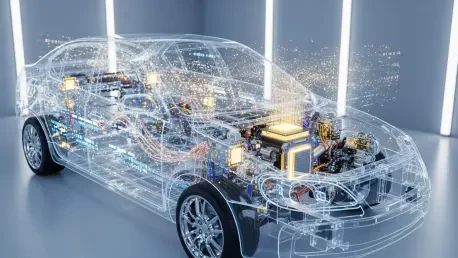
Modern connected vehicles rely on a multi-layered architecture that allows them to sense, communicate, and react in real-time, effectively creating a persistent link between the physical and digital realms. Hundreds of sensors embedded throughout the chassis monitor internal health indicators, such as engine temperature, fluid levels, and tire pressure, while simultaneously scanning the external environment for potential hazards using radar and lidar. This constant stream of high-fidelity data provides the vehicle with an unprecedented level of situational awareness, acting as a digital nervous system that bridges the gap between the car and its immediate surroundings. Such a framework ensures that the vehicle is never truly “blind” to the conditions it faces, whether those are internal mechanical failures or unexpected obstacles on a rainy highway. By integrating these disparate data points into a cohesive operational profile, the vehicle gains the ability to predict needs rather than merely reacting to failures.
Processing Intelligence at the Automotive Edge
The true value of this pervasive connectivity lies in the seamless synergy between rapid data transmission and high-speed onboard processing that occurs within the vehicle’s central computer. Raw sensor data is analyzed within mere milliseconds to make split-second decisions that can prevent catastrophic accidents, such as automatically applying the emergency brakes to avoid a collision with a pedestrian or another car. This continuous cycle of sensing, processing, and acting ensures that the vehicle can respond to dangerous situations much faster than any human driver ever could, making artificial intelligence a standard safety feature in the contemporary market. Moreover, this framework allows the car to share these insights with other vehicles in the vicinity, creating a collective intelligence that enhances the safety of the entire local traffic ecosystem. As these systems become more refined, the reliance on human intuition decreases, replaced by a mathematically driven approach to road safety.
Engineering Challenges and Ownership Enhancements
Ensuring Safety and Reliability in Harsh Environments
Developing Internet of Things systems for the automotive sector is significantly more complex than creating consumer electronics because cars must function reliably in incredibly unforgiving environments over long durations. Engineers are tasked with designing hardware that can withstand extreme vibrations, high levels of moisture, and dramatic temperature fluctuations for well over a decade without experiencing critical failure. Unlike a smartphone that is typically replaced every few years, vehicle components must maintain their integrity through thousands of thermal cycles and constant mechanical stress. Furthermore, these systems must be shielded against electromagnetic interference that could disrupt sensitive data transmissions or sensor readings. This requirement for ruggedization adds significant cost and engineering time to the development process, as every chip and sensor must be automotive-grade and rigorously tested. Consequently, the transition to connected cars is not just a software challenge but a massive hardware engineering feat.
Maintaining Operational Integrity across Global Networks
Beyond physical durability, safety-critical systems within the vehicle must include deep layers of redundancy to ensure that the car remains fully operational even when driving through remote areas or dead zones. While high-speed connectivity is a primary feature, the vehicle’s core safety functions cannot be dependent on a cloud connection that might drop during a critical maneuver on a mountain pass. Engineers utilize edge computing to ensure that essential processing happens locally, allowing the car to make autonomous decisions without waiting for a signal from a distant server. This decentralized approach protects the driver from the inherent instability of wireless networks and provides a fail-safe mechanism that keeps the car’s intelligence active at all times. Additionally, secondary backup systems are often installed to take over if a primary sensor or processor fails, providing a level of reliability that exceeds standard consumer technology. This focus on fail-safe architecture is what truly distinguishes automotive IoT from other connected industries.
Transforming the Ownership Lifecycle through Digital Updates
One of the most radical shifts in the modern driving experience is the introduction of Over-the-Air updates, which allow vehicles to improve and evolve long after they have left the dealership floor. Manufacturers can now push software patches to fix minor bugs, optimize battery management systems for electric vehicles, or unlock entirely new entertainment and navigation features overnight without a physical visit to a service center. This capability ensures that the car remains technologically relevant throughout its entire lifespan, effectively ending the era where a vehicle’s features were frozen at the time of purchase. It also allows for a more responsive relationship between the manufacturer and the consumer, as performance improvements can be deployed based on real-world driving data collected from the fleet. This shift toward software-defined vehicles means that the car becomes a dynamic asset that can actually increase in value or capability over time, a concept that was previously unheard of in the traditional market.
Transitioning to Proactive Maintenance via Smart Diagnostics
The integration of smart monitoring changes the maintenance model from a reactive approach to a proactive, condition-based system through the sophisticated use of predictive diagnostics. By monitoring component wear and tear in real-time, the vehicle can alert the owner to potential mechanical issues, such as thinning brake pads or a degrading battery cell, well before they lead to a dangerous breakdown. This integration of remote access and smart monitoring blends the car into the driver’s broader digital ecosystem, offering convenience features like pre-adjusting the cabin temperature or tracking the vehicle’s location via a smartphone app. Such features create a more seamless ownership experience, where the car acts as an intelligent assistant that manages its own health and coordinates with the driver’s schedule. Furthermore, this data-driven approach allows service centers to order parts in advance of an appointment, reducing downtime and making the repair process far more efficient.
Future Horizons and Security Considerations
Integrating Smart Infrastructure and Software Architecture
The next frontier for the automotive industry is the widespread implementation of Vehicle-to-Everything communication, where cars interact directly with smart city infrastructure like traffic lights and signs. To facilitate this, manufacturers are increasingly adopting advanced software-defined architectures and edge computing nodes that move processing power directly into the vehicle to reduce data latency. These advancements are essential for the safe deployment of autonomous driving systems and for creating a more efficient, interconnected transportation network that can alleviate urban congestion. When a car can “talk” to a traffic light, it can adjust its speed to hit a green wave, reducing fuel consumption and travel time simultaneously. This level of integration requires a standardized language across different car brands and municipal systems, a hurdle that is currently being cleared through international collaboration. As these networks expand, the car evolves into an active participant in the city’s operational intelligence.
Implementing Software-Defined Architectures for Future Growth
To support these complex interactions, the underlying software architecture of the vehicle must be flexible enough to handle massive data throughput while remaining secure from external interference. Modern cars are being built with high-performance central computing units that replace dozens of smaller, isolated electronic control units, streamlining the vehicle’s internal communication. This transition allows for more sophisticated artificial intelligence applications to run locally, enabling features like advanced environmental mapping and real-time pedestrian intent prediction. These technologies are the fundamental building blocks for the future of Level 4 autonomous driving, which is expected to expand significantly from 2026 to 2028. By moving toward a more centralized hardware configuration, manufacturers ensure that their vehicles have the computational headroom to support future software features that haven’t even been developed yet. This design philosophy ensures that the hardware won’t become a bottleneck as digital services advance.
Navigating Privacy Risks and System Complexity
As vehicles transform into rolling software platforms, they introduce significant new challenges regarding data ownership, personal privacy, and cybersecurity that must be addressed with transparency. A connected car that constantly tracks a driver’s habits, frequent locations, and even biometric data raises difficult questions about how that information is stored and who has access to it. Cybersecurity has become a top priority for automotive engineers, as a breach could potentially allow unauthorized parties to access critical driving functions or sensitive personal files. Manufacturers are now forced to implement rigorous encryption and intrusion detection systems that are updated as frequently as the car’s navigation maps. Moreover, the legal landscape is still catching up with these technological leaps, leaving consumers to navigate complex terms of service that dictate their rights over the data. Protecting this information is not just a matter of privacy but a matter of safety, as software integrity is now tied to physical security.
Establishing Long-Term Support for Connected Platforms
As the complexity of these integrated systems grows, drivers become increasingly dependent on the manufacturer’s long-term commitment to providing software support and critical security patches. There is a rising concern within the industry regarding digital obsolescence, where a perfectly functional mechanical vehicle could become unusable if its software is no longer supported or compatible with new networks. This puts a heavy responsibility on automakers to maintain legacy codebases and ensure that their older models remain secure against evolving cyber threats over the next decade. Drivers are also faced with a steeper learning curve as physical buttons are replaced by multi-layered touchscreens and voice-activated interfaces that require constant familiarization. Ultimately, the success of the connected car will depend on building trust with the public through transparent data practices and a clear roadmap for long-term vehicle viability in an era characterized by rapid and relentless technological change.
Defining the Path Toward Integrated Mobility
The transition toward a fully connected automotive ecosystem was finalized by a total shift in manufacturing priorities and consumer expectations. Stakeholders recognized that software stability and data security were the new benchmarks for luxury and safety alike, moving beyond the traditional metrics of engine displacement and trim levels. It became clear that the most successful players in the industry were those who invested heavily in robust edge computing and standardized communication protocols. To move forward, manufacturers focused on creating open yet secure platforms that allowed for cross-brand communication, ensuring that a smart city could manage traffic regardless of the vehicle’s logo. Drivers and fleet operators were encouraged to treat vehicle software with the same importance as mechanical maintenance, prioritizing frequent updates and rigorous cybersecurity checks. This period of rapid integration taught the industry that the car was no longer a standalone product but a node in a vast, living network that required constant oversight to thrive.